
Dirty Static // The Verdict
A smart idea with a clear limit. The iO makes translation, captions and meeting notes glanceable without a camera, but buyers pay 479 dollars for a narrow display, no speakers and an AI log they must trust.
Best forTravellers, students and workers who want captions, translation and meeting notes in view without wearing a camera
What works
- No camera at all, which removes the biggest social objection to smart glasses
- Live translation for 55 languages and 109 accents with latency as low as about one second in supported conditions
- Only 33 grams with a bright MicroLED display that other people cannot see
- Up to 48 hours of typical use and up to 18 hours of continuous recording from a 240mAh cell
What does not
- No speakers, so all feedback is visual and calls and media are out
- A narrow 23.5 degree field of view and a monochrome green display limit what the glasses can show
- Life Log asks for deep trust, and published reviews found memory recall uneven
- Extra AI models cost 9.99 dollars a month on top of the 479 dollar price
Research review: based on published testing, specifications, and documentation, not hands on testing.
The RayNeo iO starts with a refusal. There is no camera. In a market where smart glasses often mean a lens pointed at everyone in the room, RayNeo built a pair that cannot take a photo at all. What it offers instead is text in your line of sight: captions, translations, notes and a daily log built from what you heard.
That trade shapes everything. The iO will not record video or play sound. It is a quiet assistant for people who talk across languages, sit through meetings, or give talks from a script. Whether that focus feels smart or stripped down depends on what you wanted glasses to do in the first place.
What It Is
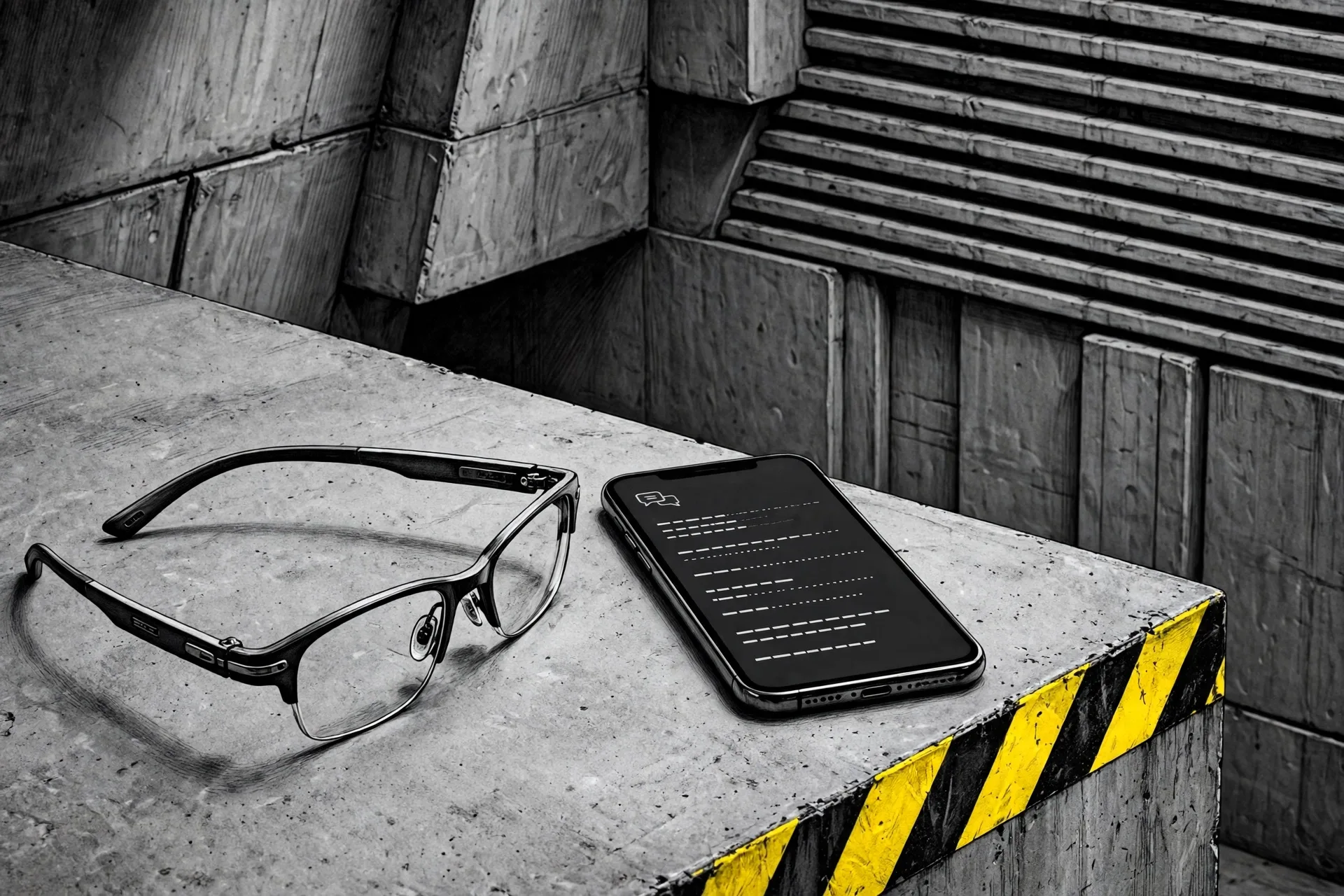
RayNeo iO is a pair of AI glasses in a classic Crown Panto frame. The front uses a magnesium and aluminium alloy, the temples use titanium, and the whole thing weighs 33 grams in the launch materials. Two colours are listed, Polar Night and Dune. The rating is IP54, which covers dust and splashes for daily wear.
The display sits in the lens. RayNeo calls the engine Firefly Engine Nano, a MicroLED unit 0.6 mm thick with up to 1,300 nits of brightness. Coverage describes a view equal to a 33 inch screen at about two metres, with a 23.5 degree field of view and 97 percent light transmittance in the display area. The text is monochrome green. Other people cannot see it.
Control comes from a small crown on the frame, from voice, and from head gestures such as a nod or a shake. A small light on the temple shows when the microphones or the translation engine are active. The glasses pair with a phone through the RayNeo AI app over Bluetooth 5.4.
Features and Specifications
The feature list is built around speech. Four microphones work with a bone conduction sensor. In this context bone conduction means the sensor picks up vibrations from your own voice, which helps the glasses separate what you said from the noise around you. That matters in a busy room, where a normal microphone hears everyone at once.
Live translation covers 55 languages and 109 accents. RayNeo and retailer listings put latency as low as about one second under supported conditions. Dictation and transcription cover up to 112 languages. A teleprompter scrolls a script as you speak, and a dashboard shows schedule, alerts and weather with a glance up.
Life Log is the feature RayNeo pushes hardest. It listens during hours you choose, turns speech into text, and builds summaries, action items and daily recaps. RayNeo says it does not save raw audio, only text, and that users can export or delete data in the app. Published coverage also describes Live Cues, where the glasses surface relevant points during a conversation.
Specifications
- Maker
- RayNeo, model iO
- Weight
- 33 grams in launch materials
- Frame
- Crown Panto, magnesium and aluminium alloy front, titanium temples
- Display
- Binocular MicroLED, monochrome green, up to 1,300 nits, 23.5 degree field of view, 97 percent transmittance in display area
- Camera
- None
- Speakers
- None
- Voice capture
- Four microphone array plus bone conduction sensor
- Translation
- 55 languages and 109 accents, latency as low as about one second in supported conditions
- Transcription
- Up to 112 languages for compatible features
- Battery
- 240mAh, up to 48 hours typical use, up to 63 hours standby, up to 18 hours continuous recording, up to 6.2 hours continuous translation
- Protection
- IP54 in launch and retailer listings
- Connection
- Bluetooth 5.4, phone app required
- AI included
- RayNeo AI and Gemini 3.1 Flash Lite at no extra charge per retailer listings, optional plan at 9.99 dollars a month for other models
- Price
- 479 dollars, 529 dollars with charging case
Real World Experience
This is a research review. Dirty Static has not tested the iO, and nothing below is presented as our own hands on work. The account draws on launch coverage from Android Authority, Digital Trends and MobileSyrup, retailer specifications from Best Buy Canada, and published review summaries from Geeky Gadgets. Facts were checked on November 23, 2026.
The strongest reports concern captions. Published review summaries describe live captions as fast and accurate, with clear punctuation, and call the teleprompter a real strength for talks and recordings. That fits the hardware. Text is all this display does, so it should do text well.
Translation drew a more mixed verdict. Review summaries call it reasonably accurate but note delay that can disrupt a fast exchange. That gap matters. A claim of about one second under supported conditions is not the same as one second in a noisy market with poor signal and two people talking at once. Buyers who need translation for work should treat the headline number as a best case.
Life Log drew both praise and caution. Review summaries credit it with useful daily summaries and prompts, and flag inconsistent memory retrieval and features that still feel early. That is the honest state of most ambient logging tools. The summary is easy to produce. Finding the exact thing you said last Tuesday, worded the way you need it, is the hard part.
Battery claims are strong on paper. Up to 48 hours of typical use sounds like two full days, but the same listings put continuous translation at 6.2 hours and continuous recording at 18 hours. The glasses last longest when you use them in glances, which is also how they are meant to be used.
What Works
The camera decision works. It removes a whole argument from every room you enter. People who would object to a lens can relax, and workplaces that ban cameras have less to ban. Our coverage of other smart glasses, including Brilliant Labs Halo smart glasses, shows how often the camera becomes the story. Here it cannot.
The weight and the private display work together. At 33 grams the iO sits close to ordinary glasses, and the text stays visible only to you. A translated line during a talk, a name during a meeting, or a script line during a recording stays discreet. That discretion is the product.
Captions are a genuine access gain. For a deaf or hard of hearing wearer, or for anyone in a loud room, clear text in view is not a novelty. It is a practical aid, provided accuracy holds in that room.
What Does Not
No speakers is a hard limit. The bone conduction sensor is for input only. Nothing plays back. You cannot take a call through the glasses, hear a translation aloud, or listen to anything. Rivals that include speakers cover more daily jobs, even when they look less discreet.
The display is narrow by design. A 23.5 degree field of view suits lines of text. It does not suit maps with detail, long documents, or rich visuals, and the green monochrome look will feel basic beside colour displays on rivals such as the glasses in our Rokid Glasses 2 coverage.
Life Log trust is the deepest issue. A tool that logs your day has to be right about consent, storage and deletion, and it has to work for the other people in the conversation too. RayNeo says raw audio is not saved and users choose the hours and can delete data. Those are company claims. Buyers in regulated work, health, law or education should check their own rules before they switch it on.
Price and the subscription close the list. At 479 dollars the iO costs more than camera glasses from larger brands, and the optional 9.99 dollar monthly plan for extra AI models adds a running cost. The included assistant and Gemini 3.1 Flash Lite may be enough for captions and translation, but buyers should know which model does which job before they pay for more.
Competition
| Option | Price signal | What it offers instead |
|---|---|---|
| RayNeo iO | 479 dollars | No camera, private text display, translation for 55 languages, Life Log, no speakers |
| Meta Ray Ban glasses | Lower starting prices in many markets | A camera, speakers and a huge app and social ecosystem, with the social cost of a lens on your face |
| Even Realities G2 | Premium price class | A similar camera free, text first idea with a focus on a clean display and daily wear |
| RayNeo X3 Pro | Higher price class | A colour display, a 12MP camera and standalone power for buyers who want full AR rather than glances |
The choice is really about the camera. If you want to film your day, the iO is out before the comparison starts. If you have ruled a camera out, the iO shortlist gets short fast, and the iO belongs near the top of it.
Final Verdict
Buy the iO if your day is talk. Meetings, lectures, travel and talks where captions, translation and notes would help, and where a camera would hurt. In that narrow job, the weight, the private display and the two day typical battery claim form a coherent package.
Skip it if you want one pair of glasses for everything. No camera, no speakers and a small green display cannot be your only wearable, and Life Log is not yet proven enough in published reviews to be the sole reason to spend 479 dollars. The iO is a focused tool at a serious price. For the right buyer that focus is the point. For everyone else it is the warning.
Sources
Facts checked November 23, 2026.
- Android Authority, RayNeo glasses coverage, for launch price, September 4 sale date, display, weight, battery, microphones, bone conduction sensor and the decision to omit speakers.
- Digital Trends, RayNeo iO smart glasses, for the display, dashboard, translation, dictation, Life Log, pricing and sale route.
- Best Buy Canada, RayNeo iO product listing, for retailer specifications on translation languages and accents, battery figures, IP54, display transmittance and the optional AI plan.
- Phandroid, RayNeo iO smart glasses put privacy first, for the camera free account, Life Log text only claim as a RayNeo claim, and launch pricing notes.
- Geeky Gadgets, RayNeo iO review summary, for published review findings on captions, translation delay, teleprompter strength, Life Log recall and battery.
- MobileSyrup, RayNeo unveils iO, for the Ambient AI Life Log account and launch context.
- Body image: Dirty Static house illustration, generated for this article. Hero image: Dirty Static house style, generated for this article.
END OF TRANSMISSION
Stay curious. Question everything.