Dan Price got bored, by his own account, and decided to push Claude Opus 5.5 to its limit on music composition. The result is a symphony in four movements, with 929 bars and 22,979 notes, running about 25 minutes. Price says the whole project used around 35 billion Opus tokens, roughly, and he has published the scores, the review logs, and the scripts so anyone can check how it was made.
That number needs context before it impresses or alarms anyone. The 35 billion tokens did not buy one clever prompt and one finished score. They paid for repetition on a scale most artists would never attempt. One Claude wrote the music. Another Claude checked it. Then they did it again, and again, for a month.
The Bigger Story
The music is written as text. Claude cannot easily click notes onto a staff, but it can write text, so the whole score was written in LilyPond, a free program that turns typed text into printed sheet music. A note becomes a letter and a number. From that same text, LilyPond can also produce basic computer playback, and a script can read, compare, and check the score much as programmers check code.
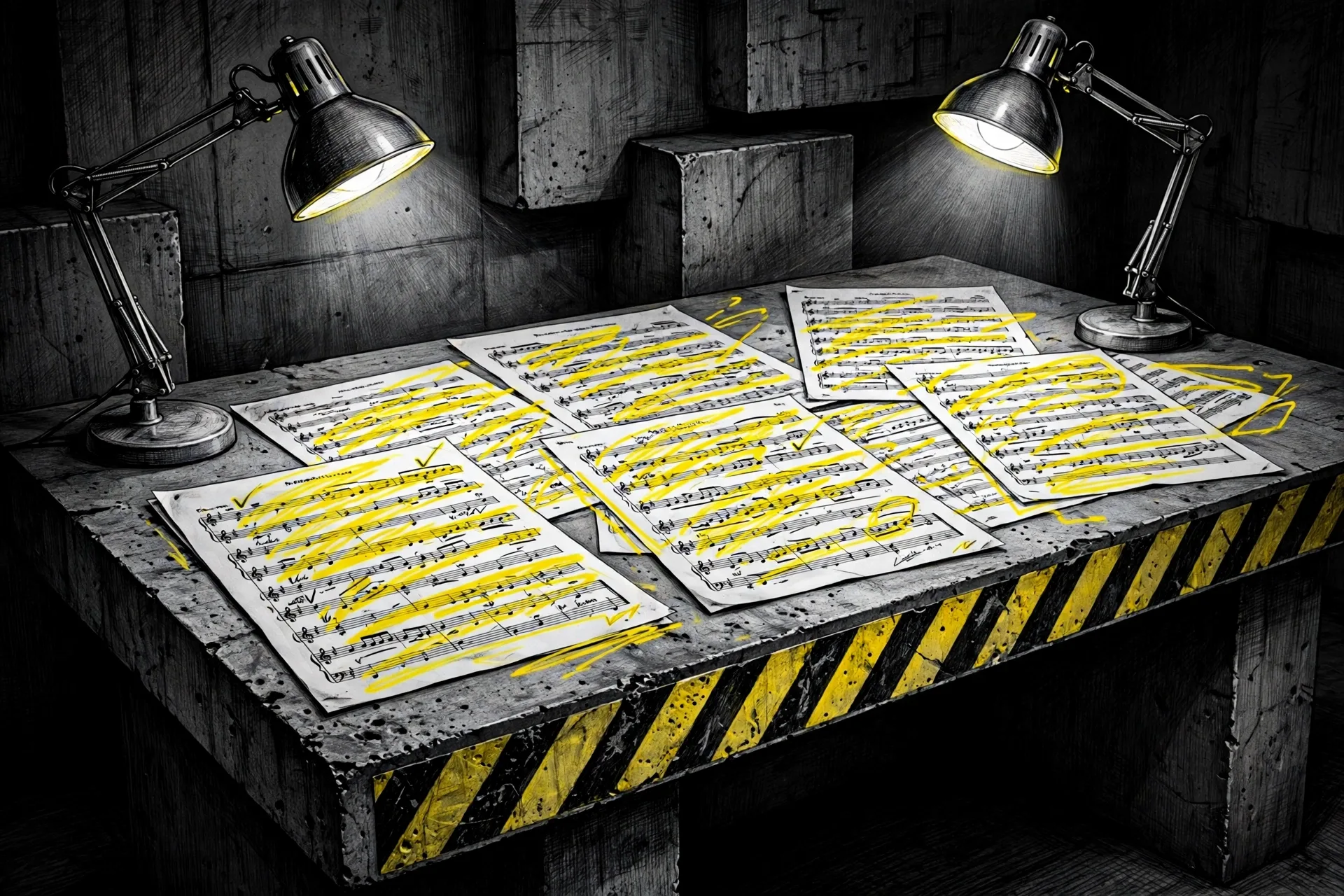
On top of that sits the method Price calls an actor critic loop. The composer Claude writes a version of a movement. A fresh critic Claude, one that has not seen the piece before, studies it and suggests specific fixes. The composer decides which fixes to accept, and that result becomes the next version for a new critic.
Each critic looked at one subject only, such as melody, harmony, orchestration, or whether the parts are playable. A written log recorded every decision, so a later critic would not quietly undo an earlier one. Each movement went through the loop about 600 times. Across four movements, that is about 2,400 rounds.
Price says he first planned about 50 rounds. At 50, the work still seemed to be improving, so he kept going and mostly let the process run on its own, prompting Claude to continue. His own summary of the lesson is blunt. For things that cannot be verified as good or bad, like art and music, make the agent do far more iterations than you think it needs.
The critics were not left to offer bare opinions. Price supplied standard textbooks on orchestration, harmony, and music notation, and each critic was assigned a chapter and had to show where the score followed it and where it did not. In one example he gives, a textbook rule says that in loud passages two horns are needed to balance one trumpet. A critic checked every loud brass chord against that rule, found three chords where an important note was too weak, and proposed fixes. The composer accepted all three.
Every tenth critic took a wider view. Claude collected scores by composers such as Beethoven, Dvořák, and Tchaikovsky, and that critic compared a whole movement with one movement by a master and answered one question: would a conductor believe a master wrote this?
Context
Price was clear about the division of labour. He set the goal, a symphony that could pass for the work of a master, with melodies people remember. He chose the method, supplied the books, and decided how long the loops ran. He left the musical choices to Claude, and he says Claude wrote 99.9 percent of every element of the composition, while he may have influenced a measure or two of note choice across the whole process.
He was also the only one who could listen. Claude cannot hear audio, so it judged the music from the written score alone. Price listened to computer playbacks and asked for a small number of changes. That single fact shapes the whole project. The system could reason about notes on a page with enormous patience. It could not hear whether the result moved anyone.
Writing the score was only the first of three jobs. The second was turning the score into a recording, and the third was making the video that shows the score lighting up as the music plays.
The recordings are not a live orchestra. They are mockups, built from notes recorded in advance by real players and played back by software in the order the score asks for. Price names the tools as REAPER, the music production program that held one track per instrument, and EastWest Hollywood Orchestra, the library of recorded notes. Claude did not click around in either program. It wrote scripts that read the LilyPond score and built each REAPER project from it.
Because Claude cannot listen, the recording loop measured what can be measured. Is the melody louder than the accompaniment? Does each note start on the beat? When a loud chord stops, does the sound die away as fast as it does on a real orchestra recording? Three critics measured each new recording, listed the worst problems with evidence, and suggested fixes, and another Claude decided which fixes to make. The four movements took 184 rounds in total.
Price listening caught what the measurements missed. He said the long timpani rolls were drowning out other instruments, the accents were too harsh, and the sound was too wet and a bit mushy. Each note became a rule for the critics to measure. The reverb was cut in half and shortened after the too wet complaint. In total, Price counts about 2,400 rounds on the score, 184 on the recordings, and 5 on the video, roughly the 2,500 in the title of his write up.
This lands in a music culture already arguing about volume and value. We covered that argument this week in Human Music Becomes Premium As AI Spreads and in Tidal Deletes Twenty Nine Million AI Tracks, where the flood was tracks uploaded for a system rather than for an audience. The symphony is a different use of scale. Instead of making millions of songs once each, Price made one work thousands of times over.
Different Perspectives
One fair reading is that this is a serious experiment in patience. Human composers revise too, and they also study textbooks, compare their work with masters, and ask other musicians to spot weak passages. Price automated the parts of that routine that can be written down as rules and checks, then ran them far longer than a human schedule would allow. The published scores, logs, and scripts on GitHub make the process open to inspection in a way a bare audio file would not be.
Another fair reading is more sceptical. A critic that shares the same training and the same blind spots as the composer may polish a work toward what the model already finds plausible. Iteration can remove errors without adding a point of view. Price himself frames the goal as passing for the work of a master, which is a test of resemblance as much as a test of originality. A listener who wants a distinct voice, shaped by a life and a set of obsessions, may find that resemblance is exactly the problem.
There is also the question of cost and effort, and here the record is thinner. Price gives the token total as a rough figure for the whole project, covering the score, the recording, and the video, not as an audited bill, and he does not publish a single price for it in his write up. Readers should treat any neat dollar figure attached to 35 billion tokens with care, because token mixes, caching, and plan pricing change what a loop like this actually costs. What is not in doubt is the scale of compute spent on revision rather than on a first draft.
Musicians who use AI tools as helpers sit somewhere between those readings. A loop that checks balance, playability, and notation against textbooks could help a human composer test a draft, even if that composer would never hand over the musical choices. The same tooling that produced a whole symphony could, in other hands, act as a tireless copy editor for music a person wrote. The project does not settle which use matters more. It shows both are now possible.
Why It Matters
The interesting shift is not that a model can produce notes. Models have produced notes for years. The shift is that revision, the slow and unglamorous part of creative work, can now be run as an industrial process. A first draft is cheap. Two thousand four hundred rounds of structured criticism is a choice, and it produces a different kind of object than a first draft does.
That choice also exposes a limit that no amount of looping removes. Every critic in the system judged text, measurements, and rules. None of them heard the music. The one human in the loop supplied the ears, the goal, and the decision to stop. Price stopped after about a month and about 2,500 rounds across the three jobs, not because a test declared the symphony finished, but because he judged that it was done. For art, he notes, there is no pass or fail test for whether music is good.
So the token count is both the headline and the warning. Thirty five billion tokens can buy stamina that no human team could match. Stamina is not taste. The work still needed a person to say what good meant, to supply the books that defined it, and to listen and say the timpani was too loud.
Closing Reflection
Price ends his account with a question his process cannot answer on its own: when would you stop revising? He planned 50 rounds and ran about 600 per movement because the work kept improving by the measures he had given it. At some point improvement by measure and improvement by ear stop being the same thing, and only a listener can tell where that point sits.
That may be the most human detail in the whole story. A machine wrote the symphony, checked it thousands of times, built the recording, and made the video. A person still had to decide that enough was enough, and then stand behind the result. The loop can run forever. Finishing remains a human act.
Reporting draws on Dan Price, Opus 5.5 writes its Magnum Opus (2500 times), published on danprice.ai in November 2026, including the scores, figures, and process log linked from that post, checked November 26, 2026.
Sources
- Dan Price, Opus 5.5 writes its Magnum Opus (2500 times), danprice.ai, November 2026: https://danprice.ai/blog/opus-symphony
- Claude Symphony project source, scores, critic reviews, and scripts on GitHub: https://github.com/halfprice06/claude-symphony
- Full virtual orchestra rendering on YouTube, linked from the Price post: https://youtu.be/AQT9LJR_FEc
- Illustrations: Dirty Static
END OF TRANSMISSION
Stay curious. Question everything.