
Dirty Static // The Verdict
The most modular terminal coding agent yet shipped, with a real bring your own agent story and maker benchmark numbers that lead by a whisker, not a mile. Worth a serious trial for Python teams. Not yet a reason to abandon a working setup.
Best forPython teams building on Pydantic AI who want one terminal for their own agents and a stock coding agent, and developers who swap models often
What works
- Everything is a plugin, including the coding agent itself, so parts can be turned off or replaced
- The --agent flag runs your own Pydantic AI agent in the same terminal you ship it from
- Runs any model and signs in with an existing ChatGPT or GitHub Copilot subscription
- Sandbox support spans local and cloud options, with the same tool code in both places
What does not
- All headline benchmark numbers come from Pydantic itself, from single runs in November
- The lead over OpenCode is 0.3 points, well inside the noise of a single run
- Harness is still beta, with the public API set to settle only at the 1.0 release in about a month
- Computer use inside Pax is not here yet and is promised for the next release
Research review: based on published testing, specifications, and documentation, not hands on testing.
Most terminal coding agents arrive as a sealed box. You get the vendor agent, the vendor defaults, and a settings file if you are lucky. Pax arrived on November 25 with the opposite pitch. The coding agent itself is a plugin. Turn it off and Pax is a plain chat client. Point Pax at an agent you already built and it runs that instead.
That pitch comes from Pydantic, the team behind the Python data validation library that much of the AI stack quietly depends on. Pax is the terminal face of the Pydantic AI Harness, a library of more than 100 capabilities that entered public beta on the same day. This review reads the launch material and the published benchmark tables closely, and works out who should try Pax now.
What It Is
Three layers need untangling, because Pydantic sells all three at once. Pydantic AI is the agent framework, the loop that calls models from the major providers and returns structured output. The Harness is a library of production capabilities on top of that core, bundles of tools, instructions, and hooks you can add to any agent. One of those capabilities is Coder(), a bundle that turns an agent into a coding agent with file and shell tools.
Pax is the terminal user interface in front of Coder(). Pydantic describes it as both a daily coding agent and a showcase for what the Harness SDK can build. That second job explains the design. Almost every choice in Pax exists to prove that the parts underneath can be rearranged.
Features and Specifications
| Area | Pax specification |
|---|---|
| Maker | Pydantic |
| Package | pydantic-ai-pax, version 0.75.0 |
| Release | November 25, 2026, with the Harness public beta |
| Licence | MIT |
| Needs | Python 3.11 or newer |
| Default agent | Coder() from the Harness, loaded as a plugin |
| Default model | openai-codex:gpt-6-astra, per launch coverage of the docs |
| Sign in routes | ChatGPT subscription via /login openai-codex, GitHub Copilot via /login github-copilot, or provider API keys |
| Sandboxes | Cloud options include e2b, boxd, daytona, opensandbox, modal, render, sprites and kubernetes, plus local micro VM options smol and BoxLite |
| Session import | Claude Code and Codex sessions appear in /resume, or import with pax --resume-claude and pax --resume-codex |
The plugin set
- coder
- The coding agent itself, with file and shell tools and Agent Skills
- sandbox
- Where the session runs, local machine or a chosen sandbox
- mcp
- Model Context Protocol tool connections
- observability
- Pydantic Logfire tracing of every tool call
The plugin claim is literal, not a metaphor. Open /plugins and you can toggle coder, sandbox, observability, mcp, and the rest. Run /plugins disable coder and the file and shell tools go away. Any Pydantic AI capability can load as a plugin by its import path, and Pydantic says Pax can write new plugins for itself when asked.
The sandbox story is the other substantial piece. File and shell tools talk to a workspace, so the same agent runs on your machine or in a cloud sandbox without changed tool code. Inside Pax you choose the sandbox before the first prompt with a command like /sandbox e2b. Pax syncs your branch and your uncommitted changes into the sandbox, and edits and builds run there. On providers with proxy support, Pydantic says your GitHub token never enters the sandbox. The proxy adds it to outbound GitHub requests instead.
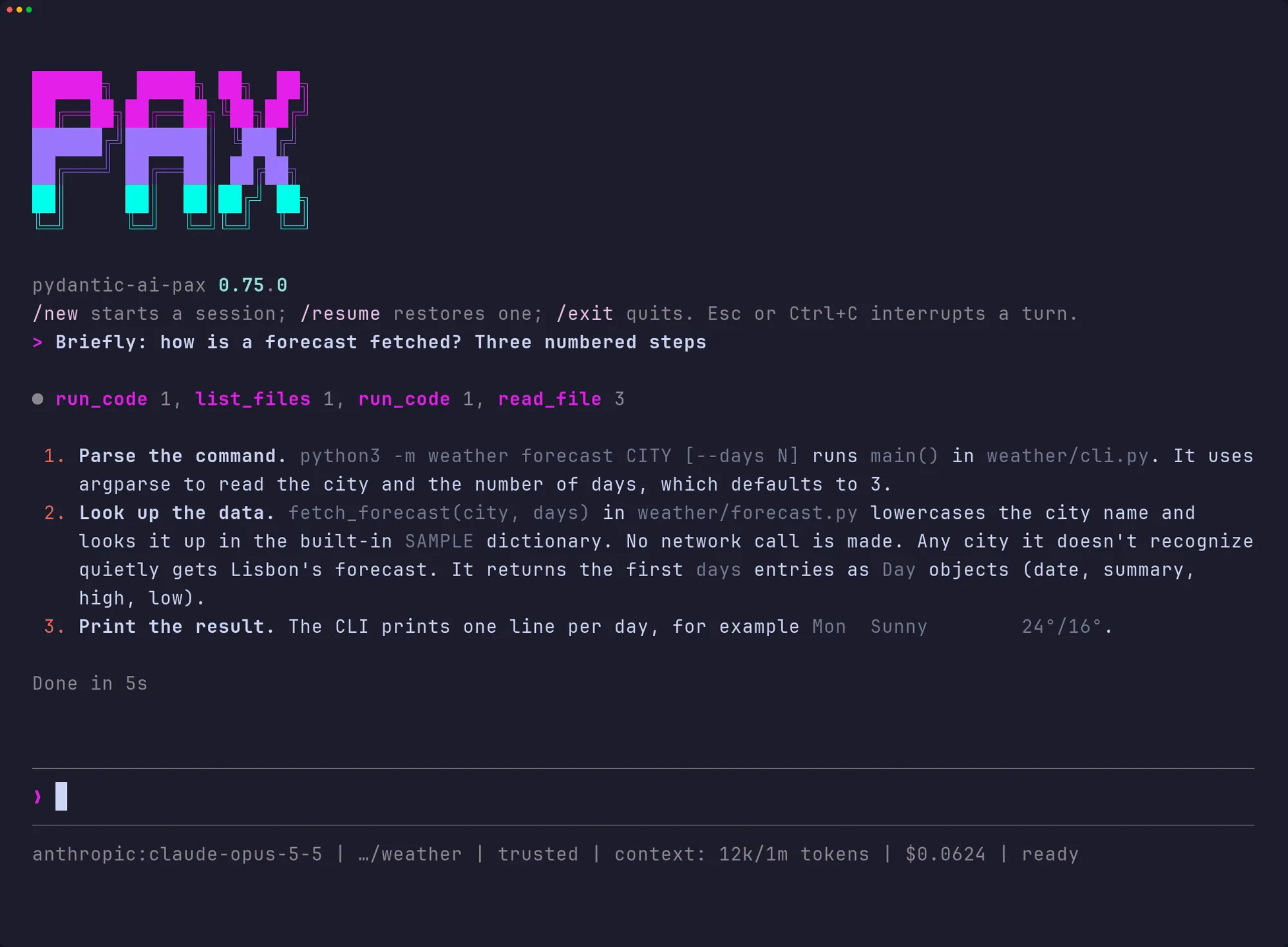
Pax in a terminal session. Image: Pydantic, from the launch post.
Real World Experience
This is a research review. Dirty Static did not run Pax, and no firsthand testing is claimed here. What follows draws on the Pydantic launch post, its published benchmark tables, and the first independent close readings of the release packages.
Start with code mode, which Pax turns on by default. Instead of passing tool results back and forth one call at a time, the model writes a short Python snippet in a runtime Pydantic calls Monty. The snippet searches and reads files and returns only what matters. A key shortcut turns on speculative execution, where Pax starts safe file reads while the model is still streaming its reply. The idea is sound and the saving is likely small per call, but coding agents make a lot of calls.
Migration is handled with unusual care. The repo_context support reads AGENTS.md and CLAUDE.md files you already wrote for other tools. The coder plugin loads Agent Skills from the folders those tools already use. Sessions from Claude Code and Codex show up beside Pax sessions in the resume list. Pydantic clearly expects its first users to arrive from a rival tool, and it removed the usual switching friction.
Then the numbers, with their labels attached. Harness-Bench SWE81 is a set of 81 software tasks run across eight models, with the model held fixed inside each comparison. Pydantic ran it. Among the four harnesses that ran all eight models, Pax averaged 58.5, OpenCode 58.2, deepagents-code 57.6, and pi 57.3. That is a lead of 0.3 points over the nearest rival, from single runs.
Harness-Bench SWE81 average score, maker reported
Scores from the Pydantic launch post, checked November 27, 2026. Single runs from November, run by Pydantic on its own benchmark. Higher is better.
Cost separates the field more than score does. Across the eight models, one run averaged $7.69 with Pax and $6.47 with pi, so pi was cheaper. Against the native harnesses the picture flips. On GPT-6.2 Sol, Pydantic reports Pax at 64.7 for $9.21 a run, against Codex at 60.1 for $21.05. On Claude Opus 5.5, Pax reports 61.2 at $24.61, against Claude Code at 60.4 for $25.10. Pydantic also notes that with the stock grader, rather than the relaxed rescore it applied to two models, Pax scored 51.0 on Sol against Codex at 49.8.
Read those figures as a claim with good table manners. The full tables are published, the method notes are printed under them, and the single run limit is stated in plain sight. What is missing is any run by someone who does not sell Pax. Until that exists, the honest summary is that Pax looks at least as capable as its rivals on this benchmark, at a notably lower cost than Codex on one flagship model. That is enough to earn a trial. It is not enough to declare a winner.
What Works
Modularity is the first strength, and it is more than tidiness. A team can strip Pax down to a chat client, add a tracing plugin, or load a capability from its own codebase by import path. Most rival tools let you configure the agent. Pax lets you remove it.
The --agent flag is the second strength, and for Pydantic AI users it may be the whole story. You build an agent in your repo, point Pax at it with a command like pax --agent my_agents:reviewer, and Pax runs that exact agent with its own model, tools, and instructions, and no plugins loaded. The same agent object can then ship in your service. Testing the thing you deploy, in a real terminal, with resume and worktree support around it, closes a gap that agent builders usually fill with throwaway scripts.
Model freedom is the third. Pax runs any model the framework supports, and the subscription sign in routes mean a ChatGPT or Copilot plan you already pay for can drive it without a separate API bill. The default model will date quickly. The freedom to swap it will not.
What Does Not
The beta label is real. Pydantic says the Harness reaches 1.0 in about a month and will then follow the same version policy as Pydantic AI. It also says the public API can change before that point, and it is asking for feedback now precisely because the surface is about to set. Anything you build on the beta should be built with that change window in mind.
Some promised pieces are not here. Durable execution that survives crashes is a Harness capability for agents built on the SDK, and Pydantic states plainly that it is not in Pax yet. Computer use, where the model sees and drives a desktop inside a sandbox, exists as a Harness capability and arrives inside Pax in the next release as /computer-use. Both may land soon. Neither should be counted today.
There is also a small naming trap. macOS ships an unrelated archiver at /bin/pax, so a fresh install may not start on the first try until the shell refreshes its path lookup, or you run pydantic-ai-pax directly. Pydantic flags this in its own guide, which suggests it bit early users at once.
Competition
| Tool | Shape | SWE81 average, maker reported | Average cost per run | Main contrast with Pax |
|---|---|---|---|---|
| Pax | Terminal agent on a plugin harness, any model | 58.5 | $7.69 | The agent itself is removable, and your own agent can take its place |
| OpenCode | Terminal agent, any model | 58.2 | $8.04 | Near equal score in this table, without the Pydantic AI agent story |
| pi | Terminal harness, any model | 57.3 | $6.47 | Cheapest of the four full runs in this table, with the lowest score of the four |
| deepagents-code | Terminal harness, any model | 57.6 | $9.43 | Priciest of the four in this table |
| Codex | Native harness for OpenAI models | 60.1 on GPT-6.2 Sol only | $21.05 on that model | Strong native tool, at more than twice the Pax run cost on the shared model |
| Claude Code | Native harness for Claude models | 60.4 on Claude Opus 5.5 only | $25.10 on that model | Mature native tool, near equal cost to Pax on the shared model |
The table also shows why the native tools are hard to displace. Claude Code and Codex carry deep polish, large user bases, and years of edge cases already handled. Pax answers with architecture rather than polish. Whether architecture wins depends on how much of the Pydantic stack you already run. Readers comparing the wider field may also want our coverage of Codex updates.
Final Verdict
Try Pax if you build with Pydantic AI, if you swap models often, or if the sealed box design of the current tools annoys you for concrete reasons. The trial costs an afternoon. Run it on your own repo, on tasks you can grade, and record completed tasks, retries, and cost beside the tool you use now.
Wait if your current setup works and you have no Pydantic AI agents to bring. The score lead in the only public table is 0.3 points from single runs, and the API is about to settle at 1.0. A month of patience buys you a stable surface and, with luck, a benchmark run from someone other than the maker.
Pax earns its attention for a reason that has little to do with that 0.3 points. It treats the coding agent as one part among many, and it lets the agent you ship be the agent you test. If that idea spreads, the sealed box tools will have to answer it. If it does not, Pax still leaves Python teams with a flexible terminal that costs nothing to try.
Sources
- Pydantic: Pax, the Pydantic AI coding agent for your terminal
- XBSTACK: Pydantic Pax vs Codex and Claude Code
- Data Phoenix: Pydantic releases Pax and seeks AI Harness beta feedback
- Terminal image: Pydantic, from the launch post linked above
END OF TRANSMISSION
Stay curious. Question everything.