Dirty Static // The Verdict
A broad specialist family with published prices that undercut the frontier rivals Microsoft names, and with the strongest claims resting on Microsoft own tests. Worth trialling where a model is actually available today, at the price printed today, rather than buying the whole family story at once.
Best forEnterprise teams already on Copilot, Foundry or Microsoft security and health products who run a lot of coding, image, voice, transcription or routing work and want to cut cost per task
What works
- Seven specialists cover coding, security, image editing, live voice, transcription and decision routing in one launch, each priced against a named frontier rival
- Several prices are concrete and checkable, including about $35 per 1,000 images for MAI Image 2.7, $0.01 per audio minute to start for MAI Realtime 1, and $0.042 per million input tokens with output free for Decision 1.1
- Two claims carry outside measurement, with MAI Image 2.7 first on the Artificial Analysis image editing board and MAI Transcribe 2 first on FLEURS across 60 languages
- Availability is stated model by model, from generally available Decision 1.1 to the security model that stays inside Microsoft products
What does not
- The biggest ratios, including cyber defence at under 2 percent of rival cost and coding at 40 percent and 5 percent, come from Microsoft tests, benchmarks and price maths
- Some headline prices are promotions with end dates, including the coding token rates that double in May 2027 and the transcription rate that ends with 2026
- Access is uneven, with the cyber model exclusive to Microsoft security products, the voice model in limited access preview, and the large coding model only inside Copilot at launch
- Counting the family takes work, since outside reports counted six and Microsoft counts seven by treating Dragon Copilot Transcribe, built on MAI Transcribe 2, as the seventh
Research review: based on published testing, specifications, and documentation, not hands on testing.
Microsoft used Ignite on November 17 to make a price argument dressed as a product launch. The company released seven new models from its in house Microsoft AI group, each one a specialist, and each one announced with a rival name and a fraction. Coding at 40 percent of one rival cost and 5 percent of another. Cyber defence at under 2 percent. Image editing at a fifth. The pattern is the story, and it deserves a careful read, because a fraction is only as good as the test and the price list behind it.
Some of those fractions rest on solid ground. Some rest on Microsoft own benchmarks, run on Microsoft own platform, at promotional prices. This review goes model by model, separates the printed prices from the claimed ratios, and ends with who should trial what now. Our separate look at MAI Code 2 and its near frontier coding claim covers the coding pair in full depth, so here they get the family view.
What It Is
MAI is the model family built by Microsoft AI, the group led by Mustafa Suleyman, and this is its second large release of 2026 after the seven model launch at Build in June. The June family centred on a general reasoning model. The November family does the opposite. Every model here does one job, and Microsoft told Reuters that building for specific domains is how it keeps costs low while matching rivals. That is a plausible engineering claim and a convenient marketing one at the same time, and the evidence differs by model.
The count itself needs a note. Microsoft calls this a family of seven. Axios counted six in its launch report, and the gap is the transcription entry. Dragon Copilot Transcribe is a product feature inside a health product, built on MAI Transcribe 2, a model first released on September 3. Count the underlying model and the family is seven. Count only all new models and it is six, plus a new home for an existing one. Neither count changes what a buyer can use, but the difference explains the conflicting headlines.
Alongside the models, Microsoft said its second generation accelerator, Maia 200, is now in production running its largest models at 1.7 times more tokens per watt, and it launched MAI Licensed Weights, a route where a customer takes a frontier MAI model, adapts it with its own data, and runs it in its own Azure environment. An AT and T example in the launch post claims a custom model for 5G network work beat GPT 6.1 Sol at a fiftieth of the cost on its task. That figure is a company claim about one customer task, offered here as context rather than evidence.
The Family at a Glance
| Model | Job | Headline claim, as stated by Microsoft | Where you can get it |
|---|---|---|---|
| MAI Cyber 2 Flash | Cyber defence | Beats GPT 6 Astra quality at under 2 percent of cost per task on CyberGym E2E | Microsoft security products only, including MDASH, from mid December |
| MAI Code 2 | Everyday enterprise coding | 98 percent of GPT 6.1 Sol coding quality at about 40 percent of the price | GitHub Copilot on paid plans |
| MAI Code 2 Flash | High volume routine coding | Comparable to GPT 6 Luna at 65 percent of price, and Haiku 5.5 at 20 percent | Copilot on every plan, plus a limited access Foundry preview |
| MAI Image 2.7 | Image generation and editing | First on Artificial Analysis image editing, at a fifth of the rival price | Public preview in Microsoft Foundry, about $35 per 1,000 images |
| MAI Realtime 1 | Live voice conversation | Beats GPT Realtime 2.1, starting at $0.01 per audio minute | Try in MAI Labs, limited access preview in Foundry |
| MAI Transcribe 2, in Dragon Copilot Transcribe | Medical transcription | Fastest and most accurate multilingual transcription, error rates halved in multilingual work | Live in Dragon Copilot, 10 million encounters a month |
| Decision 1.1 | Routing, classification and workflow decisions | 50 times faster and 79 times cheaper than GPT 6.1 Sol, per Microsoft | Generally available in Foundry, OpenRouter and Vercel |
Printed prices, checked November 20, 2026
- MAI Image 2.7
- About $35 per 1,000 images in Foundry public preview
- MAI Image 2.7 Flash
- About $10 per 1,000 images
- MAI Realtime 1
- From $0.01 per audio minute, with reasoning billed apart
- MAI Transcribe 2
- $0.10 per hour of audio, introductory price to the end of 2026
- Decision 1.1
- $0.042 per million input tokens on Global Standard, output tokens free
- MAI Cyber 2 Flash
- $0.10 input, $0.01 cached input and $0.50 output per million tokens, as listed in the benchmark costing note
- MAI Code 2
- $0.50 input and $2.50 output per million tokens in Copilot to May 17, 2027, then double
Real World Experience
This is a research review. Dirty Static did not run any of these models, and nothing here is firsthand testing. The assessment draws on the Microsoft AI launch posts for the family and for each model, the Decision 1.1 general availability post, the September MAI Transcribe 2 post, and launch coverage from Reuters as carried by other outlets, Neowin and independent pricing and benchmark reporting, all checked on November 20, 2026.
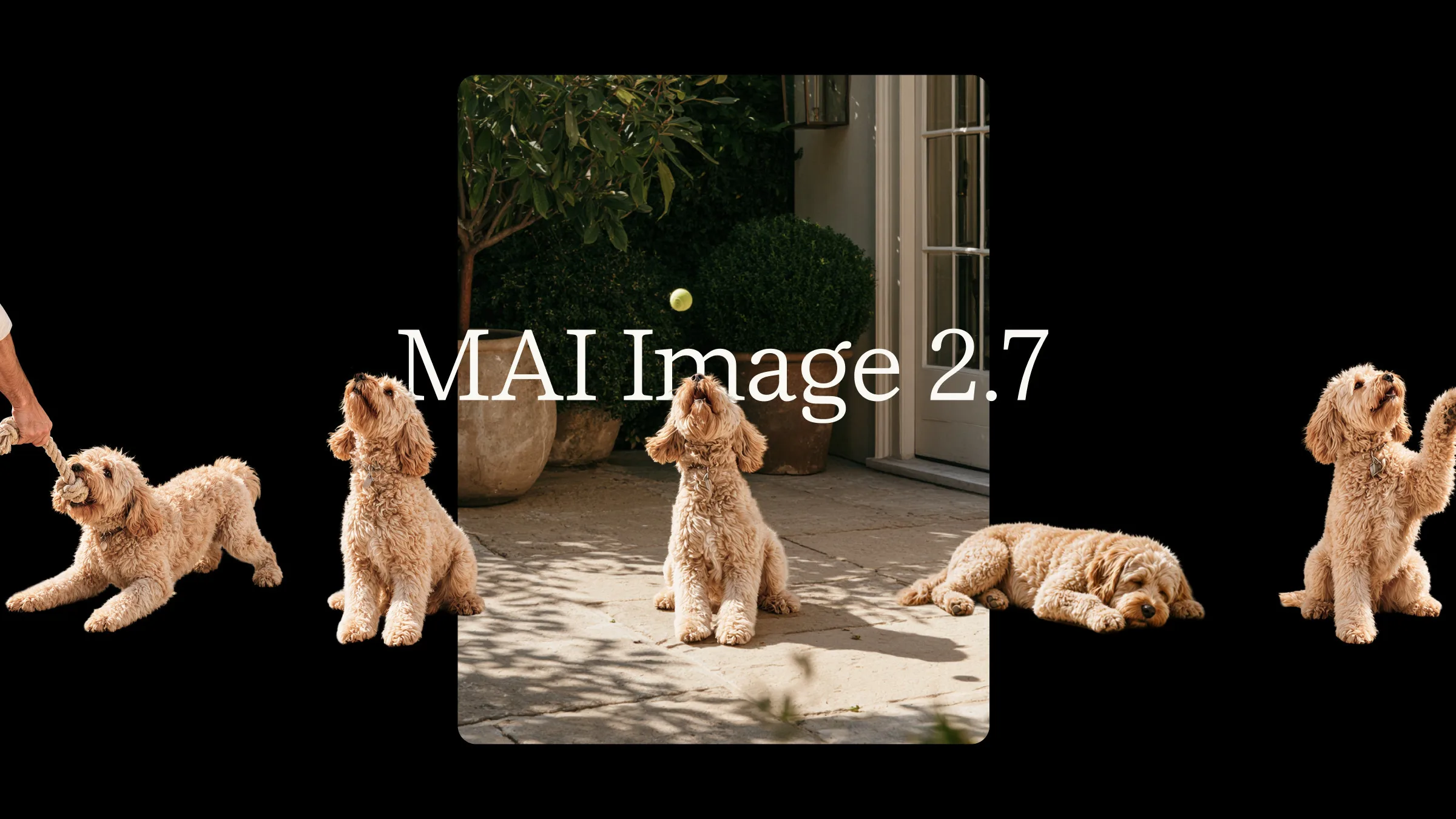
Start with the two claims that have outside support, because they anchor the family. MAI Image 2.7 holds first place on the Artificial Analysis image editing board at 1,215 Elo across 5,478 votes as of November 16, ahead of GPT Image 2.6 Sunburst at its maximum setting by four points. Four points is a tie for practical purposes, and Microsoft says so nowhere, but first place on an outside board at about a fifth of the rival cost per image is still a strong position. The model ranks fourth at text to image generation on the same service, and the Flash variant brings the price down to about $10 per 1,000 images for high volume work. Both support transparent backgrounds, both are in public preview in Foundry, and the family already powers Bing Image Creator as its default, with Adobe and Figma Weave among the platforms working with it.
MAI Transcribe 2 carries the second outside result. On FLEURS, a public benchmark of read speech, it ranks first across 60 languages at an average word error rate of 5.2 percent, and Artificial Analysis places it at the front of its accuracy and speed chart for batch transcription, with Microsoft citing processing up to ten times faster than GPT Transcribe. The Dragon Copilot deployment gives the claim a scale check that most launch posts lack. Microsoft says the transcription model now handles all doctor and patient conversation transcription in Dragon Copilot, covering 10 million encounters a month and reaching a third of physicians in the United States, with error rates in multilingual workflows cut in half. Those deployment figures are Microsoft figures, but a model running at that volume in a regulated setting is a different kind of evidence from a benchmark chart.
The coding pair sits in the middle. As our full MAI Code 2 review sets out, the 98 percent and 96 percent figures are averages across four benchmarks, three of them run on Microsoft internal platform MSBench, at the maximum reasoning effort, with the cost side worked out at a promotional price that doubles on May 17, 2027. The averages also hide a weak row, SWE Atlas, where Code 2 trails Claude Opus 5.5 by more than fourteen points. None of that makes the pair poor value. At the printed Copilot token rates, and with Code 2 placed on the Pro plan where neither rival is selectable, the pair is easy to trial and cheap to keep for routine work. It does mean the family headline ratio should be read as a starting claim to test on your own repository.
MAI Cyber 2 Flash has the boldest ratio and the narrowest door. Microsoft reports 92.3 percent task success on CyberGym E2E against 91.5 percent for GPT 6 Astra, at under 2 percent of the cost per task, worked out from list prices of $0.10 per million input tokens against $10 for the rival. To its credit, the model post discloses a benchmark problem most vendors would bury. Microsoft found that 92 of the 905 tasks rested on the same open source projects and reports as some of its training data, excluded those tasks for every model, and reported results on the remaining 813. The reference solutions were never used in training, the company says. That disclosure raises trust in the number. The limit is access. The model comes only inside Microsoft security products, replacing the current model in the MDASH profile for eligible customers from mid December, so there is no way to trial it apart from buying into that stack. Reuters reported that Microsoft plans to offer the cyber model to a limited group of customers facing a surge in software flaws that AI tools are surfacing.

The last two models are the quiet ones, and they may matter most in production. MAI Realtime 1 is Microsoft first speech to speech model, built for live conversation with interruptions, background noise and tool use, and compatible with the OpenAI Realtime API, which lowers the cost of trying it against an existing voice app. Microsoft says it beat GPT Realtime 2.1 across public benchmarks including Big Bench Audio and a voice agent task benchmark, plus its own Dynamics 365 tests. The starting price is $0.01 per audio minute, with reasoning billed apart at a per token rate, so a chatty agent that reasons a lot will cost more than the headline minute rate suggests. It is heading into Dynamics 365 Contact Center and into Dragon Copilot for simulated patient practice, and for everyone else it is a demo in MAI Labs and a limited access preview.
Decision 1.1 is the model with the clearest job and the clearest availability. It makes structured decisions inside software, such as routing, classification, ranking and workflow control, returns a confidence score, and can hold back when the information is not enough. That last habit is the point. Generative models tend to answer with confidence even when they should not, and a model trained to state its uncertainty lets an application set a threshold for acting, flagging or passing the case to a person or a larger model. Microsoft says more than 4,000 customers used it in the five weeks after its preview, that it scores 68 on the Artificial Analysis Decision Index, ahead of entries from Jev, Google and OpenAI, and that in Copilot routing it matches a large model on accuracy at 2.2 times the speed and 4.4 times lower cost. The general availability post also states the base plainly. Decision 1.1 builds on Gemma 4 26B A4B, a mid sized mixture of experts model, with a custom inference engine. At $0.042 per million input tokens with output free, it is priced like plumbing, and plumbing is what it is for. Readers who follow routing will see the same logic we covered in OpenRouter Auto Code and automatic model choice, with Microsoft now selling the router itself.
Claimed cost against the named rival, percent of rival cost per task or per unit (Microsoft figures)
Coding and cyber figures are cost per task on Microsoft chosen benchmarks, with coding at promotional prices. Image is cost per image against GPT Image 2.6 Sunburst at its maximum setting. Lower is cheaper. Company reported figures, not measured by this magazine.
What Works
The specialist shape is the first strength. A model that only does transcription, or only routes requests, or only edits images can be smaller, faster and cheaper than a general model doing the same job as a side task, and the printed prices show that shape paying off. Decision 1.1 at four cents per million input tokens and Transcribe 2 at ten cents an hour are prices that change what an application can afford to do on every request, not just on the important ones.
The second strength is that so much of the family is already placed inside products people use. The coding pair sits in the Copilot picker. The transcription model runs inside Dragon Copilot at national scale. The image family is the default in Bing Image Creator. The cyber model arrives inside MDASH, where Microsoft says MAI Cyber already accounts for almost 40 percent of scans and that 90 percent of customers who started with it stayed with it. Distribution does not prove quality, but it does mean these models face real workloads quickly, which is where weak claims get found out.
The third strength is disclosure, in places. The cyber post names its benchmark overlap and restates its results without the affected tasks. The coding post states plainly that the pair is not yet tuned for fundamental science research or very long horizon agent work. The Decision post names the open model it builds on. A launch that prints its own limits gives a buyer something to plan around, and it makes the strong claims easier to take seriously.
What Does Not
The evidence is uneven, and the boldest numbers have the thinnest support. The cyber ratio depends on one benchmark and on a list price gap of a hundred to one on input tokens, which says as much about the rival price as about this model. The coding ratios depend on Microsoft benchmarks and a promotional price with a published end date. The Realtime win rests on a mix of public benchmarks and Microsoft product tests that only Microsoft can rerun. Until outside testers publish results on the coding, cyber and voice models, those three launches are claims with prices attached, and the prices are the firmer half.
The promotions are the second problem, because family stories outlive price lists. Transcribe 2 at $0.10 an hour is an introductory price to the end of 2026, and Microsoft has not said what follows it. The coding token rates double in May 2027. The Realtime minute rate excludes the reasoning tokens a real agent will spend. A budget built on launch prices for this family needs the end dates written into it on day one, the same caution we raised with Gemini 4 Carbon and its December price step.
Access is the third problem. There is no single place to get the family. Copilot for code, Foundry for image and decision work, OpenRouter and Vercel for Decision 1.1 alone, MAI Labs for a voice demo, a health product for transcription, and a security stack you either own or do not for the cyber model. That spread reflects how Microsoft sells software, but it means evaluating the family means evaluating five buying routes, five previews in different states, and one model you cannot reach at all outside its product.
Competition
| Route | What you get | Cost shape | The trade |
|---|---|---|---|
| The MAI family | Seven specialists inside Microsoft products and Foundry | Low printed per unit prices, with two promotions carrying end dates | Strongest where you already run Copilot, Foundry, MDASH or Dragon Copilot, weakest as a general API family |
| OpenAI frontier models | The named rivals across coding, cyber, image and voice, including GPT 6.1 Sol and GPT Realtime 2.1 | Higher per task and per token prices in Microsoft comparisons | Broader access and a longer public record, at the prices this launch is built to undercut |
| Anthropic Claude models | Opus 5.5 and Haiku 5.5 as the coding rivals in this launch | Opus at about twenty times the Code 2 task cost in Microsoft tests | The clear SWE Atlas leader in Microsoft own table, which is the row that matters for deep repository work |
| Specialist rivals by job | ElevenLabs and others in transcription and voice, Google in decision and image work | Varies by job, with Transcribe 2 and Decision 1.1 priced to force a response | A best of breed stack can beat a family on any single job, at the cost of running many vendors |
The honest comparison is job by job. On image editing and transcription, outside boards currently back Microsoft position and the prices are low, so the MAI entry belongs on any shortlist. On decisions, the price and the confidence scores make Decision 1.1 easy to trial through OpenRouter without a Microsoft commitment. On coding, the answer depends on your own repository, as it did in our Code 2 review. On cyber and live voice, most buyers cannot yet run a fair trial at all, so the rational move is to wait for access and outside results rather than to plan around a ratio.
Final Verdict
Trial this family in the order its evidence deserves. Start with Decision 1.1 if your software makes a lot of small calls, because it is generally available, cheap enough to test in an afternoon, and reachable outside Azure. Try MAI Image 2.7 in Foundry if image editing volume is a real cost, and price MAI Transcribe 2 into any transcription work that can start before its introductory rate ends. Put the coding pair to work in Copilot on tasks you know well, and judge them there.
Hold off on planning around the cyber and voice ratios until access widens and someone outside Microsoft publishes numbers. The family story, that specialist models beat general ones on cost per task, is believable and the printed prices support it. The launch also shows how much of that story still rests on the seller own tests. Buy the models you can test, at the prices printed today, and let the rest earn its place when the evidence arrives.
Sources
- Microsoft AI: Seven new world class models at scalable price performance, November 17, 2026
- Microsoft AI: MAI Cyber 2 Flash, leading security, lower cost
- Microsoft AI: MAI Code 2 and MAI Code 2 Flash, everyday coding at scalable prices
- Microsoft AI: MAI Image 2.7, frontier quality at a fraction of the cost
- Microsoft AI: MAI Realtime 1, leading voice AI at $0.01 per audio minute
- Microsoft AI: MAI Transcribe 2 is the fastest, most accurate and cheapest speech recognition model in the world
- Microsoft: Microsoft Decision 1.1 is now generally available
- Neowin: Microsoft takes on OpenAI and Anthropic with seven new AI models at Ignite 2026
- Images: Hero is a generated Dirty Static house style illustration. Body images are Microsoft AI launch art for MAI Image 2.7 and MAI Cyber 2 Flash, credited above.
END OF TRANSMISSION
Stay curious. Question everything.