Dirty Static // The Verdict
The strongest maths result in the field right now, and a broad lead over Argon, bought with far more tokens and time per problem. Worth it for hard maths, science and security work where one correct answer matters. Hard to justify as a default model.
Best forTeams with hard maths, science, long context or security work where accuracy beats cost per run, and teams already budgeting Argon at its December rates
What works
- First place on MathArena at 85.4 percent, ahead of Claude Fable 5.2 and GPT-6.1 Sol
- First on the Artificial Analysis Intelligence Index v5.0 at 59, nine points ahead of Argon
- Broad gains over Argon in Google published tables, with GraphWalks at 96.2 percent and ExploitGym at 54.8 percent
- Same token price as Argon, with a one million token window and text, image, audio, video and PDF input
What does not
- MathArena cost of $15.70 per problem, about fifteen times Sol at $1.07, with part of the score estimated rather than measured
- Token price doubles on December 1 to $4 input and $20 output per million tokens, with no free tier
- Lead on MathArena sits inside the error margins, and Google tables still show losses on some computer use and software tests
- Most common MathArena failure was running past the time limit, in one case for more than eleven hours
Research review: based on published testing, specifications, and documentation, not hands on testing.
Gemini 4 Carbon now sits at the top of MathArena, the ETH Zurich benchmark that tests models on fresh maths problems they have not seen in training. Carbon scored 85.4 percent. The model it displaced, GPT-6.1 Sol from OpenAI, scored 80.6 percent. That gap looks clean until you read the next column. One Carbon run costs $15.70 per problem. One Sol run costs $1.07.
That trade is the whole review in miniature. Carbon is, on the published evidence, the strongest model Google has shipped and the current leader on at least two serious boards. It also spends far more to get there, in tokens, in time, and from December 1 in headline price as well. Whether it is worth buying depends on how much a correct answer is worth to you when a cheaper model gets it wrong.
What It Is
Google announced Gemini 4 Carbon on October 28, 2026 in a post by Koray Kavukcuoglu. The company called it its strongest model and aimed it first at cybersecurity and complex software work. Access at launch went only to a subset of cyber defenders in the Fairwind Program, a gated route Google also used for Argon.
That gate lifted on November 10. Carbon became generally available as gemini-4-carbon through the Gemini API and Google AI Studio on the paid tier, through Vertex AI and Gemini for business for enterprise users, and through the Gemini app, Search and Antigravity for Google AI Ultra subscribers. There is no free tier. Readers who met Carbon as the planning half of the pair in our Gemini 4 Hydrogen profile have seen this split before. Hydrogen executes. Carbon is meant to do the hardest thinking.
Features and Specifications
| Area | Gemini 4 Carbon specification |
|---|---|
| Maker | Google DeepMind |
| Announced | October 28, 2026 |
| Generally available | November 10, 2026 |
| Model ID | gemini-4-carbon |
| Context window | 1,048,576 tokens |
| Input | Text, image, audio, video, PDF |
| Output | Text, with thinking tokens billed at the output rate |
| First access | Fairwind Program, for a subset of cyber defenders |
| Public routes | Gemini API, Google AI Studio, Vertex AI, Gemini for business, Gemini app and Antigravity on Ultra |
Pricing, checked November 16, 2026
- Standard input, to November 30
- $2.00 per million tokens
- Standard input, from December 1
- $4.00 per million tokens
- Standard output, to November 30
- $10.00 per million tokens, thinking included
- Standard output, from December 1
- $20.00 per million tokens, thinking included
- Cached input
- $0.10 per million tokens, then $0.20 from December 1
- Free tier
- Not available
The December step matters more than the launch price. Every rate doubles on December 1, input, output and cached input alike. At the December rates Carbon costs exactly what Claude Opus 5.5 costs per token, and twice what GPT-6.1 Sol costs per token. Anyone who quotes the $2 and $10 rates without the date is quoting a promotion as if it were a price. Our Antigravity report on the 512K Gemini baselines in Antigravity shows Carbon already sitting inside Google coding tools, which is where most paid use will start.
Real World Experience
This is a research review. Dirty Static did not run Carbon, and no hands on testing is claimed here. What follows draws on MathArena, Artificial Analysis, Google published tables, and reporting from VentureBeat, The Decoder and Tbreak, all checked on November 16, 2026.
Start with the newest result, because it is the one in the headline. MathArena added Carbon and Claude Fable 5.2 on November 13. The benchmark uses newly released competition and research problems, and each model attempts each problem four times. Carbon at its high reasoning setting took first place at 85.4 percent, with a margin of plus or minus 3.0 points. Fable 5.2 at its max setting scored 82.8 percent, plus or minus 5.3 points. Sol at max scored 80.6 percent, plus or minus 2.7 points. The Decoder noted that Carbon is the first model from outside OpenAI in a while to top this board.
MathArena expected performance, November 13, 2026
Expected performance from MathArena, reported by The Decoder and Tbreak. Carbon at high, rivals at max. Higher is better.
Now read the cost column with the same care. MathArena puts the expected cost of one run at $15.70 for Carbon, $40.20 for Fable 5.2, $3.70 for Kimi K3.1 Pro and $1.07 for Sol. Fable costs more than Carbon. Sol costs about one fifteenth as much, for 4.8 fewer points. The token prices alone do not explain that gap, since Carbon and Sol share a $10 output rate at the settings recorded. Carbon simply does far more work per problem. Reporting on the benchmark notes average token counts in the hundreds of thousands per attempt on some rounds, and more than one million tokens on one ArXivLean round.
Two cautions belong beside the trophy. First, the ranges overlap. Carbon at 85.4 plus or minus 3.0 and Fable at 82.8 plus or minus 5.3 could swap places on a different sample, and the lead over Sol is not settled beyond doubt either. Second, part of Carbon score is estimated rather than measured. Because of cost, MathArena ran Carbon only on ArXivLean and estimated the rest from its observed performance. That does not make the result fake. It does make it softer than a full run on every set.
The failure mode is also worth knowing before you hand Carbon a deadline. The Decoder reports that its most common failure on MathArena was exceeding the time limit, and that it almost never gives up. In one run it kept a script going for more than eleven hours without checking progress. Persistence is a virtue on a proof. It is a liability on a bill and on a schedule.
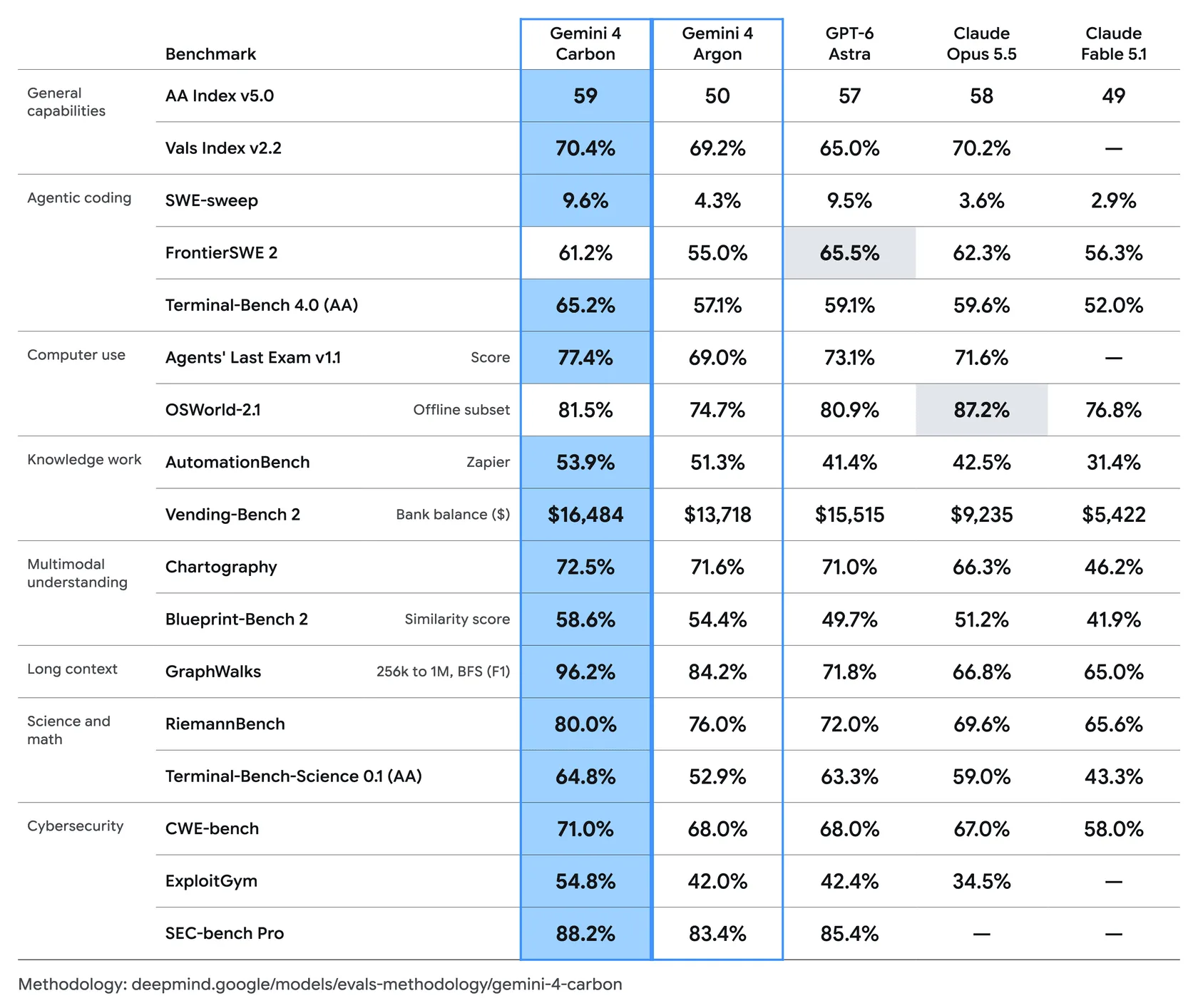
The broader boards support the direction, with smaller drama. On the Artificial Analysis Intelligence Index v5.0, an independent composite, Carbon scores 59, ahead of Claude Opus 5.5 at 58, GPT-6 Astra at 57 and Argon at 50. On LiveBench 2.0 it scores 83.5. Artificial Analysis puts its cost at $7.76 per task at list price, with about 123,000 output tokens per task. That is the strongest general case for Carbon. Against its own sibling, at the same token price, it is plainly better for about the same money.
Google own table points the same way, and it is a company table, so label it as such. Google reports Carbon ahead of Argon on every row it published, including Terminal-Bench 4.0 at 65.2 percent against 57.1 percent, GraphWalks on long context at 96.2 percent against 84.2 percent, ExploitGym at 54.8 percent against 42.0 percent and SEC-bench Pro at 88.2 percent against 83.4 percent. It also reports 80.0 percent on RiemannBench for science and maths. The same reporting shows the limits. Carbon trails Claude Opus 5.5 on the OSWorld offline subset, 81.5 percent against 87.2 percent, and trails GPT-6 Astra on FrontierSWE 2. VentureBeat also noted a higher rate of unsupported claims than Argon on one factual knowledge test in independent work. Stronger reasoning has not removed the need to check outputs.
What Works
Maths and science are the clearest strength, and now they have an independent board behind them, not only a launch graphic. A first place on fresh problems, where memorisation helps less, is a harder result to dismiss than a lead on a public test set. For research work, proof work and hard quantitative problems, Carbon has earned a trial ahead of the models it displaced.
Long context is the second strength. GraphWalks at 96.2 percent across contexts from 256,000 to one million tokens is a large gap over both Argon and the named rivals in Google table. Work that lives in a huge codebase, a long contract set or a full archive is exactly the work where losing the thread costs the most, and it is the work Carbon was built to hold.
Security is the third, with the same company source warning. Finding a flaw, showing it can be used, and writing a patch are three different jobs. Google reports gains on all three, on CWE-bench, ExploitGym and SEC-bench Pro. Those tests ran in conditions Google describes for its evaluation work, and buyers should expect lower numbers under normal guardrails. The direction still matches the Fairwind story, where defenders used the model on real vulnerability work before the public launch.
What Does Not
Cost per finished problem is the main weakness, and MathArena makes it impossible to hide behind token prices. Two models can share a rate card and produce bills that differ by a factor of fifteen, because one thinks longer, writes more, and refuses to stop. Carbon is that model on this board. Teams that buy by the token and never measure cost per completed task will learn this from an invoice.
Time is the second weakness, and it follows from the first. A model whose common failure is running past a limit needs a limit set by the buyer, in code, before the run starts. Our tutorial on setting thinking levels in Gemini 4 Hydrogen covers the same discipline in the smaller sibling. The principle is identical here. Earn the high setting with a failed run at a lower one, and cap the run.
The third weakness is certainty. The MathArena lead sits inside overlapping margins, part of the score is estimated, and the broad Google table is a vendor table. None of that cancels the result. All of it argues against switching a whole workload on one leaderboard week.
Competition
| Model | MathArena score | Cost per MathArena problem | Token price picture | Main contrast with Carbon |
|---|---|---|---|---|
| Gemini 4 Carbon | 85.4% | $15.70 | $2 / $10 to November 30, then $4 / $20 per million tokens | Top score, with high spend per problem and a December price rise |
| Claude Fable 5.2 | 82.8% | $40.20 | $8 / $40 per million tokens in launch comparisons | Close on score, far more costly per problem, with the widest error margin in this group |
| GPT-6.1 Sol | 80.6% | $1.07 | $2 / $10 per million tokens, unchanged in December comparisons | The value pick, 4.8 points behind for about one fifteenth of the run cost |
| Gemini 4 Argon | No MathArena row in sources checked | Not listed | $2 / $10 to November 30, then $4 / $20 per million tokens | Same price as Carbon, nine points behind on the Artificial Analysis index |
| Claude Opus 5.5 | No MathArena row in sources checked | Not listed | $4 / $20 per million tokens | Matches Carbon December token price, leads it on the OSWorld offline subset |
The choice is not Carbon or nothing. For most coding, document and agent work at volume, a fast model such as Hydrogen or a value model such as Sol will finish more tasks per dollar. Carbon earns its place at the top of a routing table, not as the whole table. Send it the problems that defeated the cheaper models, the long context work that needs the full window, and the security work where its published gains are largest.
Final Verdict
Use Carbon where being right is worth paying for, and measure it on your own hardest problems before you commit. Set a time cap and a token cap on every run, budget at the December rates, and compare cost per correct answer against Sol and Fable 5.2 on the same set. On the published evidence Carbon will win some of those comparisons on quality and lose most of them on cost, and both halves of that sentence matter.
Skip it as a default. A default model runs on easy work as well as hard work, and Carbon charges frontier time and frontier tokens for both, with no free tier to soften trials. The model that tops a maths board at fifteen times the run cost is a specialist tool. Treating it as a specialist, with a routing rule and a budget line of its own, is how it pays for itself.
Sources
- Google: Gemini 4 Carbon announcement, October 28, 2026, by Koray Kavukcuoglu, as reported by VentureBeat
- Tbreak: Gemini 4 Carbon tops MathArena maths benchmark
- eesel AI: Gemini 4 Carbon pricing, $2 and $10 promo, $4 and $20 after, cost per task
- AI Pro League: Gemini 4 Carbon, LiveBench 83.5 and pricing record
- Images: Hero and maths desk images are generated Dirty Static house style illustrations. The benchmark table image is a Google published table, credited above.
END OF TRANSMISSION
Stay curious. Question everything.