Dirty Static // The Verdict
A serious agent model on paper and a cheap API to try, but every score is a vendor score and the documented self hosting path needs a 194 chip Ascend cluster.
Best forTeams that want to test a low cost agent model through an API first, and Ascend shops that can actually run the documented cluster
What works
- Vendor agent scores sit close to Claude Opus 5 and GPT-5.6 Sol on Terminal Bench v2.1, at 88.4 against 89.1 and 88.8
- Weights are out under the MIT licence, so commercial use and outside testing are both allowed
- The API speaks OpenAI and Anthropic formats and plugs into Claude Code, Codex and Hermes
- Launch pricing is low, at about 0.30 dollars per million input tokens and 1.20 dollars per million output tokens
- Images enter as native tokens beside text, which suits visual coding and design work
What does not
- No independent benchmark run had been published in the coverage checked on November 15, so every score here is a Meituan score
- The sample self hosting guide uses 194 Huawei Ascend Atlas A2 chips, which puts self hosting in data centre territory
- The guide gives no path for Nvidia GPUs, so most Western shops have no documented route to run the weights
- Output limits differ across Meituan documents, with launch coverage at 128,000 tokens and parameter documents at 256,000 tokens
- On harder tests the gap widens, with 38.5 on Terminal Bench v4.0 against 53.9 for Claude Opus 5 in the same vendor table
Research review: based on published testing, specifications, and documentation, not hands on testing.
LongCat-2.5 arrived with a hardware claim first and a model claim second. Meituan says the model was trained on Chinese accelerators alone, and the weights landed on November 10 under the MIT licence. The question for a buyer is simpler than the politics around it. Does this model do agent work well enough to earn a place in a stack, and what does it cost to run it where you actually work?
This review answers that from published material only. Dirty Static did not run the model. Every benchmark below comes from Meituan own table, reported by The Decoder on November 15, and no independent run had been published in the coverage checked that day. Treat the scores as claims with numbers attached, not as settled results.
What It Is
LongCat-2.5 is a mixture of experts model built by the LongCat team at Meituan, the Chinese food delivery company that now runs a serious model lab. A mixture of experts model splits its work across many small subnetworks and wakes only some of them for each token. That is why the total size and the running cost can tell different stories. The total is 1.6 trillion parameters. The active count per token is about 48 billion.
The model was built for agents that work through long tasks in many steps, with coding as the main case. It takes text, images and video in and returns text. Users can turn its reasoning mode on or off. It builds on LongCat-2.0 and adds image understanding as the main new skill.
For training, Meituan used real software tasks drawn from GitHub pull requests, plus agent failures that were rebuilt as training tasks. In those training setups the team blocked internet access, removed Git history and cached files, and used a separate language model to check solutions for tricks. That detail matters for a review. It suggests the team tried to stop the model from gaming its own homework, even if the final scores still need outside checks.
Features and Specifications
| Area | LongCat-2.5 |
|---|---|
| Maker | LongCat team at Meituan |
| Announced | November 2, 2026 |
| Weights released | November 10, 2026, under the MIT licence |
| Total parameters | 1.6 trillion |
| Active per token | About 48 billion |
| Architecture notes | 768 routed experts with top 12 routing, per the model config |
| Context through the API | Up to 1 million tokens |
| Max output | 128,000 tokens in launch coverage; 256,000 tokens in parameter documents |
| Inputs | Text, images and video |
| Output | Text |
| Reasoning | Can be turned on or off |
| Quantized build | Expert weights and activations at 4 bits for native work on domestic accelerators |
| Sample deployment | 194 Huawei Ascend Atlas A2 chips |
| API formats | OpenAI and Anthropic |
| Agent harnesses named | Claude Code, Codex and Hermes |
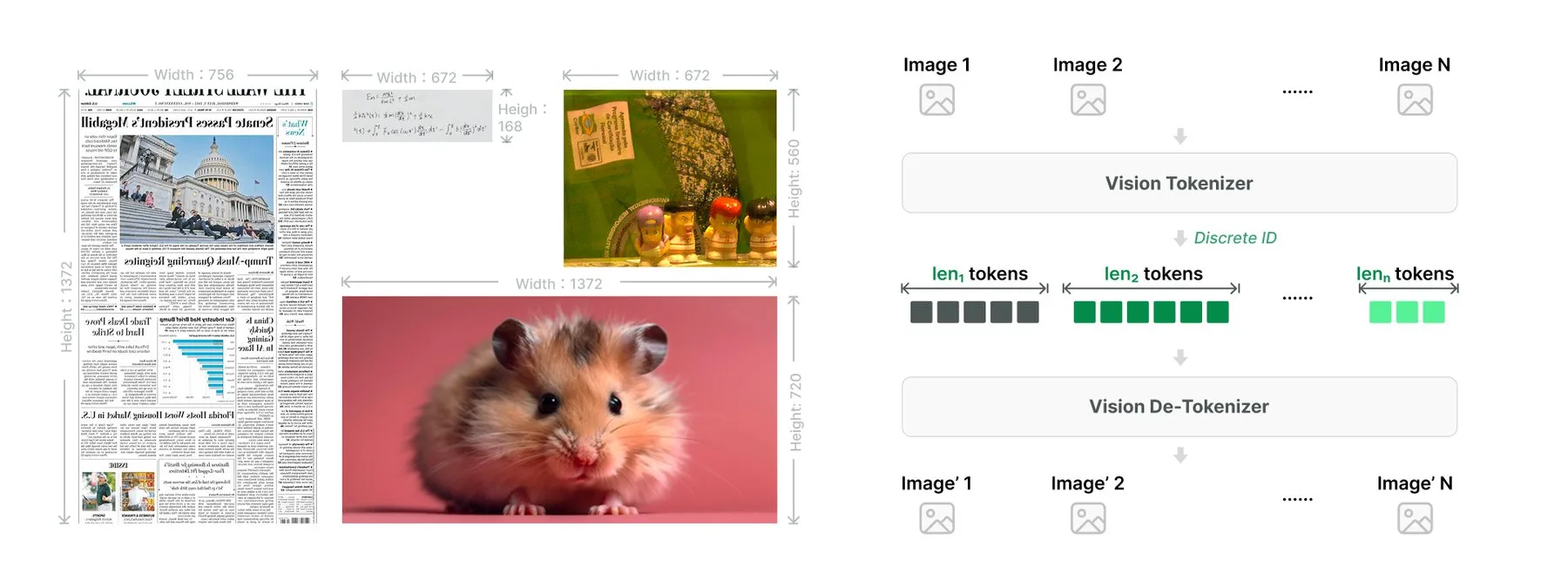
The image path deserves a closer look. Many models bolt a separate image encoder onto a text model after the fact. LongCat-2.5 instead breaks an image at its native size into discrete tokens and reads those tokens in the same stream as text. Meituan says that should help with visual coding, design work and 3D tasks. That is a claim about design intent. The visual scores in the vendor table give it some support, and outside visual tests will give it more or take it away.
The output limit split is a small thing that tells a larger story. Launch coverage put the cap at 128,000 tokens. Parameter documents checked by other reviewers put it at 262,144 tokens, which rounds to 256,000. Both numbers come from Meituan material. A team planning long agent runs should confirm the cap on its own account before it designs around either figure. Our own earlier news report on the LongCat-2.5 weights release covers the hardware announcement in full.
Real World Experience
This section is a research based discussion, not a test log. It draws on the model card, the deployment guide as reported by The Decoder, pricing documents, and the small set of outside reviews that checked those documents in November.
Start with the route most teams will actually take, which is the API. The price is the draw. Pricing documents list about 0.30 dollars per million input tokens, 0.006 dollars for cached input, and 1.20 dollars per million output tokens, under a limited time label with no end date given. The Decoder put the same launch price at about 0.27 euros in and 1.07 euros out. At those rates, a team can run a real agent trial for the cost of a team lunch and learn more than any benchmark table can teach it.
Access helps too. The API speaks both the OpenAI format and the Anthropic format. That means tools built for one stack can often point at LongCat-2.5 with a base address change and a new key. Meituan names Claude Code, Codex and Hermes as harnesses that work with it. For an agent model, that fit matters as much as raw scores, because agents live inside harnesses, not inside chat boxes.
Terminal Bench v2.1 scores, vendor table
Scores from Meituan evaluation table as reported by The Decoder, November 15, 2026. All figures are vendor reported. No independent run had been published in the coverage checked.
The vendor scores split into two stories. On Terminal Bench v2.1, which tests command line agent work, LongCat-2.5 sits at 88.4 in a tight pack near the top. On BrowseComp, a web search test, Meituan reports 91.9, the highest score in its table, though the company ran that test in its own setting. On DeepSWE, which tests fixing bugs in real code, the model jumps from 9.7 for LongCat-2.0 to 64.6, a large gain that still leaves it behind most rivals in the table.
The harder test tells the colder story. On Terminal Bench v4.0, LongCat-2.5 scores 38.5. That edges GPT-5.6 Sol at 37.3 in the same table and falls well short of Claude Opus 5 at 53.9. A fair reading is that the model handles routine agent work at a level close to the leaders, and that the leaders pull away when tasks get long and messy. That is also the pattern agent buyers see in most new models, so the result is plausible. Plausible is not the same as proven.
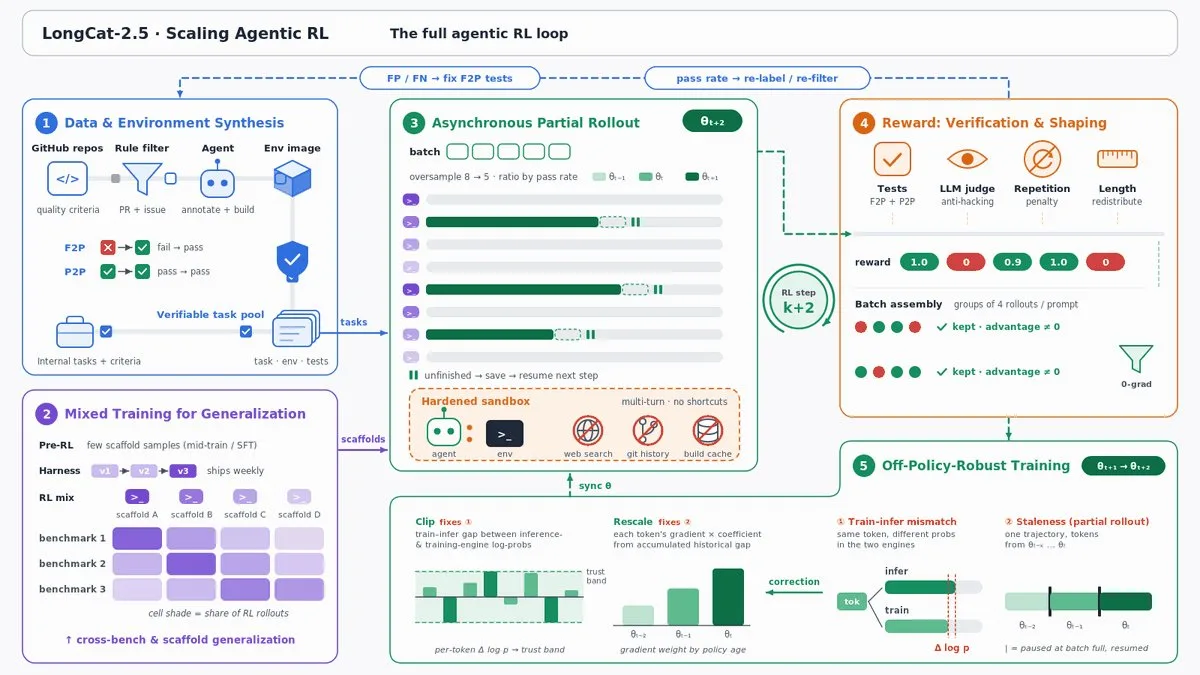
Self hosting is where the review turns hard. The documented guide quantizes expert weights and activations to 4 bits, a format the Chinese chips handle natively. Meituan says that build raised prompt throughput by 43.3 percent and response throughput by 42.77 percent against an 8 bit version in its own load tests, with accuracy on par. Those are vendor load tests. The cluster in the guide is the concrete part. It uses 194 Huawei Ascend Atlas A2 chips, with 2 for image work, 64 for prompt intake and 128 for response generation. There is no Nvidia guidance in the guide at all.
That shape decides who this release is for. A shop that already runs Ascend hardware gets a large agent model tuned for its racks from day one. A shop on Nvidia hardware gets an API and a chat page, plus weights it has no documented path to serve. Both groups can use the model. Only one group can own the running of it.
What Works
The agent focus is real in the design, not just in the marketing. The training tasks came from real pull requests. The failure cases were rebuilt as lessons. The sandbox blocked the easy cheats. Models trained that way tend to behave better in harnesses than models trained on chat data alone, and the jump on DeepSWE from 9.7 to 64.6, even as a vendor figure, points in that direction.
The licence and the price work together. MIT terms let a company use the weights in a product without a licence negotiation. The API price lets a team test the model this week without a procurement fight. Add the dual format API and the named harness support, and the trial path is about as short as this class gets. For comparison, the control question in our report on self hosted Claude Managed Agents is the same one LongCat raises from the other side of the world. Who runs the agent, and on whose chips?
What Does Not
The evidence problem comes first. Tech Times noted on November 3 that every performance claim at that point came from Meituan own testing. The weights release coverage two weeks later still cited no independent run. Until a lab with no stake in the result publishes its own numbers, a buyer is grading Meituan homework with a Meituan answer key.
Size is the second problem. Only 48 billion parameters wake per token, but the full 1.6 trillion still has to live somewhere and load from somewhere. The model card lists 208 weight files and about 3.56 trillion bytes of storage. Nobody is running this on a workstation. The 4 bit build cuts the serving cost, and it still needs a cluster that most companies will rent rather than own, if they can rent Ascend capacity at all.
Documentation drift is the third problem, and it is the most fixable. Output caps differ across Meituan own documents. Context figures differ between the model config and the API pitch. None of this is fatal, and all of it costs a new user time that a tighter document set would save.
Competition
| Model | Access | Agent score in vendor table | Self hosting path |
|---|---|---|---|
| LongCat-2.5 | MIT weights plus hosted API | Terminal Bench v2.1 at 88.4, vendor reported | Documented on 194 Ascend Atlas A2 chips only |
| Claude Opus 5 | Hosted API only | Terminal Bench v2.1 at 89.1 and v4.0 at 53.9, as listed by Meituan | None |
| GPT-5.6 Sol | Hosted API only | Terminal Bench v2.1 at 88.8 and v4.0 at 37.3, as listed by Meituan | None |
| DeepSeek V4.1 Flash | Open weights line from DeepSeek | Terminal Bench v2.1 at 90.6, as listed by Meituan | Broad community serving on common GPU stacks |
The table uses Meituan figures for rivals as well, so read it as a map of claims, not a league table. The shape still helps a decision. Claude and GPT remain the safe hosted picks, with the strongest hard test score in this table belonging to Opus 5. DeepSeek offers the open route most GPU shops can actually serve today. LongCat-2.5 offers the open route built for Ascend, at an API price that undercuts the room while the promotion lasts.
Final Verdict
Try LongCat-2.5 through its API if you run agent work and your harness speaks the OpenAI or Anthropic format. The trial is cheap, the setup is short, and your own tasks will tell you more in a day than the vendor table can. That is the honest way to test a model whose scores all come from its maker.
Choose it for self hosting only if your world already runs on Ascend. For that shop, this is a rare thing, a frontier scale agent model tuned for its hardware from the start, with a quantized build and a full cluster guide. For every other shop, wait. Wait for independent benchmarks, wait for community serving support on common GPUs, or wait for a smaller sibling that fits real racks. The model may well earn its scores. On November 15, the evidence that it has done so was still Meituan word, and a careful buyer prices a claim as a claim.
This is a research review. It draws on Meituan model card and pricing documents, The Decoder report of November 15, 2026, and outside document checks from November 2026. No hands on testing was performed. Facts checked November 15, 2026.
Sources
- The Decoder, Meituan releases a 1.6 trillion parameter agent model that never touched an Nvidia GPU, November 15, 2026. Benchmark table, image token method, training tasks, 4 bit load tests, 194 chip deployment and launch pricing in euros.
- Meituan LongCat team, model card for LongCat-2.5 on Hugging Face, checked November 15, 2026. MIT licence, architecture config, weight files, storage size and quantized build notes.
- LongCat platform pricing and parameter documents, checked in November 2026 coverage. Limited time price of about 0.30 dollars per million input tokens and 1.20 dollars per million output tokens, and the 256,000 token output figure in parameter documents.
- Tech Times, report of November 3, 2026, noting that all benchmark claims at that date were from Meituan own testing with no independent evaluator.
- Product images: Meituan via The Decoder, credited at each figure. Hero and other illustrations: Dirty Static.
END OF TRANSMISSION
Stay curious. Question everything.