
Meituan has released the weights for LongCat-2.5, and the hardware story is the point. The model was trained entirely on Chinese accelerators, with no Nvidia GPU in the training run described by the company. The weights arrived on November 10, about a week after the model was first unveiled on November 2.
That timing matters. The announcement came first as an API product. The open release is the news this week, because developers can now download the model, run it on the hardware Meituan documents, and test the claims for themselves.
The Announcement
The Decoder reported the weights release on November 15, one week after the official unveiling. Meituan is a food delivery company that has become a serious model lab, and its LongCat team built this release for agents that plan, write code, run it, check the result, and keep going across many steps.
LongCat-2.5 is a mixture of experts model. That means only part of the full model works on each token. The total count is 1.6 trillion parameters, but about 48 billion are active at a time, and that smaller number is what drives the cost of running it. Through the API it handles up to one million tokens at once and can generate responses up to 128,000 tokens long, according to Meituan. It takes text, images, and video in, returns text, and lets users turn reasoning on or off.
The new part over LongCat-2.0 is image understanding. Instead of bolting a separate image system on later, the model turns images at their native size into tokens and reads them in the same stream as text. Meituan says that approach should help with visual coding, design work, and 3D tasks. That is a company claim about intent, not a measured result, and outside tests will need to show how well it works in practice.
For training, the team used real software tasks drawn from GitHub pull requests, along with agent failures that were recreated as training tasks. In the training rooms, internet access was blocked, Git history and cached files were removed, and a separate language model checked solutions for tricks. The point was to stop the model from finding a shortcut and to force it to solve the task in front of it.
Important Details
| Item | Where it stands |
|---|---|
| Announced | November 2, 2026 |
| Weights released | November 10, 2026, under the MIT licence |
| Total parameters | 1.6 trillion |
| Active per token | About 48 billion |
| Context through the API | Up to 1 million tokens |
| Max output | Up to 128,000 tokens |
| Inputs | Text, images and video |
| Sample deployment | 194 Huawei Ascend Atlas A2 accelerators |
| Independent benchmarks | None published in the coverage checked on November 15 |
The deployment guide is where the hardware claim gets concrete. Meituan quantizes expert weights and activations to 4 bits, a format the Chinese chips can process natively. In its own load tests, the company says prompt processing throughput rose 43.3 percent and response generation rose 42.77 percent compared with an 8 bit version, with accuracy on par with the uncompressed model. Those figures are Meituan figures, reported by The Decoder, and they have not been reproduced by an outside lab in the coverage checked here.
The sample setup for that quantized build uses 194 Huawei Ascend accelerators from the Atlas A2 series. Two handle image processing, 64 handle prompt intake, and 128 handle response generation. There is no guidance for Nvidia GPUs in that guide. Meituan own posts do not name a chip vendor for the training run itself. They describe domestic or Chinese made accelerators, and the vendor name appears in the deployment guide, not in the training claim.
That distinction is worth keeping. For the earlier LongCat-2.0, Meituan said training ran in late June on a cluster of more than 50,000 Chinese chips. No card count for the LongCat-2.5 training run was given in the posts reviewed for this report, and this article does not assign the older number to the new model.

On price, Meituan is running a launch promotion. The Decoder put the price at roughly 0.27 euros per million input tokens and 1.07 euros per million output tokens. Users can also try the model in a chat service at longcat.ai, and its API supports both the OpenAI and Anthropic formats, so it can plug into agent tools such as Claude Code, Codex and Hermes. That ease of swapping is part of the pitch, and it sits near the work in our report on self hosted Claude Managed Agents, where control over where an agent runs is the whole question.
What The Benchmarks Say, And What They Do Not
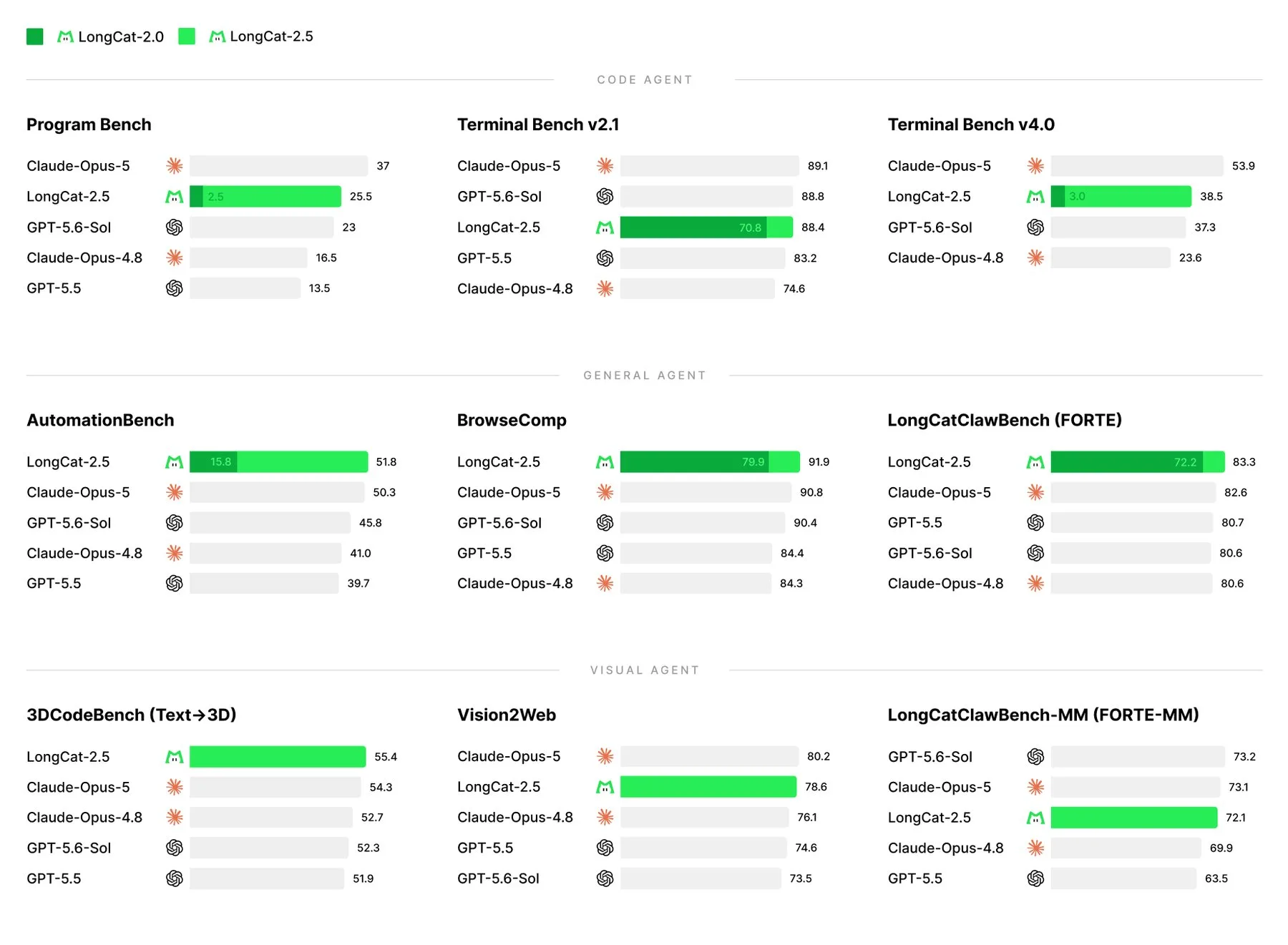
Meituan reports 88.4 points on Terminal Bench v2.1, a test of how well agents solve tasks in a command line. In the same table, the company lists Claude Opus 5 at 89.1, GPT-5.6 Sol at 88.8, and DeepSeek V4.1 Flash at the top with 90.6. On DeepSWE, a test of fixing bugs in real code, LongCat-2.5 jumps from 9.7 for the prior model to 64.6, still behind most rivals in that table.
Other numbers follow the same pattern. Terminal Bench v4.0, the harder variant, puts LongCat-2.5 at 38.5, slightly above GPT-5.6 Sol at 37.3 but well below Opus 5 at 53.9. On BrowseComp, a web search test, Meituan reports 91.9, the highest score in its table, though the company ran that test in its own setting.
None of that settles the comparison. Tech Times reported on November 3 that every performance claim for LongCat-2.5 at that point came from Meituan in house testing, with no independent evaluator publishing a result. The Decoder coverage of the weights release cites no independent run either. Until outside groups publish their own work, the fair reading is narrow: the model looks close to top Western models on several agent tests in Meituan own table, and that closeness remains unverified.
- Nov. 2, 2026Meituan unveils LongCat-2.5 as a multimodal agent model
- Nov. 3, 2026Tech Times notes all benchmark claims so far are from Meituan
- Nov. 10, 2026Weights released under the MIT licence for commercial use
- Nov. 15, 2026The Decoder reports the weights release and the 194 chip sample deployment
What’s Next
Confirmed steps are simple. The weights are out, the API is live, and developers can now run the model in the setups Meituan documents and publish results that do not come from Meituan. That outside work is the next real milestone, not another launch chart.
Open questions are larger. A model with 1.6 trillion total parameters is not a laptop model, even with only 48 billion active per token and a 4 bit build available. The documented sample needs 194 accelerators, which puts self hosting in data centre territory. Most teams that try LongCat-2.5 first will meet it through an API or through a host that already runs Ascend hardware, a pattern that also shapes the sovereign hardware push in our report on Nvidia, Rebellions and SK Telecom in Korea.
There is also a market question that the launch leaves open. A model tuned for Chinese chips from the start makes those chips more attractive outside China if the performance holds up, because the software and the hardware now arrive as a pair. If the performance does not hold up under outside testing, the release still matters as proof that the training path works, but it will not move many buying decisions.
The takeaway is plain. Meituan shipped a very large agent model, trained it without Nvidia hardware in the run it describes, and released the weights under a licence that lets others use them for business. The hardware feat is documented in the deployment guide. The performance feat is still a claim, and now that the weights are public, it is a claim anyone with the right cluster can check.
Sources
- The Decoder, Meituan releases a 1.6 trillion parameter agent model that never touched an Nvidia GPU, November 15, 2026. Weights release timing, image token method, training tasks, 4 bit results, 194 chip deployment, benchmark table and launch pricing.
- Tech Times, Meituan Releases LongCat 2.5 on Chinese Chips; Benchmark Claims Await Independent Tests, November 3, 2026. Announcement timing, active parameter count, and the warning that all benchmark claims were self reported with no independent test at that date.
- Techies Journal, report on LongCat-2.5 checked November 15, 2026. November 2 announcement and November 10 open release under MIT, and the note that Meituan posts name only domestic accelerators for training while the deployment guide names Ascend Atlas A2.
- Facts checked November 15, 2026. The benchmark image is from Meituan via The Decoder and is credited above. The other images in this article are Dirty Static illustrations in the house style.
END OF TRANSMISSION
Stay curious. Question everything.