
Dirty Static // The Verdict
Worth testing now while access is free, especially for agent and coding work in Korean or English. The scores are strong on paper and unproven outside LG, the weights are not open, and the free period has no stated end date, so build nothing you cannot move off it.
Best forDevelopers, startups and research teams who want to test a large Korean and English model on agent, coding and web search tasks at no cost, inside tools they already use
What works
- Free API access from November 9, 2026, with an API key as the only stated barrier, for service development and research
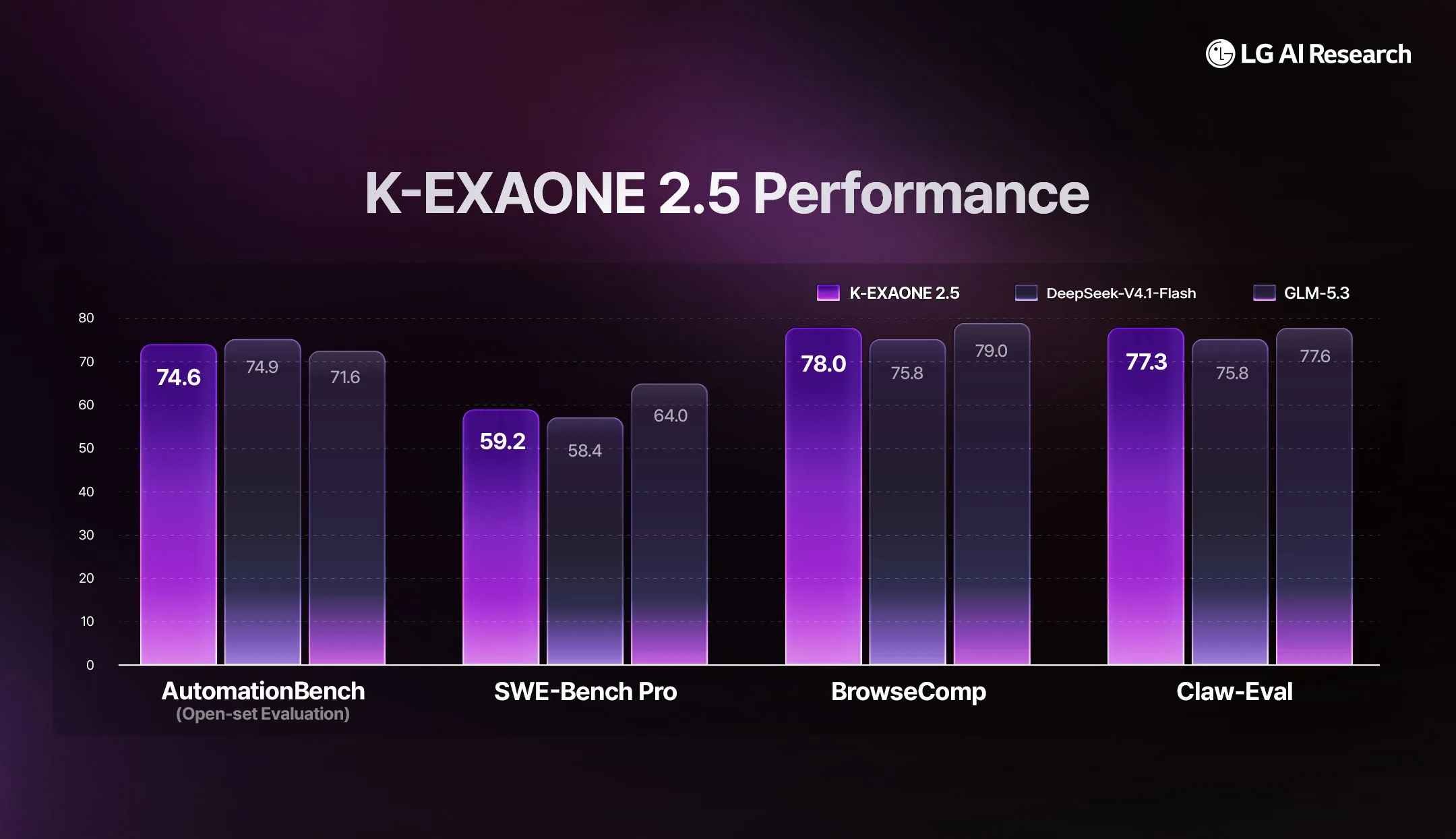
- Agent scores reported by LG sit level with DeepSeek V4.1 Flash and GLM 5.3 across four public benchmarks, a clear jump from the August model
- A 512K token context window and an OpenAI compatible endpoint mean most teams can test it by changing a model name and a base address
- Built for agent work on purpose: tool calling, structured outputs, streaming and a reasoning effort control are all documented features
What does not
- Every performance figure in this launch comes from LG internal testing on public datasets, with no independent result published yet
- This release is API access only, with no open weights announced, while the August model shipped its weights under Apache 2.0
- LG has not said how long free access lasts, what quotas apply, or what the model will cost when the free period ends
- The API model lists Korean and English only and text only input, a narrower offer than the ten languages the August model supports
Research review: based on published testing, specifications, and documentation, not hands on testing.
LG did not launch a model on November 9. It opened a door. K-EXAONE 2.5, the newest version of LG AI Research own foundation model, is now reachable by anyone who asks for an API key, and LG is charging nothing for it. The pitch sits in one number: LG says the model improved by more than 70 percent in about eight weeks.
That number deserves respect and suspicion in equal parts. The model it describes is large, the agent scores LG published are genuinely close to two strong Chinese rivals, and the price right now is zero. The scores are also all from LG. This review separates what is documented from what is claimed, so you can decide whether to spend an afternoon testing it or wait for outside proof.
What It Is
K-EXAONE 2.5 is a technology validation model, in LG own wording. That phrase matters. LG took K-EXAONE 2.0, the model it released in August, and applied further training to it. The lab says the point was to test a new training method and prove that the existing model still had large gains left in it. The results, good or bad, now feed the third model, which LG aims to finish at what it calls frontier level by January 2027.
A foundation model is the base system that other products build on. K-EXAONE is Korea sovereign AI entry in that race, developed under the national foundation model program, and we covered the wider Korean push in our report on Nvidia, Rebellions and SK Telecom building Korean sovereign AI. Version 2.5 is not a new base. It is a progress report you can call through an API.
The announcement landed at NVIDIA AI Day Seoul 2026, held at COEX in Seoul on November 9. LG also said it is reviewing NVIDIA Dynamo, a serving system for model inference, to improve speed and scale. Reviewing is the operative word. LG has not said Dynamo runs this API today.
Features and Specifications
The shape of the model changed less than its scores did. Total size stays at 750 billion parameters, the same headline figure as the August model. Active parameters, the slice of the model that works on each token, are listed at 31 billion in the platform model documentation, down from 37 billion listed for version 2.0. Context, the amount of text the model can hold in mind at once, doubled: 512K tokens against 262,144 tokens in version 2.0. A token is a small piece of text, roughly a short word or part of one.
Specifications
- Maker
- LG AI Research
- Model
- K-EXAONE 2.5, model name k-exaone_v2.5 on the API
- Status
- Technology validation model, further training on the August 2026 model
- Parameters
- 750 billion total, 31 billion active, per the platform documentation
- Context window
- 512K tokens; input plus the generation allowance cannot exceed 524,288 tokens
- Languages
- Korean and English
- Input
- Text only
- Knowledge cutoff
- January 2026
- Features
- Chat, tool calling, structured outputs, code generation, streaming
- Reasoning control
- reasoning_effort set to low, high or max, with max as the default
- Access
- API key from the EXAONE API Platform; free at launch on November 9, 2026
- Weights
- No open weights announced for version 2.5
Two specification details are easy to miss and worth pausing on. First, the language list shrank. Version 2.0 supports ten languages and ships as open weights under Apache 2.0 on Hugging Face. The version 2.5 API documentation lists Korean and English only. That may reflect the validation scope rather than a model limit, but the documentation is what a developer can rely on, and it names two languages.
Second, the reasoning control is exposed rather than hidden. The reasoning_effort setting tells the model how long to think before it answers, and a separate setting can carry earlier reasoning into later turns of a conversation. Agent tools live or die on details like that, because an agent loop sends many turns back and forth while tools run between them. LG agent guide, per published coverage of the documentation, includes setups for the Hermes agent and the OpenCode coding agent. Readers running those tools may want our Hermes setup guide and our look at running OpenCode with other coding agents before they swap a model in.
Real World Experience
This is a research review. Dirty Static did not hold an API key or run this model before publication, and nothing below pretends otherwise. What follows draws on LG announcement, the platform documentation as reported on launch day, and the benchmark table LG itself published.
The test an ordinary developer will run is simple. The endpoint speaks the OpenAI chat completions format, so existing code that calls that format can point at the EXAONE platform, swap in the model name k-exaone_v2.5, and send the same prompts it sends elsewhere. That design choice is the strongest practical signal in this launch. LG did not build a walled garden. It built a drop in replacement slot and set the price to zero.
The workload LG is aiming at is agent work: software that plans steps, calls tools, reads results and keeps going. LG named code generation, debugging, refactoring and test creation in its announcement, and the four benchmarks it chose all measure that kind of work rather than chat quality. That focus is honest about where the lab thinks this model earns its keep.
What no source can tell you yet is how the model feels in a long session: how often tool calls arrive malformed, how the max reasoning setting trades speed for quality, or how the service holds up under load from a crowd of new free accounts. Those answers come from use, not from a launch table, and they are exactly what LG says it wants the free period to produce.
K-EXAONE 2.5 agent scores reported by LG, November 9, 2026
LG internal results on public datasets, checked November 9, 2026. AutomationBench measures task automation with SaaS tools. Claw-Eval measures agent problem solving at work. BrowseComp measures web search and finding. SWE-Bench Pro measures software development and modification tasks.
What Works
The jump from version 2.0 is large on every measure LG published. On AutomationBench the August model scored 16.9 and version 2.5 scores 74.6. On BrowseComp the score rose from 50.87 to 78.0. On SWE-Bench Pro it rose from 47.1 to 59.2, and on Claw-Eval from 62.11 to 77.3. Gains of that size from further training on the same base are rare enough that the training method, whatever its details, is the real story of this release.
The position against rivals is also real, with one caveat held for the next section. Version 2.5 beats DeepSeek V4.1 Flash on three of the four measures in LG table, by small margins: 59.21 against 58.41 on SWE-Bench Pro, 78.0 against 75.8 on BrowseComp, and 77.29 against 75.78 on Claw-Eval. It trails DeepSeek by a hair on AutomationBench, 74.6 against 74.9. Against GLM 5.3 it wins only AutomationBench, and loses SWE-Bench Pro by a wider gap, 59.21 against 64.03. Level with the field is a fair summary. Ahead of the field is not.
The offer itself is clean. One platform, one API key, no payment step, and a second model on the same platform, EXAONE Tabular, for predictions on structured data. For a team in Korea, or a team anywhere that wants a strong Korean language model without routing data to a US or Chinese provider, a free test of a 750 billion parameter model with a half million token context is an easy yes.

What Does Not
Start with the 70 percent claim, because it is the headline and the weakest evidence in the launch. LG says an internal analysis combining 24 evaluation metrics improved by more than 70 percent against the August model. LG has not published the full list of 24 metrics beside that claim in the launch material, nor how the combined figure was weighted. The four agent scores it did publish support a large gain. They do not, on their own, verify a single combined number, and no outside lab has reproduced any of it yet. Treat 70 percent as a claim about LG own scorecard until someone else runs the tests.
The openness story also moved backwards. Version 2.0 gave the world its weights under Apache 2.0, which means any team could run it on its own hardware and keep it forever. Version 2.5 gives the world a key to LG servers. If the free period ends badly, or the service changes, API users have nothing to fall back on except the older model. For a validation exercise that trade is understandable. It is still a trade, and teams with strict data rules will notice that prompts now travel to LG rather than staying in house.
Last, the practical unknowns are the ones that decide real adoption: response speed at each reasoning setting, behaviour on long agent runs, and uptime once free accounts pile in. LG is reviewing NVIDIA Dynamo to help with serving, which tells you the lab itself sees scale as an open question. None of this is a reason to stay away. All of it is a reason to test with workloads you can afford to rerun elsewhere.
Competition
The rivals in LG own table are open weight models from China, and that comparison cuts both ways. They cost money through an API and nothing to download, while K-EXAONE 2.5 costs nothing through an API and cannot be downloaded at all.
| Option | Access | Context | The trade |
|---|---|---|---|
| K-EXAONE 2.5 | Free API only, no weights announced | 512K tokens | Zero cost testing of a 750B model in Korean and English, on terms LG can change |
| K-EXAONE 2.0 | Open weights, Apache 2.0, from August 2026 | 262,144 tokens | Yours to run forever in ten languages, with the weaker agent scores LG just replaced |
| DeepSeek V4.1 Flash | Open weights and a paid API | 1M tokens, per its model documentation | Broader access and a longer window, at a per token price, with scores level with 2.5 in LG table |
| GLM 5.3 | Open weights and a paid API | 1M class, per published comparisons | The strongest SWE-Bench Pro score in LG table at 64.03, at a higher API price than DeepSeek |
The honest read is that K-EXAONE 2.5 competes on price today and on promise tomorrow. While the API is free, it is the cheapest way to test frontier class agent scores. The moment LG names a price, the comparison becomes about trust, speed and Korean language depth against rivals whose weights you can already hold.
Final Verdict
Test it. That verdict is easy while the cost is an API key and an afternoon. Point an existing agent or coding workflow at the endpoint, run your own tasks in Korean and English, and compare the output against the model you use now. LG built the on ramp for exactly that experiment, and its published scores, self measured or not, are strong enough to justify running it.
Build on it with care. Do not place a production service, a customer promise or a data sensitive workload on a free validation API with no stated end date, no published quota and no weights to retreat to. The third model, due by January 2027 in LG plan, is the release this one is rehearsing for. Version 2.5 is your chance to learn, at LG expense, whether that release deserves a place in your stack when it lands.
Sources
- LG AI Research: K-EXAONE 2.5 API Available for Free
- Digital Today: LG AI Research opens K-EXAONE 2.5 API free, says performance up 70 percent
- Money Today: LG AI Research Institute opens free access to K-Exaone 2.5
- Unite.AI: LG AI Research Opens Free API Access to Its K-EXAONE 2.5 Model
- Spectrum Web Co: LG opens K-EXAONE 2.5 API free for developers
- Hugging Face: K-EXAONE 2.0 model card
- Images: Hero and agent illustrations are generated Dirty Static house style artwork. The benchmark chart image is from LG AI Research, credited at the image.
END OF TRANSMISSION
Stay curious. Question everything.