A maths teacher in California named Al Rabanera stopped sending home the kind of problems his students could lift into a chatbot and paste back as an answer. The 74 reported his change in July 2026. In place of rote problem sets, he built work around a question his students already cared about, such as buying a car, with interest rates, monthly payments, and credit scores woven into one unit, plus poster projects and design work done in class.
That single classroom tells the larger truth. Homework is not dying because teachers gave up on effort. It is dying in its old form because the old form rested on trust that no one can grant now. A worksheet sent home at night and returned in the morning used to prove a student had sat with a problem. Now it proves a file moved from one screen to another.
The Bigger Story
Homework had two jobs that schools rarely said out loud. The first job was practice. A student read in class, then worked alone at night, and the struggle at the kitchen table was meant to make the lesson stick. The second job was proof. A finished page told a teacher who had done the reading, who had grasped the method, and who needed help before the exam exposed the gap.
Chatbots break the second job while leaving the first job untouched, and that split explains the panic. The practice still matters. The proof no longer holds. When a model can produce a clean essay, a solved equation, and a tidy summary in less time than a student needs to open a textbook, a perfect submission tells a teacher almost nothing about the mind that submitted it.
The numbers show how fast the split arrived. Pew Research Center found that the share of teens in the United States who said they had used ChatGPT for schoolwork rose from 13 percent in 2023 to 26 percent in 2024. The College Board reported that the share of high school students who said they used AI tools for schoolwork grew from 79 percent in January 2025 to 84 percent in May 2025. Use at that scale is not a fringe habit. It is the normal condition under which homework now operates.
Context
Cheating did not start with ChatGPT, and honest reporting has to start there. Denise Pope, a senior lecturer at the Stanford Graduate School of Education and a cofounder of Challenge Success, has tracked student cheating for two decades. Long before chatbots, copying the homework of a classmate was the form of dishonesty students admitted most often, she told The 74.
The latest Challenge Success work, drawn from nearly 30,000 high school students, shows how close the old and new habits sit. About 32.7 percent of students said they had copied the homework of someone else at least once in the past month. About 32.8 percent said they had used AI as an aid that was not allowed. Pope and her team have surveyed more than 100,000 students since November 2022, and wider work from the group found that overall cheating rates stayed in the range of 60 to 70 percent, much as they had before ChatGPT arrived. AI did not invent the shortcut. It made the shortcut faster, private, and available at any hour.
What changed is what the shortcut costs. A study led by Sina Rismanchian at the University of California, Irvine looked at 3.2 million maths problems on the ALEKS learning platform across a decade. After the release of ChatGPT in late 2022, high school students spent 31 percent less time on word problems, the kind that can be copied into a chatbot with ease, compared with graph problems that needed hands on work inside the platform. College students showed a 27 percent drop. When students later sat tests with supervision and no access to AI, the odds of answering those word problems with success fell by 25 percent in the years after ChatGPT.
A second study gives the cost a human shape. Researchers led by Hamsa Bastani at the Wharton School studied close to a thousand high school students learning maths in Turkey, in work published in PNAS in 2025. Students who practised with a version of GPT 4 that gave straight answers solved 48 percent more practice problems than students with no AI. On an exam taken without AI, those same students scored 17 percent worse than the group that had never used it. A version of the tool built to give hints rather than answers told a different story. Practice scores rose sharply, and exam scores showed no harm. The tool was not the poison. The answer machine was.
A finished page used to prove a student had sat with a problem. Now it proves a file moved from one screen to another.
That distinction sits at the heart of the homework fight. Schools that treat all AI use as one sin will miss it, and schools that treat all AI use as progress will miss it too. A tutor that withholds the answer and forces the next step can support the struggle that makes learning stick. A chatbot that hands over the answer removes the struggle and leaves a clean page and an empty memory. We explored a cousin of this trust problem in The Verification Arms Race, where proof of real work became a contest in itself.
Different Perspectives
Teachers who want homework gone, or sharply cut, start with fairness. Homework never landed on equal ground. One student goes home to a quiet room, a parent who can help, and a laptop that works. Another goes home to a job, siblings to watch, and a phone with a cracked screen. Critics of homework made that case for years before AI entered the room, in books and studies that questioned how much night work added for younger children at all. AI added a new layer to the old gap. Paid tools, better prompts, and private tutoring in how to use them now sit on top of the gaps that were already there.
Teachers who want homework kept start with skill. Maths, languages, and music all reward practice spread across days, and class time alone rarely holds enough of it. A student who never works alone may never learn to start alone, stall alone, and push through alone. That habit matters in adult work far beyond school. On this view, killing homework to stop cheating throws away the practice because the proof failed, when the smarter move is to fix the proof.
Students sit between those camps, and their reasons are less cynical than adults often assume. In the Challenge Success surveys, the reasons students gave for cheating came back to three pressures again and again. They did not grasp the material. They ran out of time. They felt pressure to do well. None of that excuses handing in work that is not theirs. All of it explains why a rule that only punishes will keep failing. A student who uses a chatbot at midnight because the lesson never landed needs teaching first and discipline second, in that order.
There is also a case that deserves a fair hearing from the AI companies. OpenAI launched a study mode for ChatGPT that aims to guide students with questions and hints instead of handing over finished work, and other firms have built tutor modes on the same idea. The Bastani study suggests that design choice matters a great deal. The problem is trust and incentive. A company sells a tool that can do both jobs, tutoring and answering, and the student at midnight chooses which job it does. Design can nudge that choice. It cannot make it.
Why It Matters
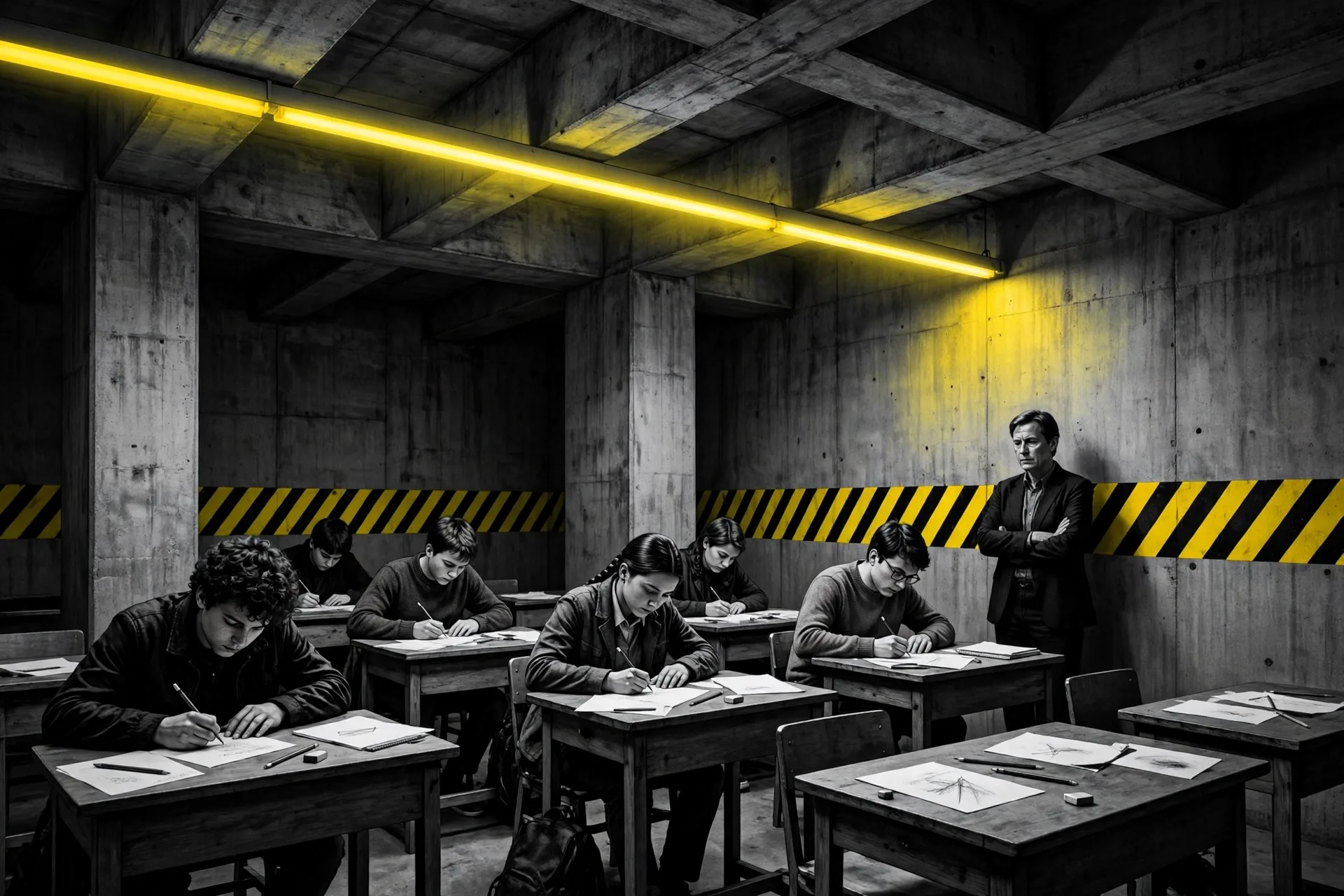
The death of the old homework changes where learning has to happen. If work at home cannot be trusted as proof, then proof has to move into rooms where a teacher can watch it form. That is why so many teachers now start homework in class, collect drafts, ask students to explain a solution out loud, or set exams on paper under supervision. The move looks backward, and in one sense it is. Schools are reaching for older forms of proof because newer forms failed under pressure, much as we saw with labels and trust in Slop Is a Slur Now.
The shift carries a cost that schools should name. Class time is finite. An hour spent watching students practise is an hour not spent teaching new material, and teachers who move all practice into class will cover less ground unless schools cut content or lengthen the day. There is no free fix here. There is a trade, and honest schools will say which side of it they chose and why.
It also changes what a good assignment looks like. Work that asks for a single right answer in a standard form is now the easiest work to outsource. Work that asks for a local example, a personal draft with visible revisions, a poster built in the room, or an answer defended in speech is harder to fake and often richer to do. Rabanera and his car buying unit point that way. The assignment did not get softer when it left the worksheet behind. It got closer to the world the maths was meant to describe.

Parents should hear the plain version of this. A child who brings home perfect homework and fails tests is not a mystery. The research above predicts that exact pattern when answers replace practice. The fix is not a detector, and it is not panic. Detectors have flagged the work of students who wrote every word, with studies showing sharp bias against students who learn English as an added language. The fix is duller and better. Ask the child to explain the work. Watch the first problems happen at the table. Treat the chatbot as a tutor that must ask questions, or not as a guest at all.
Closing Reflection
Homework is dead as a promise. A page returned in the morning no longer promises that a student wrestled with an idea at night, and schools that keep grading that promise will keep rewarding the students who fake it best.
Long live homework as practice, though, because practice never stopped mattering. It just lost its alibi. The schools that come out of this well will be the ones that stopped asking homework to prove two things at once. Let practice be practice, guided, visible, and sometimes aided by a tool that knows when to stay quiet. Let proof be proof, earned in the room, in speech, in drafts, and in work a teacher watched take shape. The worksheet died. The work did not.
Reporting draws on The 74 reporting on teachers and homework in the age of AI, published in July 2026 and syndicated widely, research from the University of California, Irvine on the ALEKS platform, Challenge Success and Stanford Graduate School of Education surveys, College Board survey findings reported in 2025, Pew Research Center surveys from 2023 and 2024, and Bastani and colleagues, published in PNAS in 2025, checked November 2026.
Sources
- The 74 via Community Sentinel, The End of Homework? Teachers Grapple With Cheating in the Age of AI, July 2026: https://communitysentinel.media/2026/07/14/the-end-of-homework-teachers-grapple-with-cheating-in-the-age-of-ai/
- LA School Report, The End of Homework? Teachers Grapple With Cheating in the Age of AI, 2026: https://www.laschoolreport.com/the-end-of-homework-teachers-grapple-with-cheating-in-the-age-of-ai/
- Frontiers in Education, Homework in the AI Era: Cheating, Challenge, or Change?, June 2025: https://public-pages-files-2025.frontiersin.org/journals/education/articles/10.3389/feduc.2025.1609518/pdf
- Transparency Coalition, Why Students Who Use ChatGPT on Homework Do Worse on the Test, on the Bastani Wharton study, 2026: https://www.transparencycoalition.ai/news/study-finds-chatgpt-helps-students-finish-their-homework-but-not-actually-learn-the-material
- Illustrations: Dirty Static
END OF TRANSMISSION
Stay curious. Question everything.