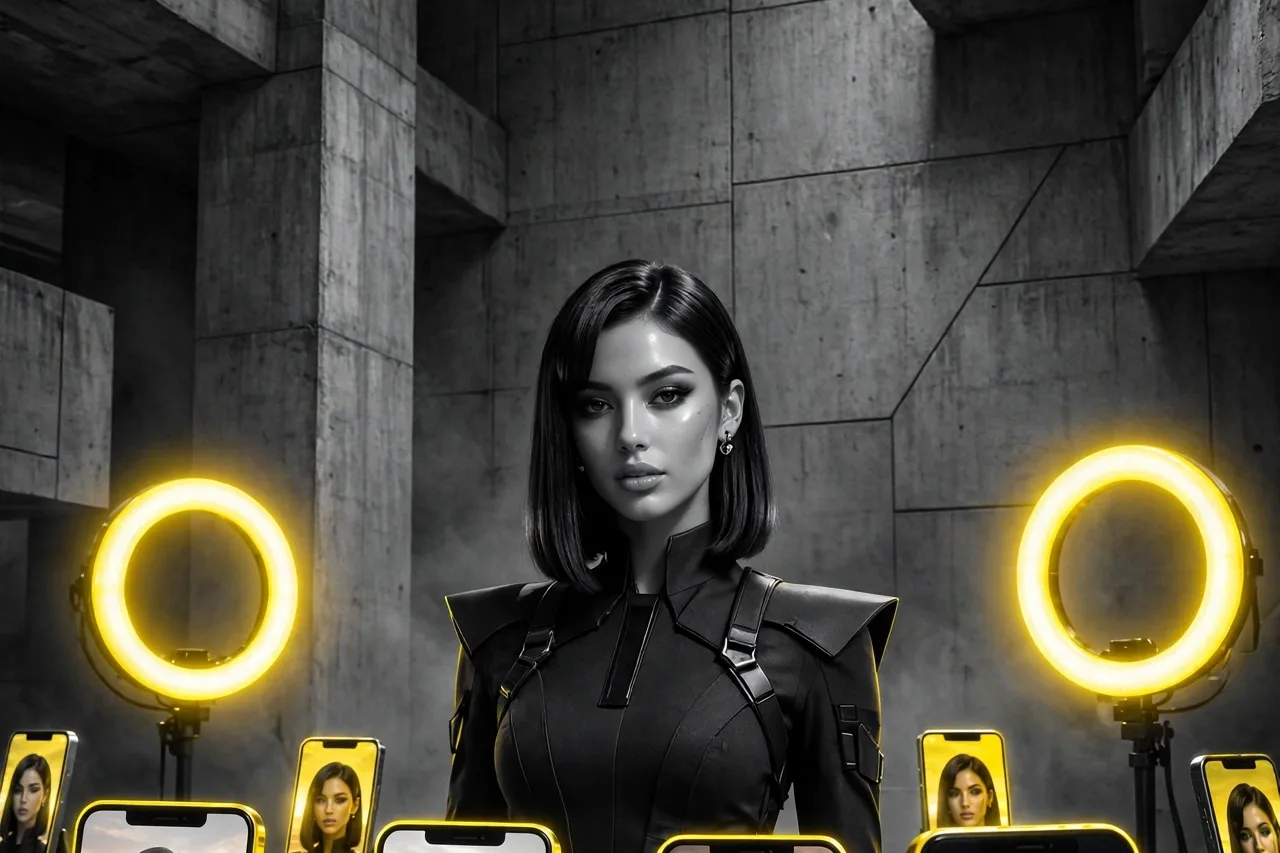
Aitana Lopez does not decide what she does this week. A team does. Euronews reported in 2023 that the staff at The Clueless, the Barcelona agency that made her, meet each week to plan her life. They choose what she will do, where she will go, and which photos will be posted, then they make those photos with AI tools and Photoshop.
Aitana is presented as a woman from Barcelona with pink hair who loves fitness and games. She is not a person. That fact is not hidden, and it has not stopped the work. Her creators told Euronews she earned about 3,000 euros in an average month and up to 10,000 euros in a strong month, at just over 1,000 euros per advert. A famous actor from Latin America sent her a message to ask her out, the agency said, without knowing she did not exist.
The Bigger Story
The pitch is simple once you strip away the glamour. A human influencer can get sick. She can age, argue, miss a flight, raise her price, or say the wrong thing on a live stream. A virtual influencer can do none of those things unless a team writes it into the script.
That control is why The Clueless built Aitana at all. Founder Ruben Cruz told Euronews that projects kept being put on hold or cancelled because of problems with human influencers and models. The agency wanted work that did not depend on egos, moods, or last minute changes. Aitana was the answer it could schedule.
Brands heard the same pitch long before AI image tools made it cheap. Lu do Magalu began in 2003 as a helper on the site of Magazine Luiza, a large retailer in Brazil, at a time when many shoppers were new to buying online. She grew into a video host, then a social media figure, then a cover model for Vogue Brasil in 2022. Reports in 2022 put her audience at more than 30 million followers across platforms. She is not a creator who chose a retailer as a sponsor. She is the retailer, wearing a face.
Lil Miquela sits between those two poles. She first posted on Instagram on April 23, 2016, as a character made by Brud, a company in Los Angeles led by Trevor McFedries and Sara DeCou. In February 2018 she took over the Prada account during Milan Fashion Week. In May 2019 she appeared in a Calvin Klein advert with the model Bella Hadid. Time named her one of the 25 most influential people on the internet in 2018. She has stayed the same age while the platform around her changed again and again.
Context
Put the three cases in order and the story stops being about one new tool. It becomes a story about a job being rebuilt so the worker can be owned.
| Year | What happened |
|---|---|
| 2003 | Lu begins as a helper on the Magazine Luiza site in Brazil |
| 2016 | Lil Miquela posts on Instagram for the first time on April 23 |
| 2018 | Time names Miquela one of the 25 most influential people on the internet |
| 2022 | Lu appears on the cover of Vogue Brasil and passes 30 million followers across platforms in reports that year |
| 2023 | The Clueless launches Aitana in Spain and reports her earnings to Euronews |
The money needs care, because the loudest numbers are the weakest ones. Aitana has the clearest case, and even hers comes from her own agency. About 3,000 euros a month on average is a living, not a fortune. It is far below the sums thrown around for top human stars, and that gap is part of the point. A small brand can afford a face that a global star would never sell it.
For Lu, a 2025 study by Kapwing counted 74 sponsored posts on Instagram in one year and used a formula based on follower counts to estimate more than 2.5 million dollars in value. Inc. reported that count in July 2025. That figure is an estimate from a formula, not a bank record. What is solid is the scale of the work itself. Seventy four paid posts in a year is a pace a retailer can plan around, because its own staff makes every one of them.
There is a second change under the first one. Miquela needed a studio. Lu needed a retailer with a large team. Aitana needed an agency and a set of AI tools that are now widely sold. Each step lowered the cost of making a person who does not exist. That is why the field no longer belongs only to big brands. Small teams can now launch a face, test it, change the hair, change the city, and keep the account when staff leave. The account is an asset in a way a human face never quite is. We saw a close cousin of this logic in Your AI Girlfriend Has a Changelog, where a companion is also a product with updates.
None of this means the virtual face has no staff behind it. It means the staff have moved out of view. Someone writes the captions. Someone chooses the dress, the street, the smile, and the cause the character will support this month. Aitana has a weekly meeting for her life. Miquela had writers and animators. Lu has a content team inside a retailer. The influencer never sleeps, but the people who run her still work office hours. The labour did not vanish. It lost its name and its face.
Different Perspectives
The case from brands and agencies is honest about control, and control is not a dirty word on its own. A campaign can be shot without travel. A post can go out in several languages on the same day. A character will not wake up to a scandal that a team did not choose. For a retailer like Magazine Luiza, Lu also gives a vast and often wary online market a familiar guide. She can explain a phone, front a sale, and speak out on an issue, all in a voice the company has shaped for more than twenty years.
Human creators hear the same facts as a threat, and the research gives them reason. A study by Brooke Erin Duffy and Rosie Nguyen at Cornell, published in New Media and Society in July 2026, drew on 78 interviews with creators, 58 pieces of creator content, and 62 news reports. Creators kept saying the same thing in plain words. I cannot take a break. I am exhausted. I am bound to platforms, sponsors, and audiences. One theme came up again and again. If I take a break, the algorithm will punish me.
Read that beside the virtual influencer pitch and the contest looks rigged. The human creator is told to post without pause or fade from view. The virtual rival was built for that exact demand. She cannot burn out in public. She cannot need a week off after a death in the family. She cannot look tired in a photo unless a team decides tired tests well. The standard that harms the human is the selling point of the replacement.
Critics raise a different charge, and it lands hardest on looks. Aitana was designed to fit the taste that already rules influencer feeds, with a body and face tuned by a team. Cruz has defended that choice by saying the agency followed the beauty norms the market rewards. Critics answer that a designed ideal is worse than a filtered human one, because there is no real person under it at all. No bad light, no ageing, no day when the face does not match the feed. Young followers compare real skin with skin that was never skin.
Audiences are not one camp, and fair reporting should not flatten them. Many followers know exactly what Miquela and Aitana are and follow anyway, in the way people follow a character in a long running show. Fiction has always had fans. The trouble starts when the line blurs, when a message asking Aitana out shows a grown man missed the label, or when a paid post borrows the trust of a diary while working like an advert. A character can be enjoyed as a character. A sales pitch dressed as a life asks for more trust than it has earned.
The influencer never sleeps, but the people who run her still work office hours. The labour did not vanish. It lost its name and its face.
Why It Matters
Disclosure is the first test, and it is a cheap one. A clear label in the bio and on paid posts lets a follower judge the thing for what it is. Aitana and Lu carry their nature in the open. Not every new account does, and the tools now make it easy to launch a face first and explain it later, or never. Platforms and ad rules in the United States and Europe both push toward clear disclosure for paid endorsements and for synthetic media. The rule is not a cure. It is a floor. Without it, every other debate starts from a trick.
The second test is what this does to the price of human presence. For years, presence was the scarce thing. A real person in a real place, tired, funny, late, and alive, was hard to fake at scale. Now the feed can be filled without it. That does not make presence worthless. It may make it worth more, in the same way live music grew in value when records got cheap. But worth will not protect creators by itself. The Cornell study shows a workforce with no paid leave, no steady income, and no shared shield against platform risk. A rival who needs none of those things will win work on cost unless buyers choose to value the human part on purpose.
The third test is ownership. A human influencer owns her face, even when contracts hem her in. A virtual influencer is owned the way a logo is owned. She can be sold, paused, recast, or retired without her consent, because there is no her to consent. That clarity should make buyers pause when a character speaks on real pain, real politics, or real identity. Lu has fronted campaigns against violence toward women, and Miquela has spoken in the voice of causes. Good intent does not settle the question of who gets to borrow a life they invented to sell a message they chose. We weighed a darker form of that borrowing in The Dead Are Posting Now, where the dead also cannot object.
There is also a plain craft point that brands should not miss. The best human creators are good because they can be surprised in public. They react, they learn a new fact on camera, they change their mind and say so. A virtual character can be written to seem surprised, and a skilled team can make that scene land. But the surprise is a product choice, tested in a meeting. Over time, feeds full of planned wonder may teach audiences to spot it, in the way they learned to spot heavy filters. That fatigue is already part of the wider fight over trust we covered in Slop Is a Slur Now.
Closing Reflection
Influencers who never sleep sound like a triumph over a human limit. Look closer and sleep was never the limit that mattered. Trust was. Rest was. A face that could age, refuse, or walk away was.
Aitana will post this week because a team met and planned it. Lu will sell this week because a retailer has kept her alive since 2003. Miquela will still be young when her first followers are deep into middle age. None of that is magic, and none of it is free. It is work, moved behind a face that cannot claim it.
The question worth keeping is not whether virtual influencers will take every job. They will not, because audiences still crave a person who was really there. The question is whether the human creators left in the feed will be allowed to be human at a human pace, or whether they will be judged, priced, and ranked against rivals who were built to need nothing. A feed that only rewards those who never rest will end up with faces who never lived.
Reporting draws on Euronews reporting on Aitana Lopez and The Clueless in November 2023, updated in December 2024, Wikipedia entries on Miquela and Aitana Lopez checked against that reporting, Inc. reporting in July 2025 on Kapwing counts for Lu do Magalu, One Show and Little Black Book accounts of Lu and Magazine Luiza, and Cornell Chronicle reporting in July 2026 on the Duffy and Nguyen creator burnout study in New Media and Society, checked November 2026.
Sources
- Cornell Chronicle, What social media creators cant say about their job, July 2026: https://news.cornell.edu/stories/2026/07/what-social-media-creators-cant-say-about-their-job
- Wikipedia, Miquela, on her first post in 2016, Prada and Calvin Klein work, and Time list place: https://en.wikipedia.org/wiki/Miquela
- Wikipedia, Aitana Lopez, on her creation by The Clueless and the reasons Cruz gave: https://en.wikipedia.org/wiki/Aitana_L%C3%B3pez
- Inc., AI Influencer Lu from Magalu Earns 40x More Than Real Influencers, July 2025, on the Kapwing count of 74 sponsored posts: https://www.inc.com/annabel-burba/why-this-ai-influencer-earns-40-times-more-than-its-human-counterpart/91217795
- Little Black Book, How Lu from Magalu Became the Biggest Virtual Influencer in the World, 2022: https://lbbonline.com/news/how-lu-from-magalu-became-the-biggest-virtual-influencer-in-the-world
- Illustrations: Dirty Static
END OF TRANSMISSION
Stay curious. Question everything.