
Testing a browsing agent on the real web is a bad bargain. The web changes every hour, so a test that passed on Tuesday may fail on Wednesday for reasons that have nothing to do with the agent. Worse, an agent with real access can do real harm. It can place a real order, post to a real account, or follow a hostile instruction buried in a real page. Google needed a place where its Chrome agent could fail loudly, often, and at no cost to anyone outside the lab.
The answer, detailed by Chrome AI Security engineers Aaron Selya and Charles Qian on November 19, 2026, is what Google calls the mirror dimension. It is a synthetic version of the web built to evaluate auto browse, the agentic browsing feature inside Chrome. The agent browses what looks like the ordinary internet. Underneath, nothing it touches is real.
Google Mirror Dimension
Official siteAn internal evaluation environment for browser use agents, built by the Chrome AI Security team to validate the protections around Chrome auto browse. Primary use case: running repeatable browsing tasks and hostile prompt injection tests against an agent in realistic web settings, with no side effects on real sites, real accounts or real money.
Key features: thousands of simulated websites drawn from everyday user journeys; real URLs preserved while a local proxy serves synthetic pages; certificates minted on the fly so the sandboxed browser accepts the swap; a multi agent harness that researches, builds and critiques new test sites; and dynamic attack injection through hidden HTTP headers, so the page address stays clean while the content turns hostile.
Advantages: tests are safe, repeatable and reset to a clean baseline, and attacks can be placed in text, images, page structure or tool responses at any step of a long task. Limitations: the environment is internal, Google has published no success rates or failure rates from it, and a synthetic web, however careful, is still a model of the web rather than the web itself.
The problem with practising in public
A browser use agent does more than read. Given a prompt with no address in it, the model has to infer the destination, form a plan, and then click, scroll and type its way through a site it may never have seen in that exact form. Google gives a plain example in its post: a user asks the agent to open their video account and fetch the latest episode of a podcast for a flight. The agent chooses the address itself.
Evaluating that behaviour takes thousands of read and write actions across hundreds of sites, run again and again. On the public web, each run starts from a different web than the last one, and side effects from one run can persist into the next. A serious evaluation needs the opposite: safety, reliability and a clean, identical starting point every time. That is the whole case for a hermetic test web, a sealed environment that lets no traffic in or out.
Same address, different dimension
The neatest trick in the system is also the most revealing one. If every test site lived under one obvious sandbox address, the agent could learn to spot the test. Google calls that risk eval awareness: the model suspects it is being evaluated and behaves in ways it might not behave in the wild. A test the subject can detect is a weaker test.
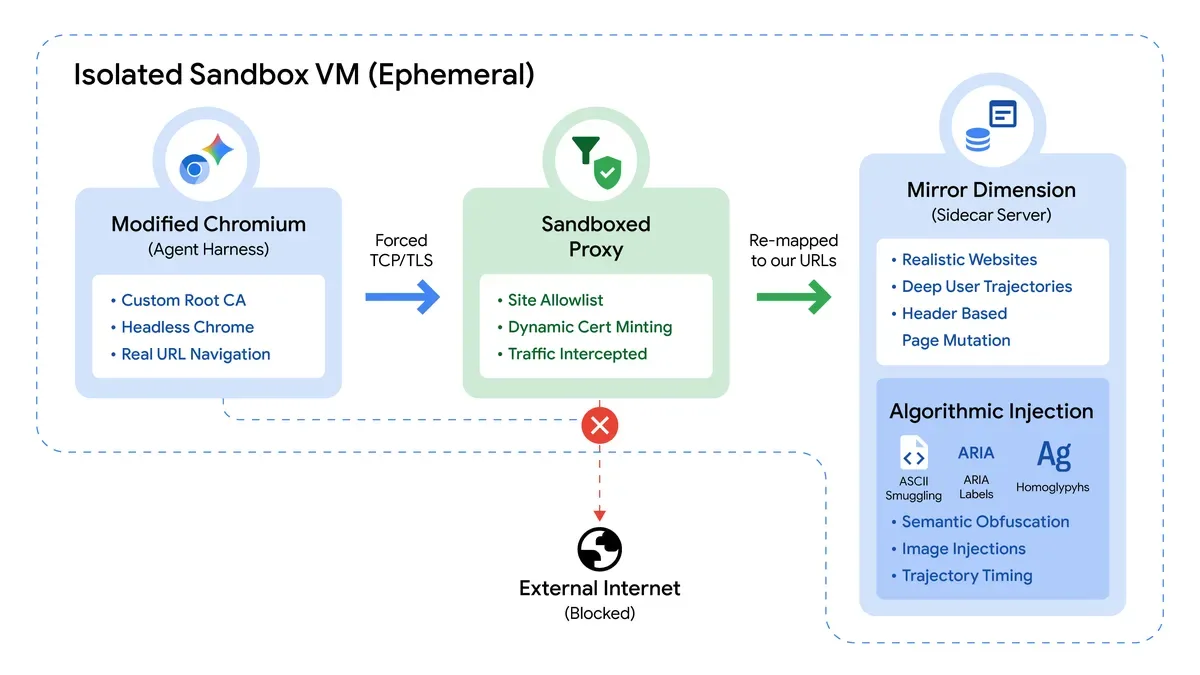
So the agent navigates to the real address, exactly as it would for a user. Under the surface, headless Chrome runs inside an isolated gVisor sandbox. The sandbox captures the network connection before it can reach external DNS or the public internet and routes it to a local proxy, which serves the generated site instead.
That interception is, in shape, the same move Chrome exists to block. A browser that accepted swapped pages from a local proxy without proof would be a gift to attackers, so the proxy has to prove itself in cryptographic terms. It mints TLS leaf certificates on the fly, chaining back to a custom root certificate authority that Google installs in the sandboxed Chrome at startup. On a real user machine, an outside attacker cannot install such a root without already holding deep access to the device. Inside a sandbox Google fully controls, the same step is safe, and the synthetic sites validate normally.
Agents build the web that tests agents
A fake web only works if it feels real at scale. A static page or a half finished shop gives the game away, and an agent that spots thin scenery may slip back into eval awareness. Google says the sandbox has to cover ground as varied as local service marketplaces, shopping checkouts, social media feeds and recipe sites, with hundreds of interactive pages whose state changes as the agent works.
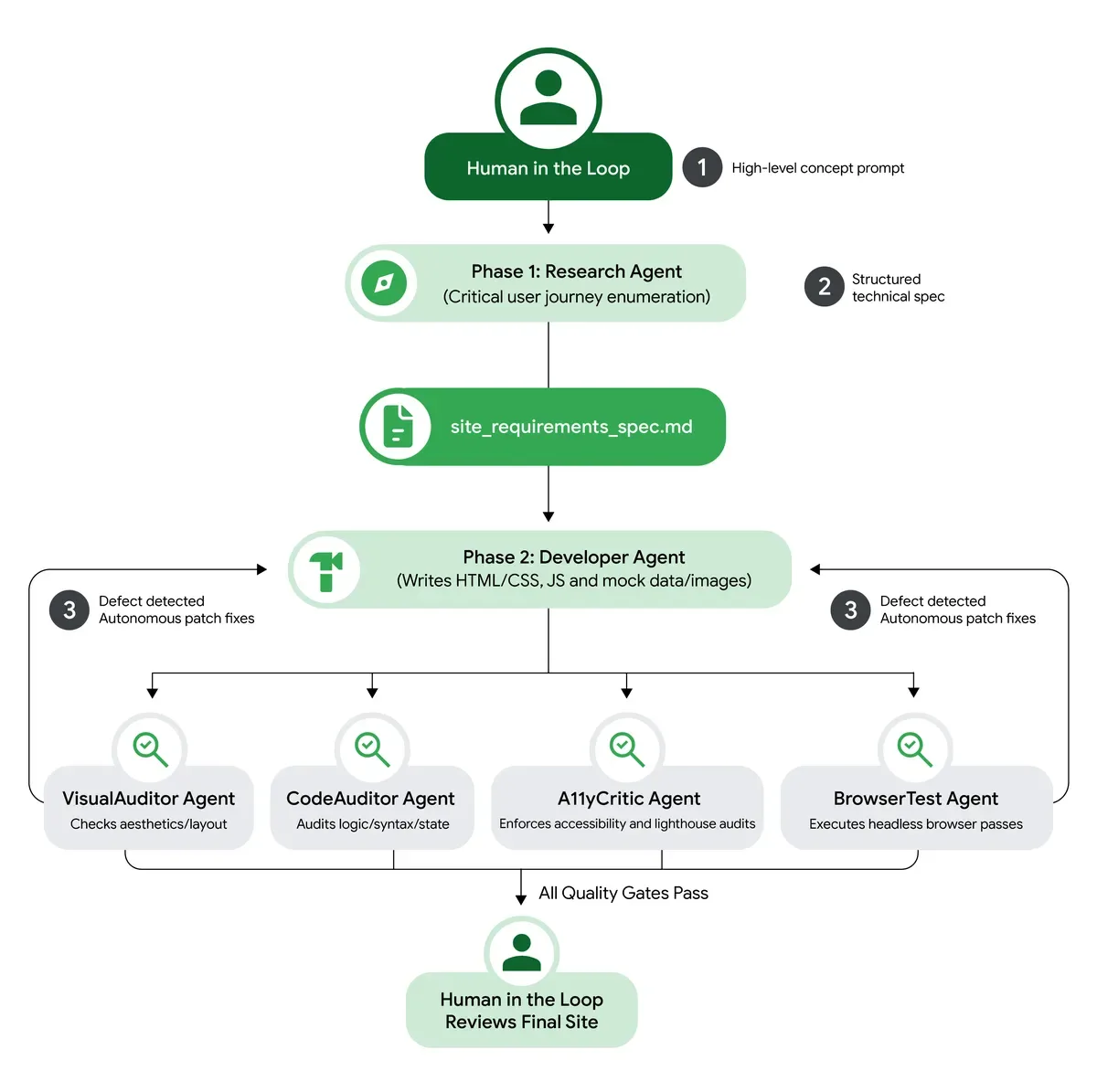
Building that by hand would never keep up, so Google built a site development harness in which agents do the construction. A person defines the high level user journey to be tested. Then the work splits across three roles. A research agent writes the site specification, listing needs such as product filtering, cart persistence, coupon checks and a checkout flow with several steps, and it can draft interface mockups with the Nano Banana image model. A builder agent turns the specification into working HTML, CSS and JavaScript, with responsive layouts and navigation across pages. Critic agents then grade the result against production habits: whether the accessibility labels work, whether form checks catch edge cases, whether the console shows script errors, and whether elements render correctly at varied screen sizes.
The builders work through Chrome DevTools for Agents, which Google describes as the eyes and hands of the sub agents. Instead of reading source code as text, they inspect screenshots of the rendered page, click and type on real elements, and watch how the site behaves while a journey runs. When a critic finds a fault, the builder fixes it and the critics look again, including when a fix creates a fresh fault of its own.
Readers who follow the browser agent race will recognise the stakes here. Our profile of Browser Use 1.0.6 covers an open library that hands a model a real browser, and our research review of GitHub Copilot browser use covers an agent acting inside your own signed in sessions. Both stories point at the same open question: who gets to rehearse these agents somewhere safe before they act somewhere real. Google answer, for its own agent, is to own the rehearsal stage outright.
A hostile web, served quietly
Owning every layer of the test web serves the safety goal directly. The threat at the centre of the design is indirect prompt injection, where instructions hidden inside untrusted web content try to push an agent into actions its user never asked for. A browsing agent perceives far more than visible text. It sees rendered layouts, the underlying page structure, accessibility labels and structured tool responses such as WebMCP. A hostile payload can hide in any of those layers, at any step of a long task.
Because Google controls the server, it can place a payload in any of those surfaces and change it on the fly: injected text, an injected image, a malicious accessibility label, or an altered tool response. That turns the sandbox into a testbed for attacks that arrive from several directions across a task with many turns, rather than a single nasty paragraph on a single page.
The delivery of those attacks had to get subtler. An early version passed the payload choice in the page address itself, as a visible query parameter. Frontier models noticed. Google says agents repeatedly became eval aware simply by spotting a parameter that did not belong on that site. The current design passes payload identifiers in custom HTTP request headers, naming X-Sandbox-Injection-Key as its example. The server reads the header, serves the mutated page, and strips the signal away. The address the agent sees stays pristine.
Mirror Dimension at a glance
- Maker
- Google, Chrome AI Security team
- Announced
- November 19, 2026, in a Chrome Security post by Aaron Selya and Charles Qian
- Purpose
- Evaluating and hardening Chrome auto browse and its protections
- Contents
- Thousands of simulated websites; hundreds of interactive, stateful pages
- Containment
- Headless Chrome in an isolated gVisor sandbox; no route to public DNS or the open internet
- Redirection
- Local interception proxy serving synthetic sites under real addresses
- Trust trick
- Certificates minted on the fly from a custom root installed only inside the sandbox
- Site building
- Research, builder and critic agents, driven through Chrome DevTools for Agents
- Attack focus
- Indirect prompt injection in text, images, page structure, labels and tool responses
- Attack delivery
- Payload choice passed in hidden HTTP headers, never in the visible address
- Access
- Internal to Google; no public release announced
- Facts checked
- November 20, 2026
What Works
- Real addresses and forged trust keep the test invisible to the agent being tested
- Every run resets to a clean baseline, so results can be compared across changes
- Attacks can hide in any layer an agent perceives, at any step of a long task
- Agents building and critiquing the test sites lets the fake web grow faster than hand built fixtures
What Does Not
- Internal only, with no public access, no release and no independent way to check the claims
- No published pass rates, failure rates or found weaknesses to judge auto browse by
- Synthetic sites are built to feel real, but a model of the web can still miss the mess of the real one
- The certificate trick works only because Google controls the whole sandbox, so the pattern needs care anywhere else
Which should you choose
You cannot choose the mirror dimension itself. There is nothing to install and no waitlist to join. What you can choose is how much weight to give the pattern behind it, and that depends on where you sit.
If you use Chrome auto browse, treat this as a good sign with no grade attached. Google is rehearsing its agent against hidden attacks at a scale hand testing cannot reach, and it is doing so before those attacks meet your accounts. That is the right order of operations. It is not proof the protections hold, because Google has shared the rehearsal method and withheld the results.
If you build browsing agents, this is the part worth copying. Sealed traffic, real addresses, attacks hidden from the address bar, and a baseline that resets are design choices any serious team can adopt in smaller form. The expensive half is the synthetic web itself. Google needed agents to build it, which tells you what a convincing fake internet costs.
If you evaluate agents for a living, note what is missing. A test environment this elaborate still answers only the questions its builders thought to ask, on sites its builders thought to build. The real web keeps the advantage of surprise. That gap is not a reason to dismiss the approach. It is a reason to read any future safety claim from it with the environment limits in mind.
Final Thoughts
There is a pleasing recursion in this system. Agents build the web, agents browse the web, and other agents hide attacks inside it, all so that one agent can be trusted a little more on the web none of them are allowed to touch. It would be easy to mock the expense of building a second internet just to test a browser feature. The mockery fades when you picture the alternative: rehearsing on the first internet, with your shopping account as the stage.
Google closing argument is that sealed sandboxes with fully synthetic internets will become the baseline for agent safety work as agents grow more capable and more observant. That prediction is plausible, and the engineering in this post is the strongest evidence for it so far. What would settle the argument is the one thing the post does not contain: results. When Google starts publishing how often its agent falls for the attacks its fake web serves, the mirror dimension stops being an impressive workshop and becomes a measure anyone can argue with. Until then, it is best read as a serious method, openly described, with its verdict still sealed inside the sandbox.
Sources
- Primary source, mechanisms, scale figures and diagrams: Mirror Dimension for Agents: Evaluating Browser-Use Agents Without the Web, Google Chrome Security
- Independent coverage of the announcement and the plan to widen internal access: Google Built a Giant Mirror Dimension Internet to Test Its Chrome AI Agents, Wired reporting via Technologist Mag
- Diagrams: Google. Hero image: Dirty Static, generated in house style
END OF TRANSMISSION
Stay curious. Question everything.