
Databricks announced the second generation of Genie on November 11 in San Francisco, and the pitch is a change of job. Genie began as an assistant that answered questions about company data. Databricks now describes it as an agent that can own a goal, work in the background on its own compute, split work among subagents, track progress, chase missing inputs, and come back to a person only when a decision is needed.
One part of that pitch needs saying plainly at the start. The part that makes Genie always on is not out yet. Databricks says Genie and Genie Ontology are generally available to all customers, while Genie Search, Ontology Manager and the new always on Genie are coming soon to preview and beta programs. No dates were given.
The Announcement
The new Genie runs in what Databricks calls autonomous mode. A user shares a goal and clear boundaries, and Genie manages the task from there. It can run on a schedule or in response to a trigger, and it can hand parts of the work to several subagents at once so pieces move in parallel.
The company gives workaday examples rather than stunts. Genie can keep a quarterly forecast on track, watch customer usage patterns and flag shifts that matter, track revenue trends, or handle personal tasks such as staying on top of email and preparing a person for meetings. When it needs a human, it now has two places to ask. A priority inbox inside Genie collects the items that need attention, and each alert also arrives as its own email, with later updates kept in the same thread and a link back into the app.
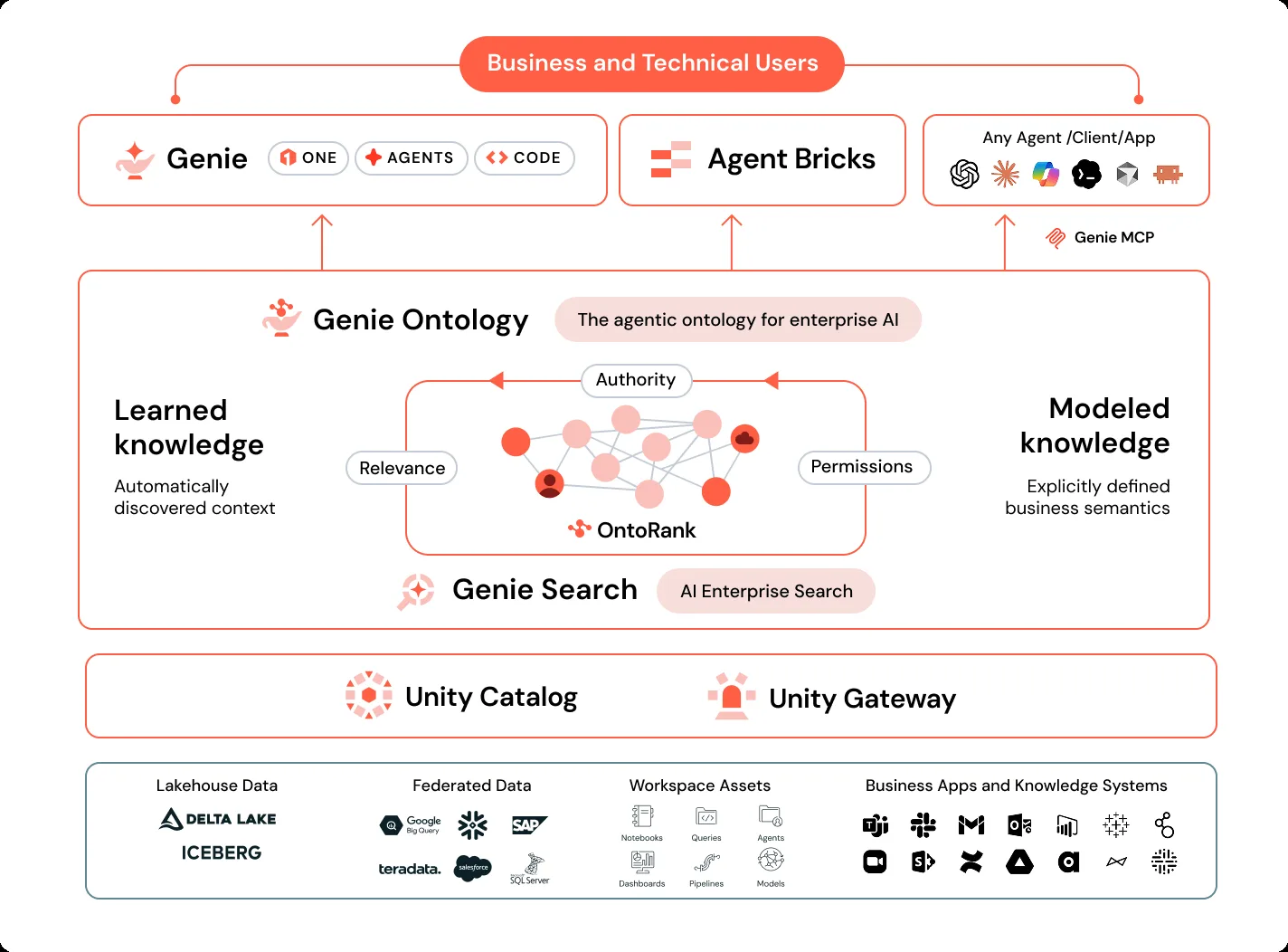
Governance is part of the same announcement, not a footnote. Databricks says Genie runs inside a customer environment that the customer already has, follows the permissions set in Unity Catalog and the approval rules and budgets set in Unity Gateway, and that every action is fully auditable. Users choose which actions need approval. The rest, within those boundaries, runs without them.
Important Details
| Item | Where it stands |
|---|---|
| Announced | November 11, 2026, San Francisco |
| New role | Agent that owns a goal, works in the background on its own compute, delegates to subagents |
| Human contact | Priority inbox for decisions, plus one email thread per alert |
| Context layer | Genie Ontology, holding definitions, metrics, people and processes, kept current as the business changes |
| Search | Genie Search, across the lakehouse and more than 100 sources, including Google Drive, Jira and Confluence |
| Governance | Unity Catalog permissions and Unity Gateway approval rules and budgets; every action auditable, per Databricks |
| Generally available | Genie and Genie Ontology |
| Not yet available | Genie Search, Ontology Manager and the always on Genie, coming soon to preview and beta programs |
| Price | No price stated for the always on mode; Databricks says Genie is part of its platform, paid for by use rather than per seat, with spending limits set by admins |
The Context Layer Is the Real Product
Genie Ontology is the layer Databricks says every Genie action is grounded in. An ontology, in plain terms, is a map of what things mean and how they connect. This one captures company context that runs across teams, from definitions and metrics to the people and processes behind them, and Databricks says it keeps that map current as the business changes.
The blog post on the launch says agents build most of that map on their own, learning from the dashboards, queries and notebooks people already use, with business logic from outside business intelligence tools and a connector for organisation structure added as further sources. Teams set the authoritative definitions in Unity Catalog, and a ranking system Databricks calls OntoRank gives those definitions precedence. Ontology Manager, the new tool for managing and governing that context, can flag concepts that get asked about often and still lack a firm definition.
Databricks supports the context argument with a benchmark it built with Turing. In that test, Genie answered correctly in 91 percent of task runs, which the company says is 1.6 times the rate of the stronger of two frontier agents it tested against, while using less than half as many tokens. The tasks required connecting knowledge spread across tables, dashboards and notebooks. Treat the number as what it is. It is the company own evaluation, run in its own workspace, on tasks chosen to reward exactly the context Genie Ontology supplies. No outside lab has published a matching test, and a fresh deployment with a thin context map is a different test from a mature one.
Analysts who spoke to TechTarget made a similar point from the outside. Mike Leone of Moor Insights and Strategy said the shift matters because Genie stops waiting to be asked. Sanjeev Mohan, founder of the analyst firm SanjMo, argued that agents fail less from weak models than from missing context, and that governing what agents do, not only what they read, is the work still ahead. Both views fit the evidence in the release. The controls Databricks describes govern access, approvals and budgets in detail. They say less about how Genie should flag that it is unsure before an unprompted answer travels.
Search, Artifacts and Other Doors Into Genie
Three more pieces arrived with the agent. Genie Search gives people and agents one governed way to search the lakehouse and the documents, tickets and chats held in business apps. Databricks says it now offers more than 100 connectors, and that content can be brought into the lakehouse, indexed where it lives, or queried live through MCP, the open protocol agents use to reach outside tools. Because search runs through Genie Ontology, Databricks says it interprets what it finds inside business context and inside existing permissions, rather than only locating a file.
Genie Agents, the team level agents inside the family, can now work across PDFs, contracts and slides held in Unity Catalog volumes alongside governed tables, with no separate vector index. New connectors let agents read from and act in tools such as Atlassian products, Google Drive and GitHub, and a sharing feature lets teams offer governed agents to partners without exposing the data underneath. Genie can also produce slides, dashboards and interactive reports grounded in governed data, and Databricks says those artifacts stay current as the data changes.
Access runs in both directions. Teams can reach Genie in a browser, in a mobile app, by email and inside collaboration and AI tools. Through Genie MCP, tools such as ChatGPT, Claude, Microsoft Copilot Cowork and Grok Bot can draw on Genie Ontology and Genie Search and work with the same governed context. The pattern is the same one rivals are building toward, as our report on sandboxed agent sessions from Google and our coverage of managed agents in Mistral Studio both show. Everyone sells autonomy now. The argument is over who holds the context and the keys.
- June 2024Databricks introduces Genie as a conversational assistant for company data
- Earlier in 2026Genie One arrives, followed by Genie Ontology in preview in June
- November 11, 2026Second generation Genie announced at Data + AI Live; Genie and Genie Ontology generally available
- Coming soon, no date givenGenie Search, Ontology Manager and the always on Genie enter preview and beta programs
What’s Next
The confirmed steps are short. Customers can use Genie and Genie Ontology now, on the platform pricing Databricks already charges, with admins setting spending limits through Unity Gateway. Everything that makes the launch distinctive, the background mode, the search layer and the tool for governing the ontology, waits on preview and beta programs that Databricks has not dated.
The open questions are the ones that decide whether this launch matters. Databricks has not said when the preview opens, which customers get in, or what the always on mode costs beyond platform use. It has not published the benchmark tasks in a form others can rerun. And the test that counts, whether an agent with a good map of one company keeps making sound calls over weeks of unsupervised work, can only be run by the customers who join that preview.
So read the launch in two halves. The context layer is real, available and, on the company own numbers, worth a great deal inside a mature deployment. The coworker who never sleeps is, for now, a preview promise with a priority inbox drawn around it. Databricks has built the map and the fence. The agent that works inside them is still on its way.
Facts checked November 12, 2026, against the Databricks press release and blog post of November 11, 2026, and independent coverage published the same day. Figures from the benchmark are Databricks own evaluation results, not independently measured results.
Sources
- Databricks, Databricks Launches New Always-on Genie: Autonomous AI for Complex Enterprise Work, November 11, 2026: https://www.databricks.com/company/newsroom/press-releases/databricks-launches-new-always-genie-autonomous-ai-complex
- Databricks Blog, The new Genie: autonomous AI for complex enterprise work, November 11, 2026: https://www.databricks.com/blog/new-genie-autonomous-ai-complex-enterprise-work
- TechTarget, Databricks turns Genie into always-on agent for complex work, November 11, 2026: https://www.techtarget.com/news/databricks-turns-genie-into-always-on-agent-for-complex-work/874354/
- Hero image: Dirty Static illustration
- Body image: Databricks, Genie Ontology diagram, from the Databricks blog post above
END OF TRANSMISSION
Stay curious. Question everything.