
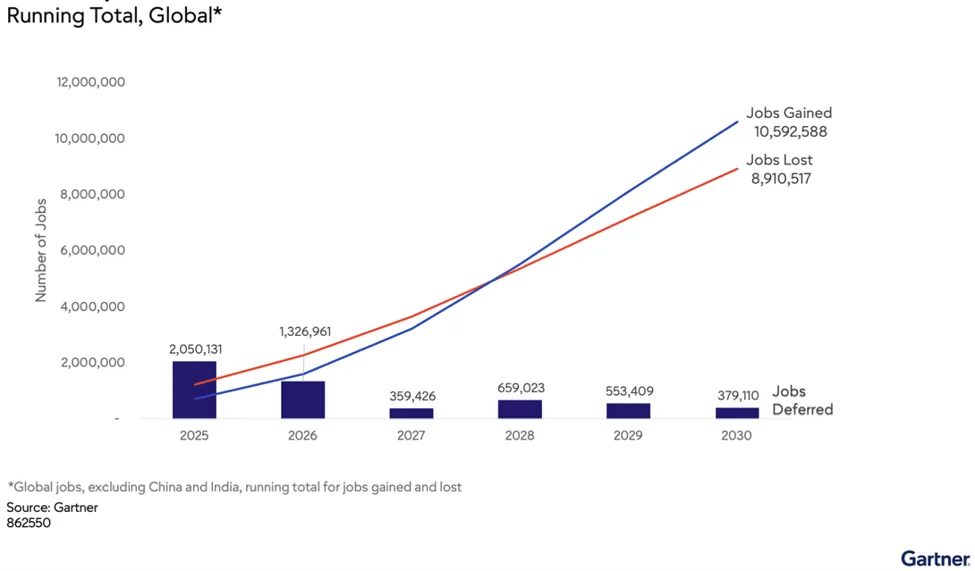
On November 10 in Barcelona, Gartner gave worried workers the calmest headline it could honestly offer. AI will create more jobs than it removes. By 2030 the firm expects 10.6 million new jobs and 8.9 million jobs removed worldwide, a net gain of 1.7 million.
Read the next line of the same forecast and the calm thins out. In 2026, Gartner counts 2.2 million jobs lost to AI and 1.6 million gained. The gain is a forecast about the end of the decade. The loss is the part people are living through now.
The Bigger Story
A net figure can hide more than it reveals, and this one hides a great deal. The gap between 10.6 million created and 8.9 million removed sounds like a verdict on the whole labour market. Set against the global workforce, it is a small margin built from two large flows moving in opposite directions.
Gartner itself points to the larger number in its own release. Just over 20 percent of workers worldwide, some 435.5 million people, will have to adapt to a new shape of work by 2030, changing what they do and where their duties start and stop. That is the story most workers will actually meet. Their job title survives. Their Tuesday does not.
Helen Poitevin, a distinguished VP analyst at Gartner, framed the gain as a choice firms make rather than a gift the technology hands out.
Organizations most advanced in AI execution view AI not as a replacement for labor, but as a catalyst to reinvent operations and rebalance workforce and technology capabilities to compete in changing markets.
That framing matters because it puts the outcome in the hands of employers. On this reading, firms that treat AI as a tool for cutting staff get one future, and firms that treat it as a reason to rebuild the work get another. The forecast is not a law of nature. It is a bet on which habit wins.
Context
Before any job is created or removed, there is a quieter move that workers feel first. The job is simply never posted. Gartner counts 1.3 million positions where hiring was put off in 2026, down from 2.1 million the year before, and expects 5 million people to face that delay in total by 2030.
John Lovelock, a distinguished VP analyst and chief forecaster at Gartner, drew the line plainly in the release. Deferred jobs are not the same as lost jobs, he said. They simply are not created. Computerworld, reporting on the same forecast on November 12, added that junior roles take the hardest hit from those delays, and that many of the delayed roles do get hired after a wait of 12 to 24 months, while some slide into loss for good.
That delay has a shape, and the shape should worry anyone who cares how a trade renews itself. If the first rung of the ladder is the one firms keep pulling up while they wait to see what AI can do, then the senior staff of 2035 have fewer places to learn their craft. We saw a version of this squeeze in Writing Freelance Postings Fall 31 Percent in a Year, where the work that vanished first was the small work that once trained people up.
Gartner has been building toward this forecast all year. In May 2026 the firm said creation would overtake loss beginning in 2028, and its analyst Kaelyn Lowmaster put the human cost in one sharp line. AI will bring more gains than losses in the end, she said, but in the process it will break down millions of careers. A survey behind that work, taken in December 2025 among 110 HR leaders, found that 40 percent of firms had already cut roles they saw as outdated, and nearly half had rebuilt their teams into new shapes.
There is one more figure that cuts against easy comfort. Computerworld notes a separate Gartner forecast from September which expects about 30 percent of roles cut in AI linked layoffs to be filled again by 2029. A firm that cuts too fast may end up buying the same skill back, often at a higher price, after the damage to trust is done.

Different Perspectives
The global net gain splits fast once you ask where a person works. Gartner sorts the outlook into three groups, and only two of them come out ahead.
Technology comes out best by a wide margin. The sector has the highest exposure of the three, with nearly 70 percent of its workforce in the path of AI, yet Gartner expects 1.9 million jobs created against 0.4 million lost. Industries built on physical assets and heavy plant land near flat, with 6.4 million created and 6 million lost. The public sector is the clear loser, with 0.4 million gains against 0.9 million losses, a pattern we have tracked before in Netherlands 25,000 Government Jobs at Risk.
For a worker in the public sector, the headline on this article is simply false. There is no net gain in their world, and Gartner gives a blunt reason through Lovelock in the Computerworld report. Without the pull of revenue growth, governments are expected to chase savings and staff cuts. The same tool, pointed at a different balance sheet, gives a different answer.
The skeptical view starts with the nature of the document itself. This is a forecast from a firm that sells advice to the executives making these calls, built on how well AI projects are expected to land in the years ahead. Lovelock told Computerworld the balance will flip once AI moves through what Gartner calls the Trough of Disillusionment, a stage in its own Hype Cycle model where early excitement fades and real results arrive. That may prove right. It is still a prediction about a mood, dressed in the clothing of a count.
Workers in trades already hit have heard net comfort before, and it does not pay rent. In Voice Actors Are Losing Jobs Already the losses were not a forecast. They were bookings that stopped coming. A net gain spread across a planet and a decade can be true in total and still leave a given street, studio, or office with less work than it had.
The fairest reading keeps both truths in view. Gartner is not a lone voice crying calm. Its analysts have spent two years warning about broken career paths, delayed hiring, and skills that fade in as little as two to five years. When a firm that sells that warning also says the total will end up positive, the claim deserves a hearing. It does not deserve to be read as a promise made to any one worker.
Why It Matters
The fight over this forecast will shape how firms behave, and behaviour is where the numbers come from. A boss who reads only the headline may relax and assume the market will sort things out. A boss who reads the deferred hiring figures may keep a freeze in place and call it prudence. Both reactions change real lives long before 2030 arrives to grade the forecast.
What the forecast asks for, between its own lines, is work that most firms find dull. Rebuild roles instead of just cutting them. Keep a path in for junior staff even when a tool can fake their output. Train people for the reshaped job while they still hold the old one. None of that trends. All of it decides whether the net gain shows up as shared ground or as a statistic quoted over a smaller staff.
There is also a trust question hiding in the rehiring figure. If close to a third of cut roles return within a few years, then many cuts were never really about what AI could do. They were about what a firm could claim while the market rewarded the claim. Workers learn that lesson fast, and they carry it into every later promise about change being painless this time.
Closing Reflection
By 2030 the count may well land where Gartner says it will, with creation ahead by 1.7 million. Most people reading that future headline will not feel a net gain or a net loss. They will feel a job that kept its name and lost its shape, a first rung that moved, a skill that aged faster than they did.
The honest question is not whether the total tips positive. It is who gets helped across the gap between the job that ends and the job that begins, and who is left to cross it alone while the headline calls it progress.
Reporting draws on the Gartner press release of November 10, 2026, the Gartner HR release of May 2026, and Computerworld reporting of November 12, 2026, checked November 12, 2026.
Sources
- Gartner, Gartner Forecasts AI Will Drive a Net Increase of 1.7 Million Jobs by 2030, November 10, 2026: https://www.gartner.com/en/newsroom/press-releases/2026-11-10-gartner-forecasts-artificial-intelligence-will-drive-a-net-increase-of-1-7-million-jobs-by-2030
- Gartner, Gartner HR Research Reveals AI Will Create More Jobs Than It Eliminates Beginning in 2028, May 2026: https://www.gartner.com/en/newsroom/press-releases/2026-05-13-gartner-hr-research-reveals-ai-will-create-more-jobs-than-it-eliminates-beginning-in-2028
- Computerworld, AI related job creation to outpace losses by 2030, says Gartner, November 12, 2026: https://www.computerworld.com/article/4247895/ai-related-job-creation-to-outpace-losses-by-2030-says-gartner.html
- Chart image: Gartner
- Illustrations: Dirty Static
END OF TRANSMISSION
Stay curious. Question everything.