
A lot of AI work is not writing. It is judging. Does this ticket ask for a refund. Which team should own it. Does this photo show damage. Teams often ask a chat model to answer in prose, then write more code to pull a usable value back out of that prose. Gemini Decision 1 skips the prose on purpose.
Google DeepMind introduced the model on November 11, 2026, as the engine for a new endpoint called the Gemini Decisions API. It is available through the Gemini API in Google AI Studio. You send one shared input and a set of questions. The model scores the options you gave it and returns numbers your code can act on at once.
Gemini Decision 1
Official siteA scoring model for bounded choices, with the model ID gemini-decision-1. Primary use case: judgments with a fixed set of answers, such as tool selection, policy checks, model routing, and context grading, where code needs a value rather than a written reply.
Key features: one shared multimodal input billed once per request; up to 1,000 independent questions in a single pass; three question types that can mix in one call; a confidence score on every answer so weak cases can go to a fallback model or a person.
What it does
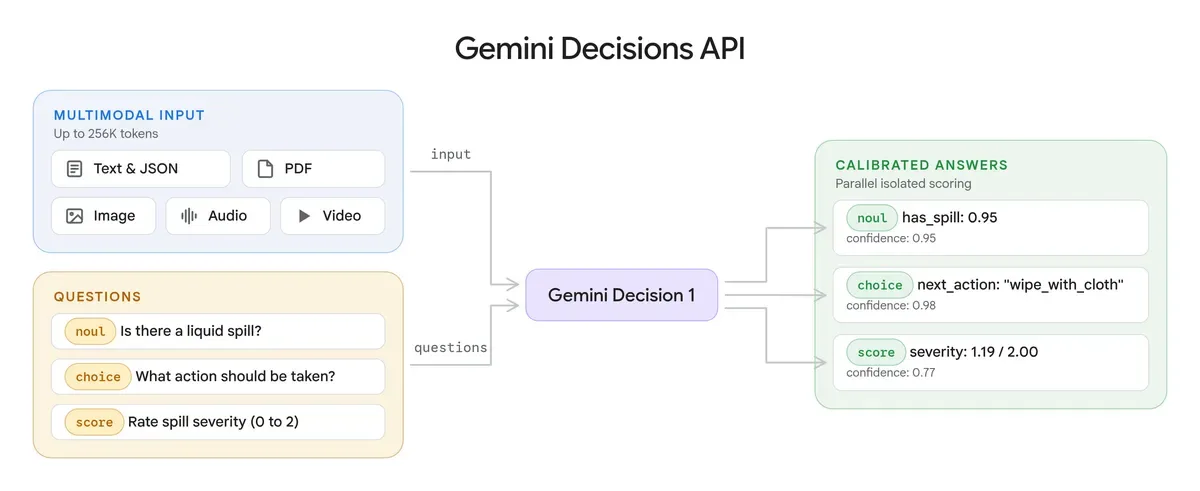
The input can mix text with images, audio, video, and PDF files, up to 256K tokens in one request. Google says the model scores candidate options in a single forward pass rather than generating answer text one token at a time. That design is the whole point. Output tokens are always zero, so output is never billed.
Each question is judged on its own against the shared input. Adding a question does not change the answers to the others. Our Workshop guide shows the pattern in code: use the Gemini Decisions API for batch checks builds four judgments on one support ticket in a single call.
The three question types
| Type | What you ask | What comes back |
|---|---|---|
| noul | A yes or no check on a condition | The probability that the condition holds, from 0.01 to 0.99, plus confidence |
| choice | A pick from a fixed set of 2 to 255 options | The winning option and a normalized probability for every option, plus confidence |
| score | A grade against an ordered rubric that starts at 0 | A weighted score and a probability for each level, plus confidence |
Confidence is the part code will lean on most. A high score with low confidence is not a green light. It is a signal to send the case to a larger model that can reason, or to a person who can read the context the rubric missed.
 One input in, three kinds of judgment out. The confidence dial decides what happens next. Illustration: Dirty Static
Speed, price, and the claims around them
Google quotes median model compute of 50 to 100 milliseconds and 150 to 250 milliseconds end to end, on inputs up to 16K tokens, with time staying nearly flat from 1 to 100 questions per request. Google also says the model leads its benchmark suite across agent routing, reasoning, ranking, and multimodal work, with the lowest calibration error in that suite, and that it costs nearly five times less than Gemini 3.5 Flash-Lite with the Interactions API across the same suite. Those are Google claims from the launch post, not results from our own tests. Treat them as a reason to test the API on your own data, not as a verdict on it.
The price itself is simple enough to check by hand. The shared input is billed once per request at $0.10 per million input tokens, no matter how many questions ride on it. Each question adds only its own instruction and criteria tokens. There is no charge for output, and Google lists no separate charge for audio transcription or optical character work inside the input.
Decision 1 at a glance
- Model
- Gemini Decision 1, model ID gemini-decision-1
- Launched
- November 11, 2026, by Google DeepMind
- Access
- Gemini API in Google AI Studio, version v1beta; Google Cloud support coming soon
- Input
- One shared input, up to 256K tokens, in text, image, audio, video, or PDF form
- Questions
- Up to 1,000 per request, of types noul, choice, and score
- Price
- $0.10 per million input tokens, $0 for output; a no cost tier for prototyping
- Latency claim
- 150 to 250 milliseconds end to end, per Google
- Facts checked
- November 12, 2026
How Google says teams use it
Google lists four uses inside its own products. Gemini Notebook uses the API as a router that sends each query to a model tier and thinking level, and Google claims up to 40 percent lower latency for everyday queries while harder tasks go to deeper reasoning models. Stitch uses it in a rapid canvas experiment to build playable wireframes and apply edits made by voice or tap. A Google Labs app called CC uses it to pick an emoji reaction from a palette of more than 200 options. Search uses it as a safety layer for MCP tools, to detect adversarial behavior inside a tight latency budget.
Outside Google, the launch post says integrations are rolling out across OpenRouter, LangChain, Vercel, LiteLLM, Pydantic AI, Pipecat, LiveKit, and OpenCode, alongside the Google SDKs. That list matters less as a logo wall than as a sign of fit. Routing and grading sit inside agent stacks, so a scoring endpoint has to plug into the stack teams already run.
Who it is for
Best for teams whose apps make many small calls with fixed answers. Support routing, content grading, policy checks, tool selection, and model routing all fit the shape. So do photo and document checks where the answer is a score, not a story. If your queue makes hundreds of those calls, paying once for a shared input and getting numbers back in about a quarter of a second, on Google figures, is a cleaner design than parsing prose all day.
Skip it when the work needs words. Decision 1 cannot draft a reply, explain a borderline call to a customer, extract a field it was not asked to grade, or reason through a problem in steps. It also cannot rescue a bad rubric. Vague criteria will produce confident looking numbers for the wrong question, and only a labeled test set from your own traffic will show that before your users do.
What Works
- Numbers code can act on at once, with no prose to parse and no output tokens to bill
- One shared input billed once, even with up to 1,000 questions in the same request
- A confidence score on every answer, so weak cases can go to a fallback or a person
- Native multimodal input, so a photo, a recording, and a PDF can face the same questions
What Does Not
- No reasons and no explanation, so borderline calls still need a model or a person who can give one
- A choice question must pick from the options it was given, even when none fits well
- Speed, benchmark, and cost edge figures are Google claims, not independent tests
- Google Cloud support is not here yet, so teams in that stack wait
Final Thoughts
Decision 1 is a useful correction to a lazy habit. Not every AI call should be a chat. When the answer is a choice, a grade, or a yes or no call, a paragraph is waste, and the code that parses it is waste on top of waste. A fast score with an honest confidence value is the better tool for that job.
The test that matters is not the launch chart. Run it on a set of your own cases where a person has already made the call, check how often each confidence band proves right, and keep the cases it gets wrong where you can study them. If the numbers hold on your data, this is cheap and sensible plumbing for agent work. If they do not, the confidence score at least tells you where not to trust it, and that alone puts it ahead of a model that writes a fluent answer either way.
This profile is a desk assessment built from Google launch post and the published Decisions API documentation. No hands on test is claimed. Prices, limits, and access above are the published ones as of November 12, 2026.
Sources
- Launch facts, question types, pricing, latency, benchmark claims, and internal uses: Gemini Decisions API: Fast multimodal decisions, Google Blog, November 11, 2026
- API documentation and guide, checked November 12, 2026: Gemini Decisions API documentation, Google AI Studio
- Body image: Google, from the launch post. Gate illustration and hero: Dirty Static
END OF TRANSMISSION
Stay curious. Question everything.