
Most teams do not need their smartest model to close every ticket. They need a model that can write the patch, run the tests, read the long document and keep moving when a tool call fails. That execution work is where bills grow, because agent tasks run for many turns and each turn sends the whole context again.
Gemini 4 Hydrogen is Google answer to that job. Google released it on November 12, 2026 as the fast member of the Gemini 4 family, below Carbon and Argon, and as the model it recommends for teams moving up from Gemini 3.8 Flash. This profile sets out what Hydrogen does, what it costs, and how to pick a thinking level without paying for thought a task never needed.
Gemini 4 Hydrogen
Official siteA fast AI model built for execution rather than deep planning. Primary use case: everyday coding, document work and agent tasks that run for many steps and need speed and cost control more than maximum reasoning.
Key features: four thinking levels, with high as the default and a new top level called xhigh; input in text, images, PDFs, spreadsheets, audio and video, with text as output; a shared window of 1,048,576 tokens for input, thinking and output; and a pairing mode in Google Antigravity where an Orchestrator can hand planning to Carbon and execution to Hydrogen in one session.
What Hydrogen does
Google describes Hydrogen as a model for rapid execution across coding and agent workflows. In its launch post the company points at work such as fixing issues in a code base, answering questions about that code, running tests, doing deep research and turning dense files into reports and structured deliverables. The model card says Hydrogen was adapted from Gemini 4 Carbon, and its knowledge cutoff is March 2026.
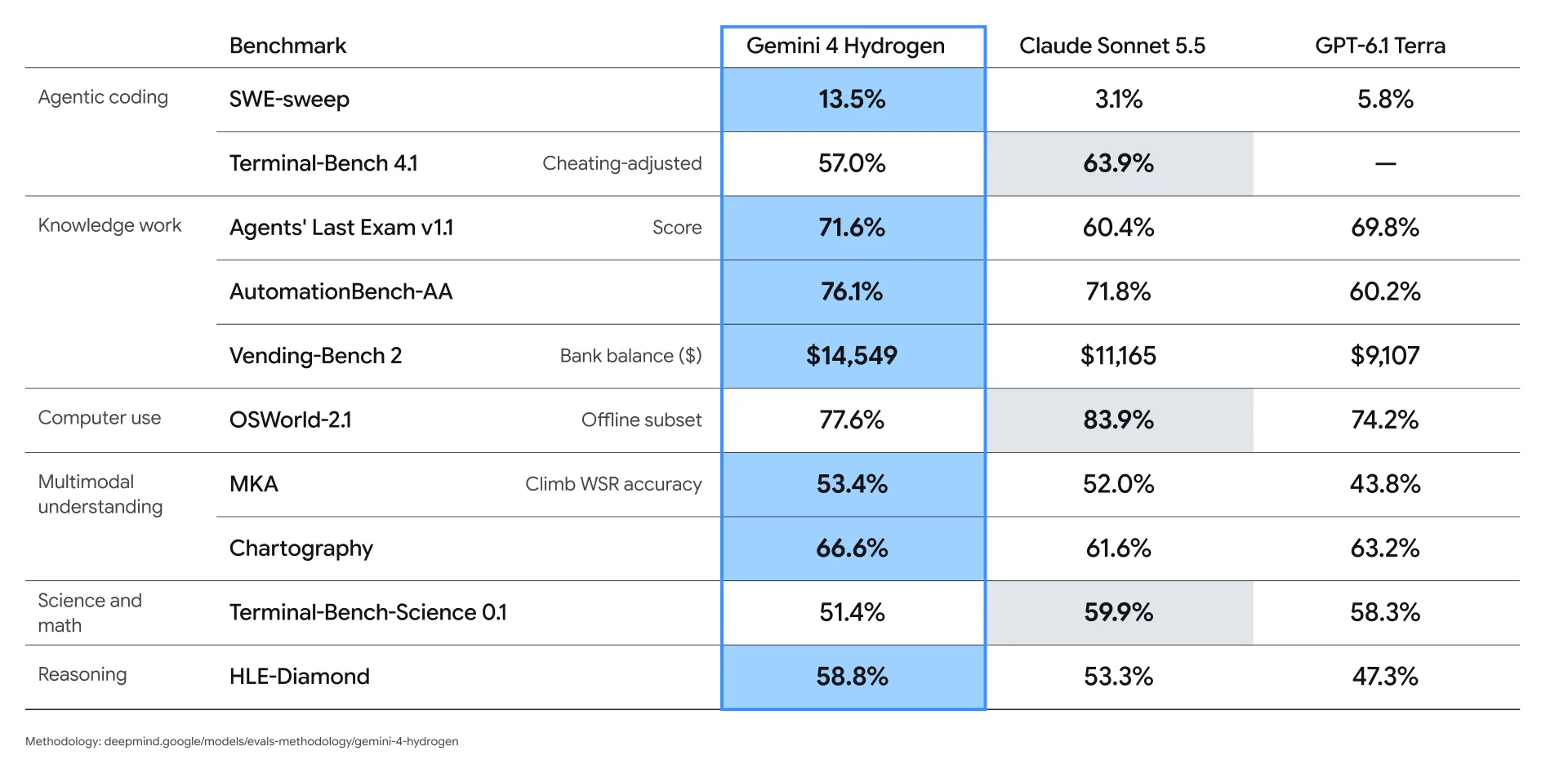
Two Google claims frame the upgrade from Flash. Google says Hydrogen finishes tasks 2.5 times faster than Gemini 3.8 Flash at the high setting, and makes fabricated claims more than five times less often. Those are company figures from company tests. Independent scoring from Artificial Analysis, covered below, supports the direction of the claim while giving a smaller speed gap on its own tasks, so read the exact multiple with care.
The score that makes the pitch
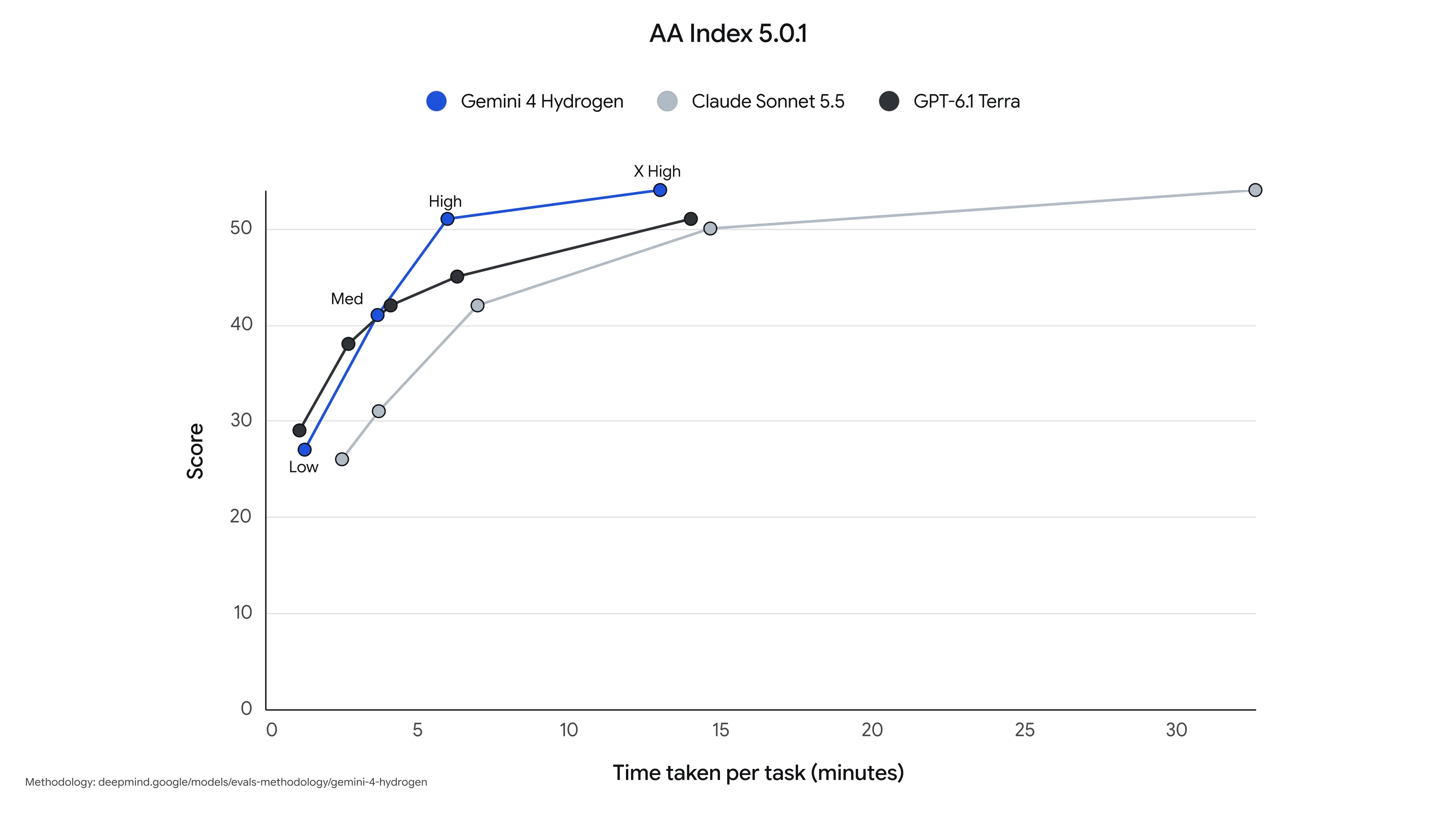
On the Artificial Analysis Intelligence Index, a composite of knowledge, reasoning, coding and professional tasks, Hydrogen scores 51 at high and 54 at xhigh. Argon scores 50 at high and Carbon scores 60 at high, on the same index. A fast model edging past one frontier sibling while costing less per token is the whole sales argument in one line, and it holds up in the independent table as well as in Google own chart.
Other results fill out the shape. Google reports 57 percent on Terminal Bench 4.1, against 18.2 percent for Flash, and 71.6 percent on Agents Last Exam v1.1. It reports first place on the Vals Tax Agent Bench at 52.3 percent and a tie for first on the Vals Legal Research Bench. Terminal work is also where a rival still leads: published comparisons put Claude Sonnet 5.5 ahead of Hydrogen on Terminal Bench and on computer use tests, by roughly six to nine points.
Four thinking levels, one real decision
A thinking level is a control for how much reasoning the model does before it answers. Thinking tokens bill at the output rate, so the level you pick sets both the quality ceiling and a large part of the bill. Hydrogen has four levels, and Artificial Analysis measured each one as a separate entry on its index. The spread is wide enough that the level matters more than most prompt tweaks.
Cost per task by thinking level, Artificial Analysis Intelligence Index
Cost per task and index score from Artificial Analysis, accessed November 13, 2026. Costs reflect tokens used in that test set, not a price quote for your workload.
| Level | Best fit, in Google guidance | Index score | Cost per task |
|---|---|---|---|
| low | Routing, sorting, short summaries and extraction | 27 | $0.29 |
| medium | General coding and document questions | 41 | $0.80 |
| high | Agent runs, hard debugging and complex analysis. The default | 51 | $1.87 |
| xhigh | The hardest reasoning and long software work | 54 | $3.16 |
The step from high to xhigh is the trap in the table. It buys three index points for 69 percent more cost per task and a large jump in time and output tokens. Our tutorial on setting thinking levels in Hydrogen walks through setting the level per job in code. The short rule from the data is plain: earn xhigh with a failed run at high, never start there.
Pricing and platforms
Facts checked November 13, 2026 against Google launch post and published pricing coverage. Prices are US list prices per million tokens, with thinking tokens billed as output.
Specifications
- Model ID
- gemini-4-hydrogen
- Released
- November 12, 2026, generally available
- Context window
- 1,048,576 tokens, shared by input, thinking and output
- Output per segment
- Up to 65,536 tokens, with longer output through continuation and background mode
- Input types
- Text, images, PDFs, spreadsheets, audio and video
- Thinking levels
- low, medium, high (default) and xhigh
- Knowledge cutoff
- March 2026
| Tier | Input per 1M | Output per 1M |
|---|---|---|
| Standard | $1.50 | $7.50 |
| Batch | $0.75 | $3.75 |
| Flex | $0.75 | $3.75 |
| Priority | $2.70 | $13.50 |
Cached input on Standard costs $0.075 per million tokens for the reused part, per published pricing coverage. A free API tier exists with rate limits, and Google terms state that free tier input and output may be used to improve Google products, so paid tiers are the right home for private work data. Hydrogen costs double the current Flash rate per token, though Flash standard rates rise to match Hydrogen on January 1, 2027, and Artificial Analysis found Hydrogen cheaper per completed task because it used far fewer tokens.
| Model | Input / output per 1M now | Index at high | Note |
|---|---|---|---|
| Gemini 4 Hydrogen | $1.50 / $7.50 | 51, and 54 at xhigh | Fast execution model, free tier available |
| Gemini 4 Argon | $2.00 / $10.00 | 50 | Frontier model, price rises to $4.00 / $20.00 on December 1 |
| Gemini 4 Carbon | $2.00 / $10.00 | 60 | Strongest in the family, price rises on December 1 as well |
| Gemini 3.8 Flash | $0.75 / $3.75 | 31 | Predecessor, standard rates rise on January 1, 2027 |
What Works
- Scores 51 at high and 54 at xhigh on the Artificial Analysis index, past Argon at 50 and at a lower token price
- Flat pricing across the full one million token window, with Batch and Flex at half price
- Four thinking levels let one model cover routing work and hard agent work, if you set them with care
- Free tier plus rollout across AI Studio, the Gemini app and Search makes it easy to test
What Does Not
- Default high level can overspend on simple jobs, and xhigh adds 69 percent to cost per task for three index points
- Google model card notes hallucinations, occasional timeouts and more unjustified refusals on some multimodal prompts
- Terminal and computer use tests still favour Claude Sonnet 5.5 in published comparisons
- Free tier terms allow Google to use input and output to improve its products
Which should you choose
Choose Hydrogen for agent and coding work at volume. If your workload is patches, tests, document synthesis and tool use across many turns, Hydrogen at high gives most of the family score at the lowest family price, and the Orchestrator pairing in Antigravity lets Carbon plan while Hydrogen executes. Google reports that pairing reached near Carbon success rates on Terminal Bench 4.0 while using 24 percent less quota and finishing 19 percent faster.
Choose Carbon for the hardest single problems. Nine index points is a real gap on work where one wrong turn costs hours. Carbon is the ceiling in this family, priced like it, and worth it only where Hydrogen at high or xhigh has shown a shortfall on your own tests. Route by task rather than by habit, and let your own test set, not the family chart, draw that line.
Stay on Flash only for the shortest window. Flash is half the token price until the end of December, but it scores 31 against 51 on the same index and used far more tokens per task in independent tests. Once its rates rise in January, the cost argument for staying is gone.
Final thoughts
Hydrogen is the most honest kind of model launch: not the smartest model in the room, and clear about it. Its value is a ratio, strong scores divided by speed and cost per finished task, and on the published numbers that ratio beats both its predecessor and one of its bigger siblings. The one decision it refuses to make for you is how hard it should think. Teams that set that level with intent will get the workhorse Google is selling. Teams that accept the default will get a faster model and a larger bill, and will blame the wrong thing.
Sources
- Launch, availability, family role and Orchestrator results: Introducing Gemini 4 Hydrogen, Google, November 12, 2026
- Pricing tiers, benchmarks and migration changes: Gemini 4 Hydrogen: Pricing, Benchmarks and API Changes, Neurohive, November 12, 2026
- Thinking level scores, cost and time per task: Gemini 4 Hydrogen Benchmarks, AgentsPulse, November 13, 2026
- Family pricing and thinking defaults: Gemini 4 Hydrogen vs Carbon vs Argon, ImportStatic, November 13, 2026
- Day one API support and cache pricing: Gemini 4 Hydrogen API Pricing and Day 0 Support on LiteLLM, LiteLLM, November 12, 2026
- Benchmark and thinking charts: Google
END OF TRANSMISSION
Stay curious. Question everything.