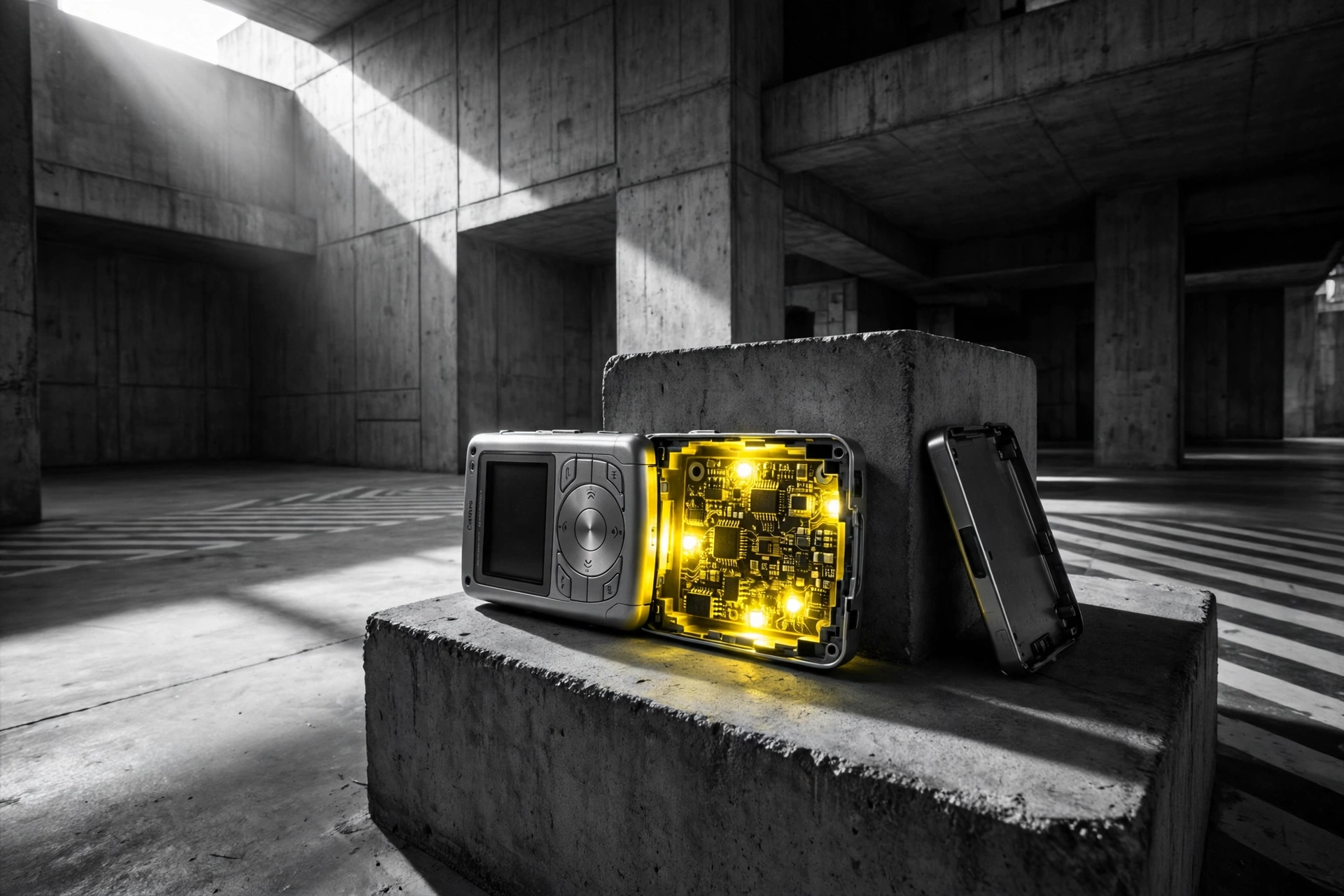
Open an early iPod today and the faults are physical. Hard drives wear out, batteries swell, and the 3rd generation model still charges over FireWire, a connector the rest of the world dropped long ago. The standard rescue is a flash storage swap and a fresh battery, and it works well. What it can never do is give the player Bluetooth, Wi-Fi, or a single streaming app.
Certain Things, a London based open source group, is working on a more drastic answer. Sprout throws out the iPod brain entirely and replaces it with a new mainboard, one that keeps the case, the screen, and the click wheel but adds the connections a 2004 music player was never meant to have.
Sprout and Sprout Pi
Official siteA modern motherboard for old iPods, designed to reuse the original screen, click wheel, and case. Primary use case: bringing an early click wheel iPod up to modern habits, meaning wireless headphones, podcasts over Wi-Fi, and, on the Pi version, streaming and apps, without soldering and without giving up the player itself.
Key features: Bluetooth audio that works with AirPods and other wireless headphones, Wi-Fi, a Cirrus Logic CS43131 DAC heard through the original 3.5 mm headphone jack, digital audio out over USB-C, a microSD slot that takes cards up to 2 TB, and an interface rebuilt to look and behave like the original, Cover Flow included. Sprout Pi adds music streaming, AirPlay streaming, and custom apps on a Linux system.
The swap
Most iPod mods work around the original board. They swap the hard drive for flash storage, fit a larger battery, and leave Apple logic running the show, which means wired headphones and iTunes stay part of the deal. Sprout replaces the logic itself. You open the case, lift the original mainboard out, and drop Sprout in its place. The screen, the click wheel, and the ribbon cables all stay, and the finished player looks and feels like the one you started with.
The tools are modest: a screwdriver and a plastic opening tool, per the Crowd Supply page. No soldering is involved, and the group stresses that the swap is fully reversible. Keep the old board in a drawer and you can put the iPod back to stock whenever you like.
One consequence shapes the whole design. The storage on those early players lives on the board that comes out, so your music moves to a microSD card. That sounds like a downgrade until you read the ceiling: cards up to 2 TB, which the project translates as room for about 500,000 songs. A player that shipped with 10 or 20 GB ends up carrying a library no iPod was ever sold with.
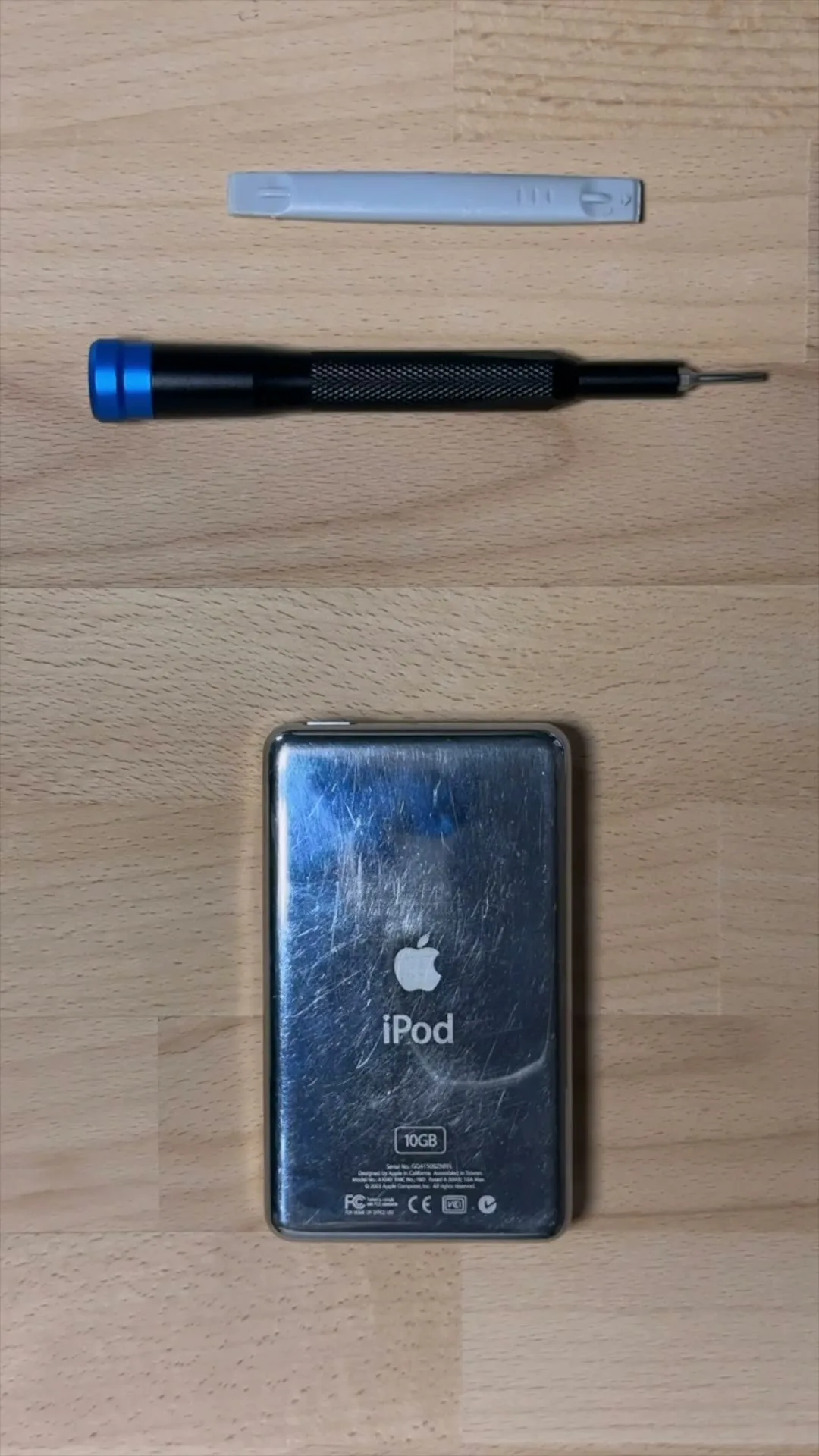 The whole toolkit: a screwdriver, a plastic opening tool, and one tired iPod. Still from the installation film. Image: Certain Things
Two boards, two brains
Sprout comes in two versions, and the split between them is the heart of the design. Sprout Pico is built around the Raspberry Pi RP2350, a microcontroller. It turns on at once and handles your own library and podcast downloads, with the Bluetooth, Wi-Fi, and DAC hardware shared across both versions. Pico is also the only version that fits the iPod mini.
Sprout Pi keeps the RP2350 and adds a Raspberry Pi Compute Module Zero beside it. Under the familiar menus, the Pi version is a Linux computer, and that second brain is what unlocks streaming from Spotify and Apple Music, podcast streaming, AirPlay streaming, and custom apps. Launch coverage describes the division of labour plainly: plain playback stays on the small chip to protect battery life, while heavier work, apps and games included, runs on the Linux side.
That split is a sensible answer to the obvious objection. A full Linux system sipping power all day would murder a battery sized for 2004. Letting the microcontroller run the music and waking the bigger chip only when an app needs it is how the project can still talk about long playback times, which brings us to the targets below.
| Sprout Pico | Sprout Pi | |
|---|---|---|
| Brains | Raspberry Pi RP2350 | RP2350 plus Raspberry Pi Compute Module Zero |
| Fits | iPod 3rd generation, 4th generation, mini | iPod 3rd generation, 4th generation |
| Streaming | No | Spotify and Apple Music |
| Podcasts | Downloads over Wi-Fi | Downloads and streaming |
| Apps | No | Custom apps on Linux |
| Battery target | 40 hours on 3rd and 4th generation, 20 hours on mini | 40 hours |
Battery figures are the project targets for continuous playback over Bluetooth, from prototype testing: 40 hours assumes a 2,500 mAh cell in the larger players, and the mini target of 20 hours assumes a 1,200 mAh cell. Treat them as goals with evidence behind them, not as measurements you can hold the group to.
What it adds
The connection list is where twenty years of progress shows up. Bluetooth audio pairs with AirPods and other wireless headphones and speakers. The CS43131 DAC feeds the original headphone jack for wired listeners, and digital audio also leaves over USB-C, which handles charging and drag and drop file transfer as well. Files land in MP3, AAC, ALAC, FLAC, and Opus, and inline remote controls work over USB-C. Podcasts download over Wi-Fi on both versions. There are even two GPIO pins exposed through the original remote connector, a gift to anyone who wants to build on the board.
The software keeps the faith. The interface is written from scratch to work like the original, click wheel menus and all, with Cover Flow, a podcasts section, search, and an AirPods entry in the menu for headphone settings. OMG! Ubuntu, which covered the launch, also notes recreations of old iPod games such as Parachute tucked into the extras. Casting out to Google Cast speakers sits on the feature list as work in progress, carrying the same proof of concept warning as the streaming support.
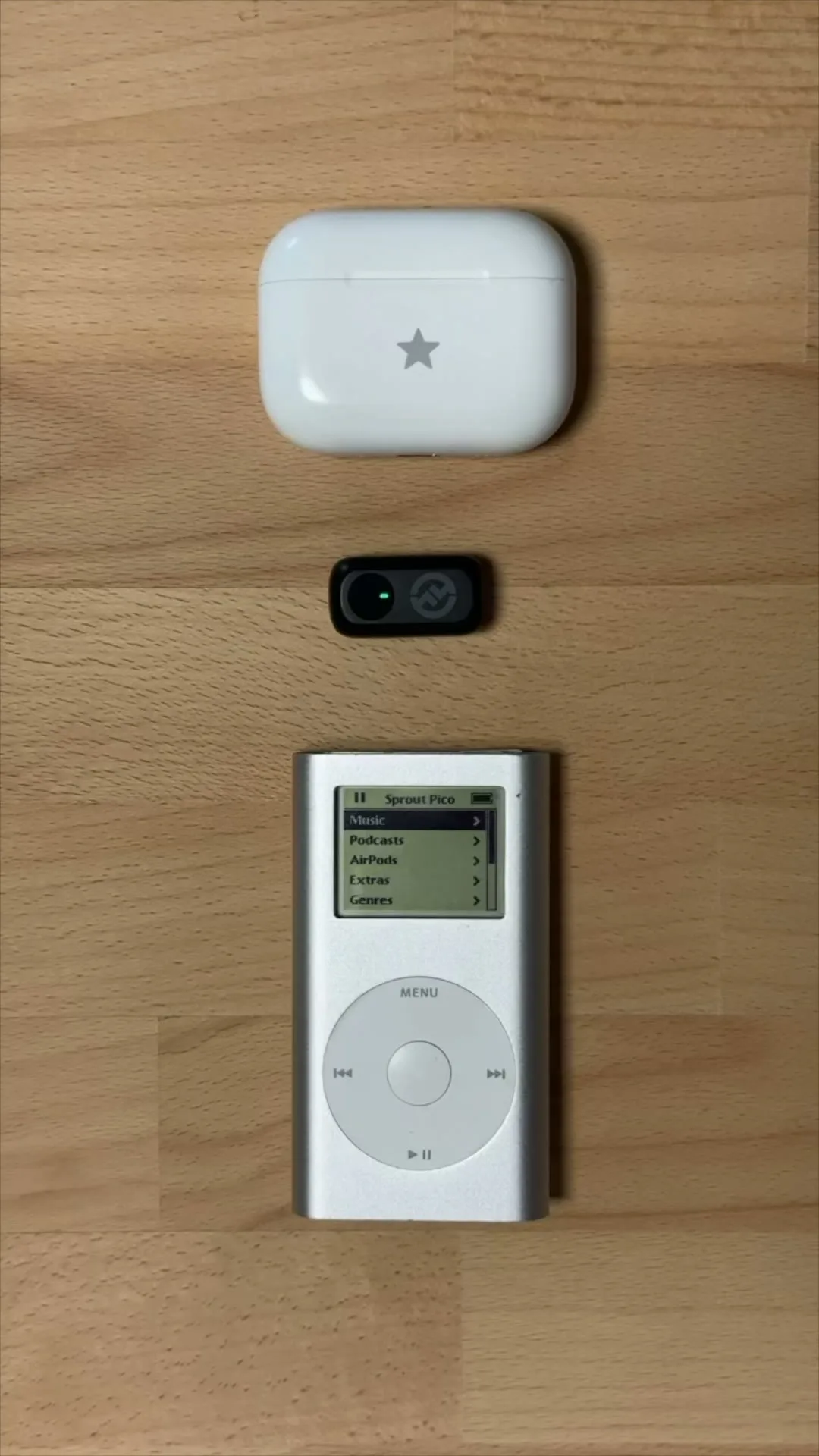 The Sprout Pico menu on an iPod mini, AirPods entry and all. Still from the Bluetooth film. Image: Certain Things
None of this carries Apple blessing. Apple has not approved the board, the interface, or any of it, and launch coverage points out that Apple may hold patents on some of the interface touches the Sprout software echoes. The makers aim for close enough to feel right without building a clone. Whether that line holds is a question for lawyers rather than reviewers, but it belongs in any honest account of the project.
Open source, properly
The openness is not a garnish. Per the Crowd Supply page, the hardware, meaning schematics, board layouts, and the bill of materials, is licensed under CERN-OHL-S v2. The firmware, the software, and the Sprout Pi runtime are under MPL-2.0. The documentation is under CC BY 4.0, and it includes the group notes on reverse engineering the iPod display, the click wheel, and the headphone connectors, which may outlast the board itself as a resource for other modders.
The files are not all public yet. The group says everything will be published on its GitHub before the end of the campaign, with issues and pull requests welcome. That ordering matters for a verdict: the licences are stated and specific, but the code drop is still a promise dated to a campaign that has not started.
Context helps here. Software level iPod modding is decades old; Rockbox has replaced iPod firmware since the mid 2000s, and hardware mods have usually demanded either a donor pile of parts or real bench skill. A reversible board swap that a careful owner can do with two tools is a different kind of offer, closer to a repair part than to a science project.
Price and platforms
There is no price to report, and anyone who quotes you one is guessing. The Crowd Supply campaign page exists to collect launch notifications, and the project simulator on the Certain Things site is the closest thing to a demo you can try today. When the campaign lands, the platform list to check your drawer against is short: iPod 3rd generation and 4th generation in their monochrome forms take either board, and the iPod mini, 1st and 2nd generation, takes Pico only.
What Works
- A full board replacement, so Bluetooth, Wi-Fi, a modern DAC and USB-C arrive in one reversible swap
- No soldering, two basic tools, and the original screen, click wheel and case all stay in service
- MicroSD storage up to 2 TB turns a 10 or 20 GB player into a serious library
- Sprout Pi runs Linux under the classic interface, with streaming and custom apps
- Open source with named licences for hardware, software and documentation
What Does Not
- No price, no release date, and a campaign that has not launched yet
- Only the oldest models are supported: 3rd generation, 4th generation and mini, nothing later
- Streaming, AirPlay and Google Cast are proofs of concept, and streaming services change their APIs often
- The mini misses the Pi version entirely, so no streaming on the smallest player
- Apple has approved none of it, and the interface echoes Apple designs closely
Who should try it
Best for: owners of a 3rd generation, 4th generation, or mini iPod who already love the object and resent its limits, and modders who want a documented, open platform rather than a sealed gadget. The low prices those early models fetch, noted on the Crowd Supply page, make the experiment easier to justify once a price exists.
Everyone else should wait for the campaign. Readers with a later iPod get nothing from Sprout today, and readers who want streaming on a small player right now already own a phone that does it. What Sprout sells, when it sells, is the feeling of the original machine with the annoyances removed.
Final Thoughts
The iPod modding scene spent twenty years preserving these players as they were. Sprout is the first project in that scene to argue that preservation can mean a new brain, as long as the hands, the wheel, and the face stay the same. The engineering split, a microcontroller for the music and a Linux module for the modern world, is genuinely clever, and the open licences mean the work survives even if the campaign does not. Now it has to survive contact with a price tag and a shipping date.
Sources
- The project site: Sprout at Certain Things, read November 11, 2026 (versions, feature table, battery targets, supported models)
- The campaign page: Sprout Pi Mainboard on Crowd Supply (the swap, specifications, licences, notification signup)
- Launch coverage: Sprout Pi lets old iPods run Linux apps and stream Spotify, Joey Sneddon, OMG! Ubuntu, November 2026 (the Pico and Pi division of labour, the Parachute recreation, the patent note)
- Project films and stills: Certain Things
END OF TRANSMISSION
Stay curious. Question everything.