
This research review weighs the Framework Desktop in its 128GB Ryzen AI Max+ 395 form against the DGX Spark it now undercuts by about half: verified specs, current prices from Framework and its rivals, and published local AI results from Framework and owners. The capacity story is real. So are the limits that come with it.
Dirty Static // The Verdict
The same 128GB capacity as a DGX Spark for about half the money, with a normal PC attached. Buy the memory, accept the bandwidth.
Best forLocal AI builders, developers and small teams that want large models on their own desk on x86, without paying NVIDIA prices
What works
- 128GB of unified memory holds large local models that no single consumer graphics card can hold
- The current 128GB price of $3,449 is about half the roughly $6,950 asked for a 128GB DGX Spark
- A normal PC in the ways that count: x86, Windows or Linux, a standard Mini-ITX board and dual M.2 storage you can swap yourself
- A quiet 4.5 litre box at 3.1 kilograms with the power supply inside, built for a desk, a shelf or a backpack
What does not
- Memory and chip are soldered, so the capacity you buy is final and the usual Framework upgrade story stops at the board
- 256 GB/s of memory bandwidth caps dense model speed, whatever the model size on the box
- No CUDA: ROCm and Vulkan paths work, but tools built for NVIDIA need porting and some need patience
- The DIY price leaves storage and an operating system to you, so a finished build costs more than the headline figure
Research review: based on published testing, specifications, and documentation, not hands on testing.
The pitch for this machine used to need a caveat. When the Framework Desktop launched in 2025, its 128GB model cost $1,999 and the DGX Spark cost $3,999, so the maths wrote the headline by itself. Memory prices then climbed through 2026 and both machines got more expensive. What matters now is that they climbed together. In October 2026 the 128GB Framework Desktop sat at $3,449 in Framework pricing as reported by current buyer guides, while the 128GB DGX Spark sat at about $6,950, the tier we documented in our DGX Spark review. Half price survived the price rises. This review asks what the half you do not pay would have bought.
What It Is
The Framework Desktop is a 4.5 litre desktop built around one AMD chip, the Ryzen AI Max+ 395, codename Strix Halo. The chip pairs a 16 core Zen 5 CPU with a Radeon 8060S graphics unit and an XDNA 2 neural unit, and all three share one pool of LPDDR5x memory. In the 128GB model that pool is large enough to hold models that no single consumer graphics card can load, and that one fact is the entire reason this configuration exists.
Unlike the Spark, this is also an ordinary PC. It runs Windows or Linux, it plays games at 1080p and 1440p, it edits video, and it is built on a standard Mini-ITX mainboard with a standard FlexATX power supply and a 120mm fan. Framework sells it as a DIY Edition you assemble, as a prebuilt machine with Fedora installed, or as the mainboard alone for a case you already own. The front panel takes swappable tiles and two Expansion Cards, the same port modules Framework uses on its laptops.
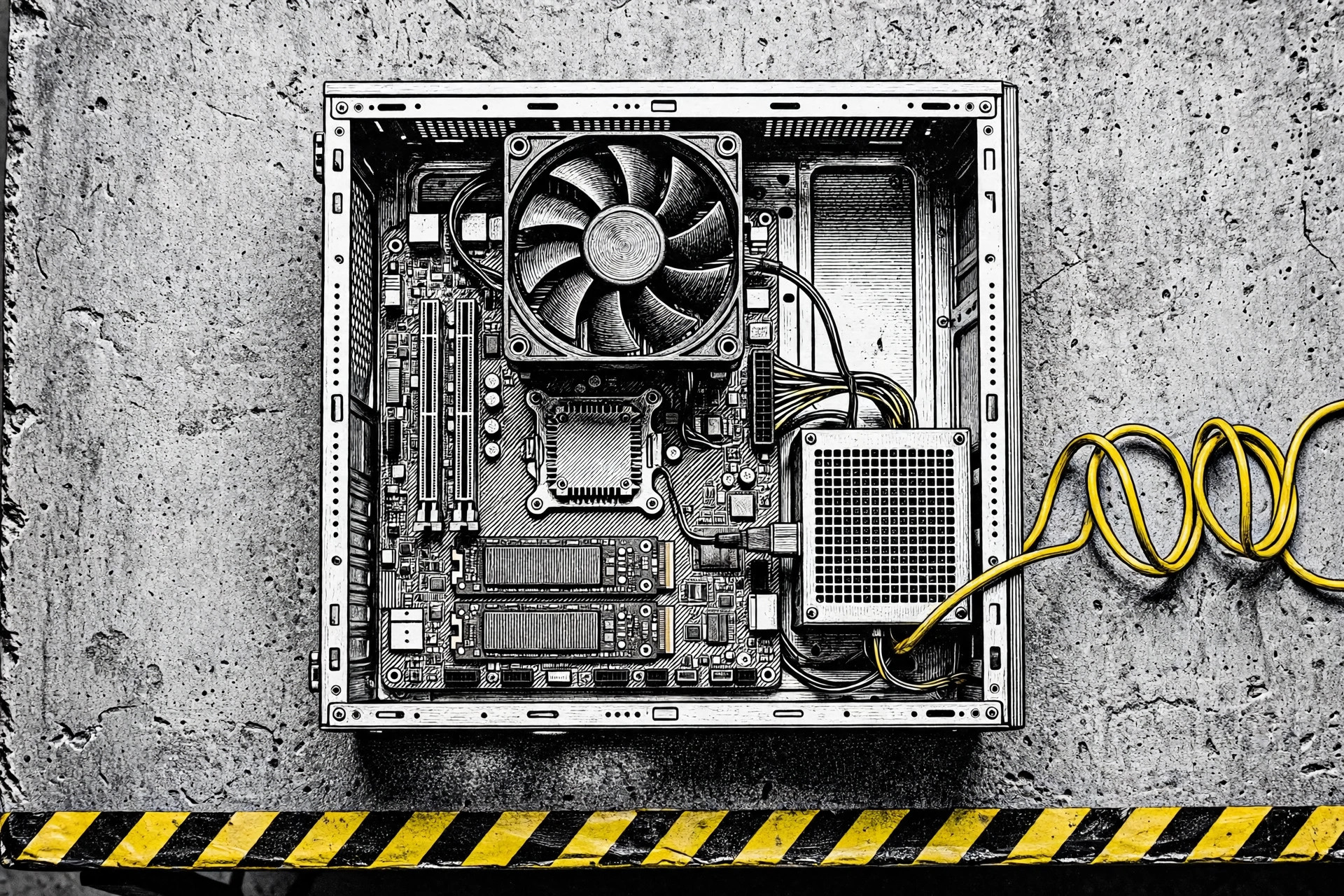
House style illustration. The board, fan, storage slots and supply inside the real machine are standard parts, which is the point.
Features and Specifications
| Part | Framework Desktop, 128GB specification |
|---|---|
| Chip | AMD Ryzen AI Max+ 395 (Strix Halo), TSMC 4nm class process |
| CPU | 16 Zen 5 cores, 32 threads, boost up to 5.1 GHz |
| Graphics | Radeon 8060S, RDNA 3.5, 40 compute units, up to 2.9 GHz |
| Neural unit | XDNA 2, up to 50 TOPS; AMD rates the full platform at up to 126 TOPS |
| Memory | 128GB LPDDR5x at 8000 MT/s, unified, 256 bit bus, 256 GB/s bandwidth, soldered |
| Graphics memory | Up to 96GB assignable to graphics in standard settings, per Framework and HP figures for this chip |
| Storage | Dual M.2 2280 NVMe slots, drives sold apart on the DIY Edition |
| Networking | 5 GbE Ethernet, Wi-Fi 7 module, Bluetooth 5.4 |
| Ports | 2 USB4 USB-C, 2 USB-A, 2 DisplayPort 2.1, HDMI 2.1, 3.5mm audio, 2 front Expansion Card slots |
| Expansion | PCIe x4 slot, usable for fast network cards on the bare board |
| Power | 400 watt FlexATX supply inside the case; chip power configurable from 45 to 120 watts |
| Size and weight | 96.8 x 205.5 x 226.1 mm, 3.1 kg |
| Operating system | Windows or Linux; prebuilt builds ship with Fedora |
The comparison that decides this review sits in two rows. Memory capacity matches the Spark at 128GB. Memory bandwidth nearly matches it too, at 256 GB/s against 273 GB/s. Token generation on local models is mostly a bandwidth contest, so a buyer should expect Spark class speed from this box on the models both can run, and that is what published results show. What the Spark adds for its extra money is not speed at this tier. It is CUDA, the DGX software stack, and ConnectX networking at 200 Gb/s for linking two units as one.
Price is the other deciding row, and it has moved for everyone. Framework raised this model from $1,999 at launch to $2,459 in January 2026 and then to $3,449 by the autumn, blaming memory supply, the same force NVIDIA cited when the Spark climbed. A new 192GB Framework model on the Ryzen AI Max+ PRO 495 opened for orders at $6,799, which tells you where the top of this market now sits.
128GB local AI desktops, price in USD, October 2026
Framework Desktop 128GB at Framework pricing as reported in October 2026; DGX Spark 128GB at the roughly $6,950 tier reported by ServeTheHome; DGX Spark 64GB at its $4,999 launch price. Prices move with memory supply.
Real World Experience
This is a research review, built from Framework documentation and its own local AI guides, published reviews from Tom’s Guide, PC Gamer and others, and owner reports, rather than hands on time in our lab. The picture those sources draw is consistent, and it splits by model type exactly as the bandwidth figure predicts.
Capacity first, because capacity is the purchase. Framework’s own guide for this machine, updated in August 2026, recommends the 128GB model around models such as DeepSeek V4 Flash in a 90.9GB build, with room left for context and the runtime. Its table for the 64GB model lists a 122 billion parameter mixture of experts model in a 52.5GB build. Owners report the same class of result: one detailed owner guide loaded the 120 billion parameter gpt-oss model with full graphics offload and a 120k context window, and measured close to 50 tokens per second at the start of a session, with speed falling as context grows.
Speed second, with the honest split. Mixture of experts models read only part of their weights per token, so they run at usable speed on 256 GB/s. Dense models read everything, every token, and they slow down hard at 70 billion parameters and up. Framework itself makes this point in plain terms in its guide and steers buyers who care about speed toward mixture of experts models. Prompt processing, the wait while a coding agent reads your files, is the weaker side of this platform next to NVIDIA hardware, and long context work is where Spark owners get something real for their money.
The software story is better than it was at launch and still the main friction. llama.cpp is the strong path, with ROCm and Vulkan backends, and LM Studio and Ollama sit on top of it. Framework maintains guides, containers and model picks for this chip, and a community of Strix Halo forks has grown around it. vLLM runs, but Framework itself notes it suits data centres and many users at once better than a personal box. Anything in your workflow that assumes CUDA needs a port, a substitute, or a decision to walk away.
As a PC, the reviews are warm. Tom’s Guide called it a powerful and highly customizable mini PC and praised the build, which owners put at about ten minutes of fitting a drive and a fan. PC Gamer was cooler on value as a gaming machine and sharper on the obvious point: a desktop with a soldered chip and soldered memory is less upgradeable than the desktops Framework says it improves on. Both readings are fair, and which one lands depends on whether you came for the PC or for the memory.
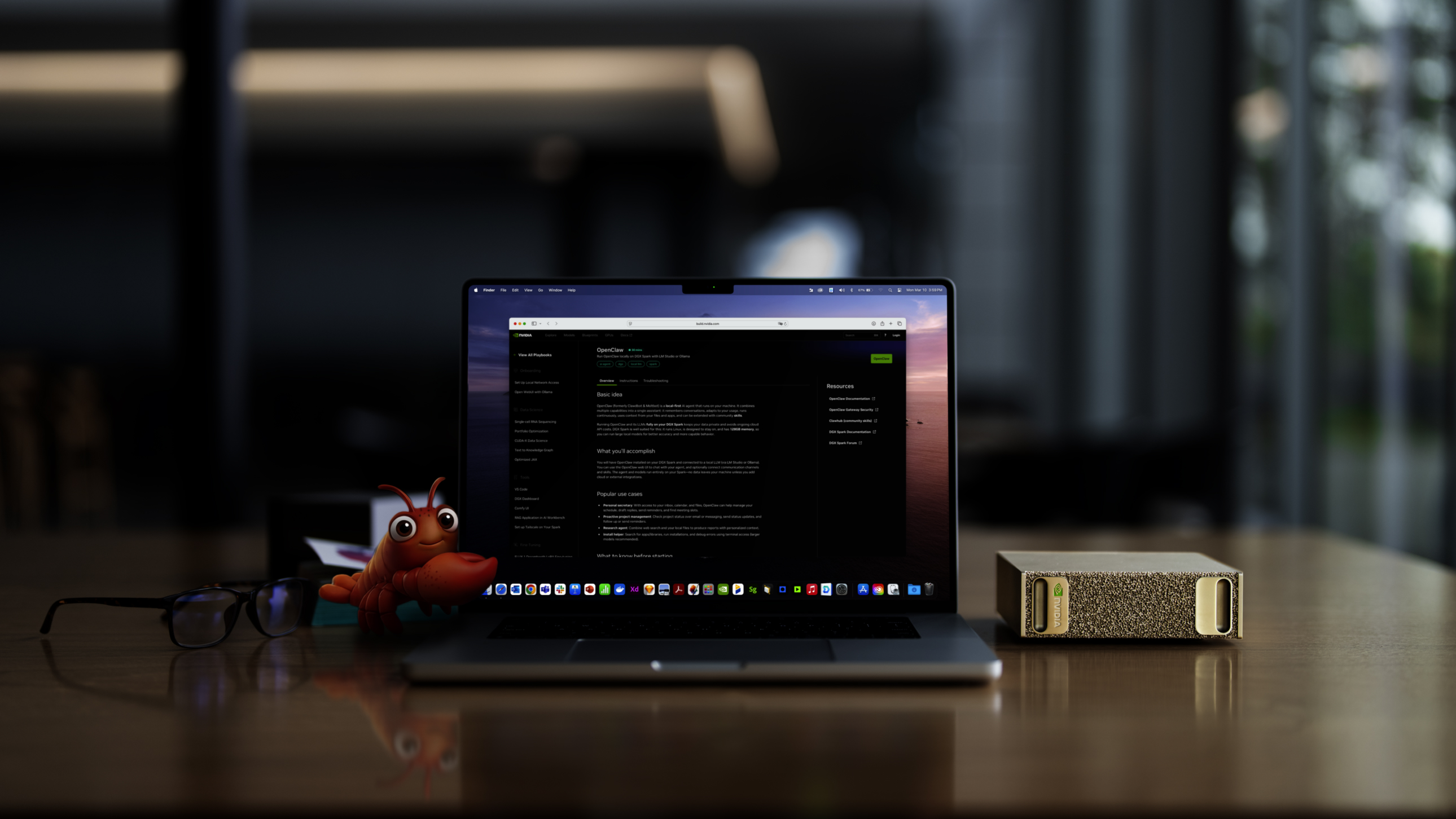
The rival. A DGX Spark on a desk, in NVIDIA’s own product photo.
What Works
The value case is stark. No other route puts 128GB of unified memory, a 16 core CPU and usable graphics in one quiet box at $3,449, and the rival with the same capacity costs about twice that. For private work on large models, the Framework does the defining job of the Spark at half the bill.
It is also a computer when the model is closed. Most local AI boxes ask you to keep a second machine for daily work. This one edits, codes, plays and serves as the daily driver, on the operating system you already use, with ports and storage you can change. The 5 GbE port, dual drive slots and standard board mean it can grow into a small server or a cluster node later, over USB4 or with a fast network card in the PCIe slot.
Finally, Framework sells the board alone and documents the platform in the open. If the case does not suit, the mainboard drops into a standard case or a rack tray. That is a longer life story than a sealed appliance can offer, even with its limits.
What Does Not
The solder is the standing contradiction. Framework built its name on machines you upgrade for a decade, and its desktop fixes the two parts you most want to change, the chip and the memory, at the moment of purchase. Buy 64GB today and there is no path to 128GB but a new board. Framework is open about this and blames the chip design, which is true and does not soften it.
Bandwidth is the second limit, and no setting removes it. At 256 GB/s, dense models at scale are slow, prompt processing trails NVIDIA, and the gap to a discrete graphics card with four times the bandwidth is total on any model small enough to fit in that card. Buyers whose models fit in 32GB should not buy this machine for AI at all. A card based PC will run them far faster for less.
The third limit is the stack. ROCm support for this chip, target name gfx1151, has improved through community and Framework work, but it is not CUDA and it is not close in breadth. Some tools arrive late, some need a fork, and some never arrive. Price that risk honestly if your tools are NVIDIA shaped.
Competition
| Option | Memory | Memory bandwidth | Price (USD) | The trade |
|---|---|---|---|---|
| Framework Desktop 128GB | 128GB unified | 256 GB/s | $3,449 | The same capacity class as a Spark, on x86, in a modular PC with no CUDA |
| NVIDIA DGX Spark 128GB | 128GB unified | 273 GB/s | About $6,950 | CUDA, the DGX stack and 200 Gb/s cluster networking, at about double the money |
| NVIDIA DGX Spark 64GB | 64GB unified | 273 GB/s | From $4,999 | The NVIDIA stack with half the Framework memory, for $1,550 more |
| Other Strix Halo mini PCs | 128GB unified | 256 GB/s | About $3,599 and up in October listings | The same chip and memory with no modular board story and thinner support |
| Apple Mac Studio, 128GB class | 128GB unified | Far higher, by configuration | $5,099 in an October 2026 Apple store reading | Much faster memory and a polished desktop, on macOS, with no NVIDIA or AMD stack |
| RTX 5090 PC | 32GB on the card | About 1.79 TB/s on the card | Varies | Several times the speed on models that fit, and a hard wall at 32GB |
The table shows why this machine keeps winning its niche. Rivals beat it on one axis at a time: the Spark on stack and networking, the Mac on bandwidth, a card PC on raw speed, rival Strix Halo boxes on nothing much at all. None of them match its mix of capacity, price and ordinary PC manners.
Final Verdict
Buy the 128GB Framework Desktop if you want large models running locally, privately and daily, if your tools live happily on llama.cpp, ROCm or Vulkan, and if a good normal PC has value to you beyond the models. For that buyer this is the rational form of the DGX Spark idea: the same memory, near the same bandwidth, half the money, and a machine that still earns its desk space on the days no model is loaded.
Skip it if your work needs CUDA, if you serve many users at once, or if your models fit in a graphics card you already own. Skip the smaller models too unless the price forces it, because memory is the whole argument here and the solder makes the choice permanent. At launch money this machine was an easy call. At $3,449 it is still the best value in large local AI, just a more deliberate one. The Spark sells certainty. Framework sells capacity and a computer. At half price, capacity wins for most desks.
This is a research review. It draws on Framework product pages and its August 2026 local AI guide, AMD specifications for the Ryzen AI Max+ 395, published reviews from Tom’s Guide and PC Gamer, owner reporting from Boiling Steam, and October 2026 pricing reporting, checked November 2026. No hands on testing was performed.
Sources
- Framework: Framework Desktop product page
- Framework: Choosing a Framework Desktop for Local AI
- Framework Community: 192GB Framework Desktop open for pre-order
- Tom’s Guide: Framework Desktop review
- PC Gamer: Framework Desktop PC review
- Boiling Steam: Framework Desktop, how to expand unified memory for LLM use
- Geekblog: Framework Desktop 2026, specs, prices and alternatives
- Pandromeda: Ryzen AI Max+ 395 vs DGX Spark, specs and price
- NVIDIA: DGX Spark product page
- Dirty Static: NVIDIA DGX Spark review
- Product image of the DGX Spark: NVIDIA. Hero and board images: Dirty Static house style illustrations.
END OF TRANSMISSION
Stay curious. Question everything.