The fox arrived in July and the verdict arrived with it. Ozzy Fox, a music driven series for preschool children about a family of foxes turning daily routines into songs, launched on YouTube and Disney Junior and was promptly called AI slop in coverage and in comments. Critics pointed at plain backgrounds, at props that looked unfinished, and at a striking absence of letters and numbers on objects in the scenes. Those details read, to a trained eye in 2026, like the marks a video generator leaves when it avoids text it cannot render.
Animaj, the Paris based studio that made the show with Disney Jr., insists that reading is wrong about how the work was made. The studio says animators drew the show and defined the acting, the timing, and the key poses, while its own models filled in the movement between those poses. This month it published that defence as a manifesto, and the manifesto goes further than one show. It names slop as the enemy, argues that slop is an economic problem before it is a technology problem, and warns that storytellers who refuse AI will not stop the flood. They will just leave the flood to people who care less.
The Bigger Story
Start with what Ozzy Fox actually is, because the accusation blurred it. The series was created by Jennifer Oxley, whose credits include Peg + Cat and Wonder Pets, and developed by Guillermo García Carsí, the creator of Pocoyo. Animaj describes episodes built around ordinary moments in a young child’s day, such as brushing teeth, cleaning up, or leaving the playground, turned into a mission with an original song at its centre. Writers, directors, storyboard artists, and animators worked on the show, with input from specialists in child development, and Animaj says the first two episodes drew more than 1.5 million views in less than five days on YouTube.
The production method sits between two poles that public debate keeps treating as one. At one pole is the prompt box, where a person types a line and a model returns a finished clip with no artist shaping the performance. Animaj rejects that pole in unusually blunt language in its own account of the show.
So no, we did not type a prompt and get a fox.
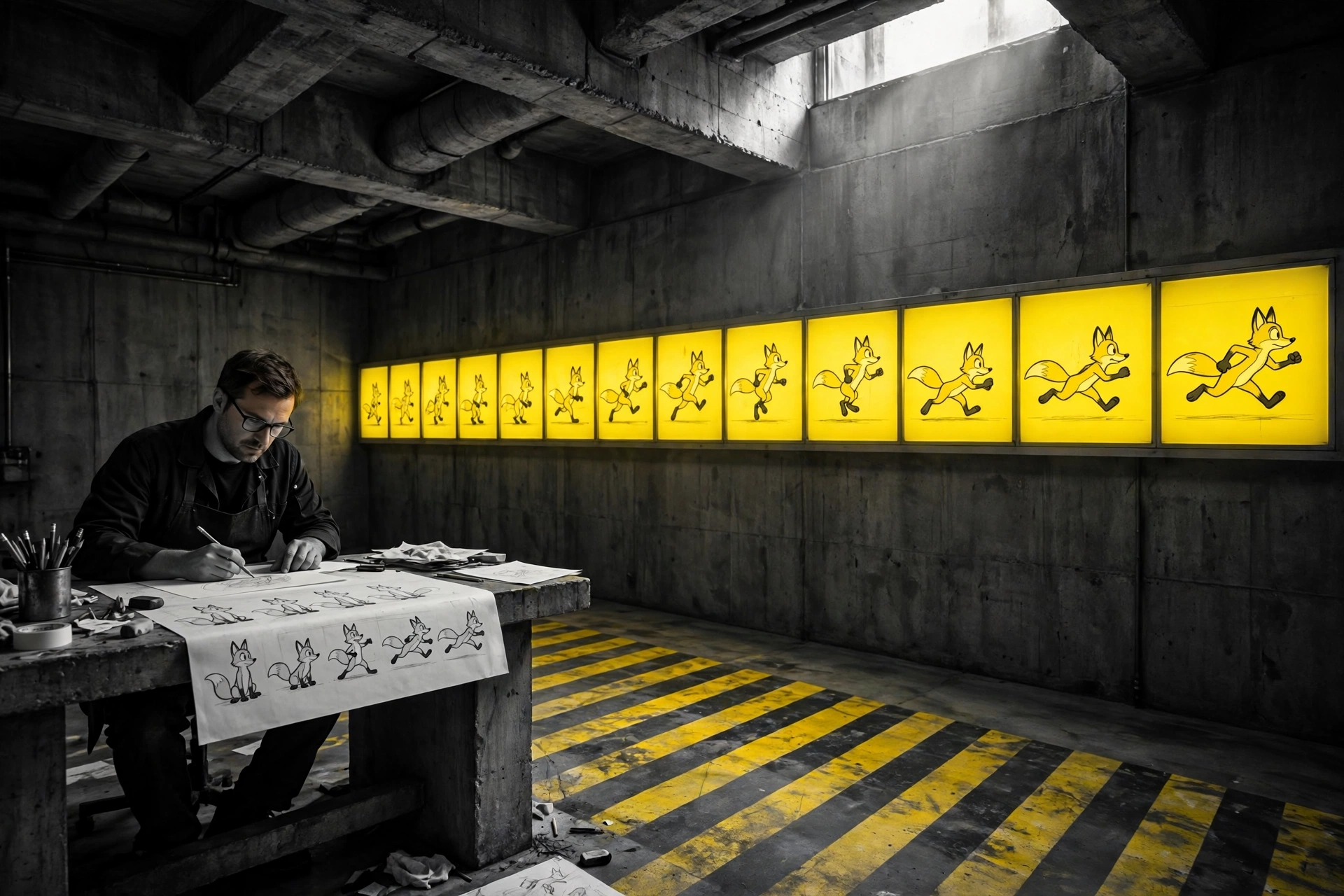
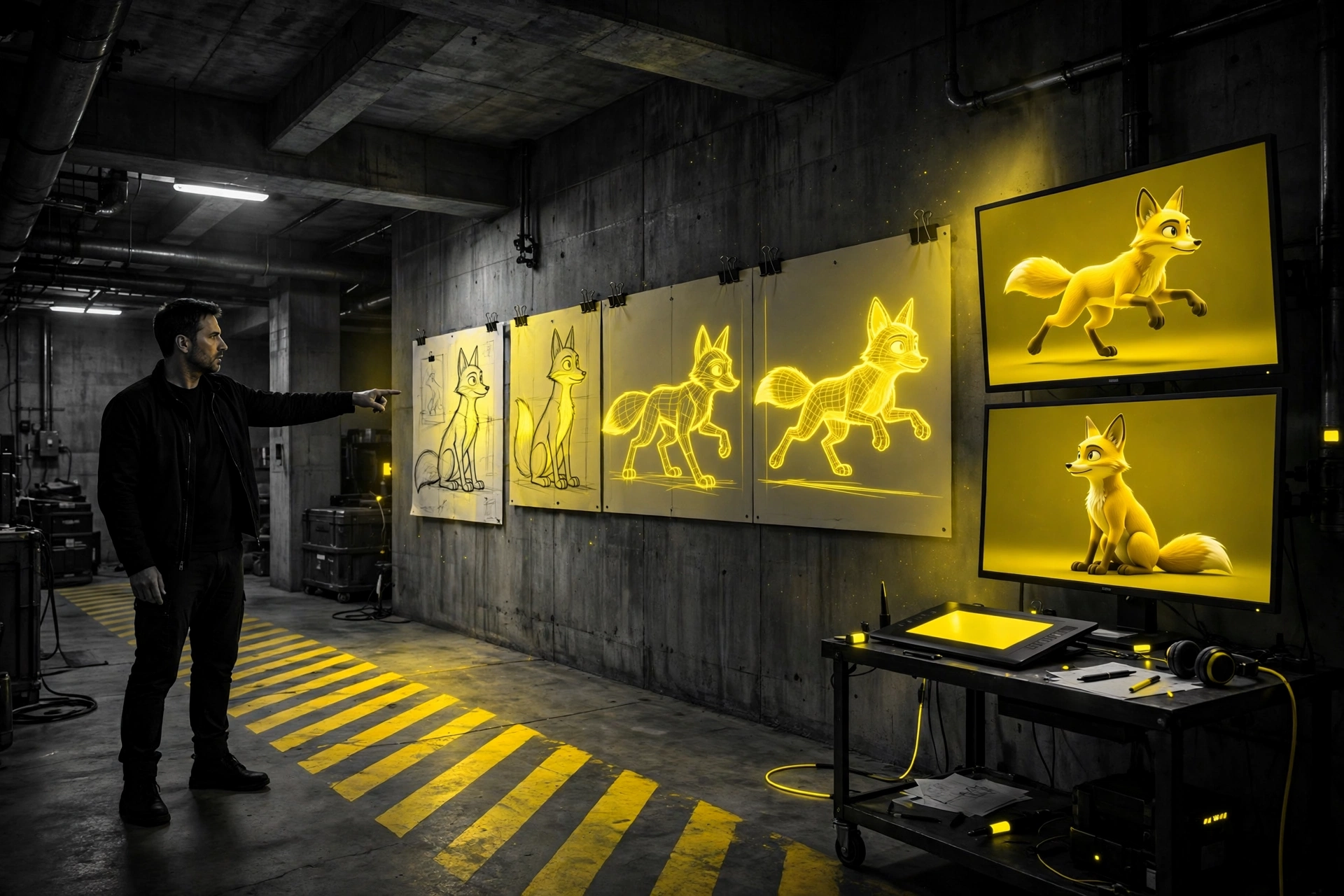
At the other pole is the classic pipeline, where animators draw or pose every stage of a movement by hand. Animaj sits in the middle and says so. Its Sketch to Motion work takes an approved animatic, meaning a rough moving version of the storyboard, and speeds up the creation of the poses that connect one key pose to the next. Animators still define the key poses and the performance. The model helps with the labour between them, and the studio says every frame is ultimately reviewed and approved by an artist.
In November that middle ground got a product name and a public stage. At Disney Accelerator Demo Day on November 3 at the Walt Disney Studios lot in Burbank, Animaj showed FlipMove, a workflow that carries a scene from approved animatic to finished animation. Disney describes it as starting with an artist’s sketched animatic, building staged 3D shots, and speeding up layout, director retakes, and the work between poses, while creative teams keep full control. Animation World Network reported that FlipMove links tools with names such as Sketch to Pose and Motion In Betweening, adds a step that turns a 2D animatic into camera placement, props, and staging in 3D, and can turn a director note into a revised scene in about two minutes rather than twenty. CNET, reporting on November 13, added that Animaj has also built a workflow in which a set of agents has access to its tools and to context about the show, with the director choosing what fits the work.
The timing matters. CNET reported that Ozzy Fox is now heading to Disney Plus after its July debut, and Disney confirmed at Demo Day that a second season is already in production. A show accused of being disposable has, by the ordinary measures of television, done the opposite of disappearing. Animation World Network put its YouTube total at more than 25 million views since July.
Context
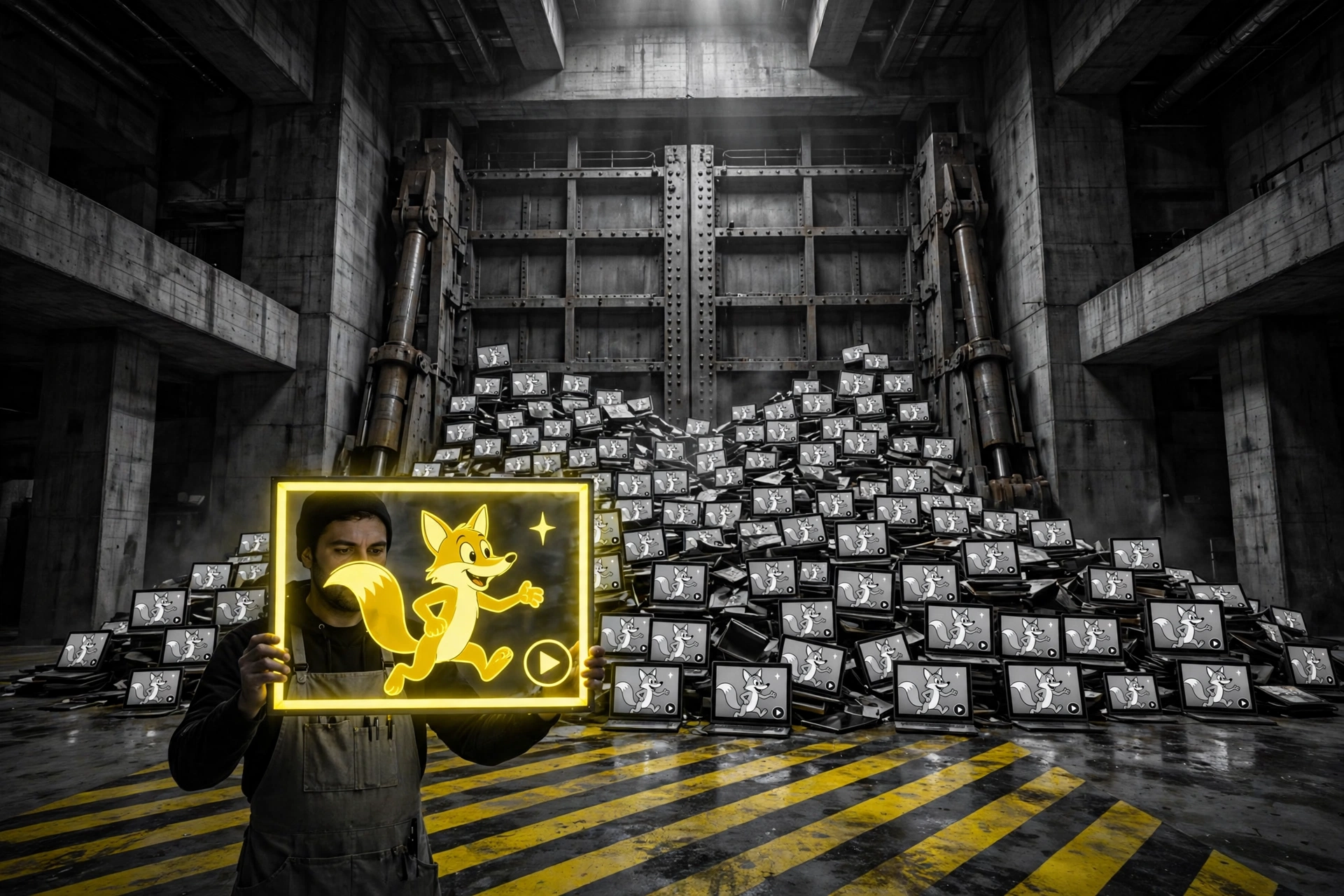
The manifesto, published on Animaj’s own site under the title AI Isn’t the Enemy, Slop Is, makes five arguments, and the first one reframes the whole fight. Slop, the studio says, existed long before AI. Cheap cartoons built by copying and pasting were already flooding platforms for children years ago. AI did not create slop, in this account. It industrialised its production.
The economics underneath that claim are hard to dispute, even for readers who dislike the conclusion. The manifesto notes that content for children earns less advertising revenue than other content on platforms such as YouTube, while strong animation remains expensive to make. A system built on those numbers rewards whoever can produce the most for the least. That reward existed when the cheap work was made by underpaid humans copying templates. It grows sharper when a model can produce the cheap work in minutes.
Animaj was built inside that system, not outside it. The company was founded in 2022 by Sixte de Vauplane and Gregory Dray, a former YouTube executive, and it now holds well known properties for young children including Pocoyo and Maya the Bee. Google backed the studio through its AI Futures Fund, with a one million dollar investment reported by C21Media and early access to Google models. That backing gives the studio a stake in the argument it is making, and readers should hold that fact beside the argument itself. A studio funded to use AI well has reasons to say AI can be used well.
Our earlier features have tracked the word from other sides of the same flood. Slop Is a Slur Now traced how slop moved from a narrow test, work that was unrequested and unreviewed, toward a broad insult aimed at almost anything a model touched. Todays round one feature, No AI Slop Manifesto Unites Builders Publicly, read a pledge from software builders that defines slop as a failure of review rather than a failure of the model. Animaj lands in a strikingly similar place from a different industry, which suggests the narrow definition is gaining ground in more than one trade at once. Work is slop when nobody with taste stood behind it, whatever helped to make it.
- 2022Animaj is founded in Paris by Sixte de Vauplane and Gregory Dray
- July 2026Ozzy Fox launches on YouTube and Disney Junior and draws slop accusations over backgrounds and missing text in scenes
- November 3, 2026Animaj shows FlipMove at Disney Accelerator Demo Day, and Disney confirms a second season is in production
- November 13, 2026CNET reports Ozzy Fox heading to Disney Plus, drawn by humans with AI speeding up the work
Different Perspectives
The audience suspicion that started this story deserves a fair hearing, because it was not invented from nothing. Viewers for children have spent two years wading through a feed full of strange, cheap, and sometimes disturbing generated videos with no named creator and no visible care. When a new show arrives with plain backgrounds and no letters on its signs, parents and animators alike reach for the pattern they have learned. Creative Bloq, covering the July reaction, noted the stiffness and odd looking sequences people flagged, while also concluding that the show is AI assisted rather than AI generated, and that flaws in it are more likely the result of a chosen style or human error than of a model inventing images on its own.
Animators who fear for their work hear a different part of the manifesto most clearly, and Animaj does not hide it. Point five says some jobs will disappear and others will change in deep ways, and that schools still train young animators for a pipeline built around technical tasks that AI can now speed up or automate. The studio argues training should prepare artists to direct the technology, with taste, craft, and judgement as the core skills, and that studios owe their artists that training now. That is a more honest paragraph than most company statements on this subject manage. It is also, from the seat of a young animator who spent years learning exactly those technical tasks, a paragraph that describes a loss before it describes an opportunity.
A third view questions the manifesto as a document, whatever its merits line by line. It arrived after an accusation, it defends the authors own show and business model, and its most quoted line is also its most convenient one. If slop is the enemy and Animaj fights slop, then criticism of Animaj can be recast as confusion, or even as help for the farms. Co founder Gregory Dray made a version of that move in comments reported by C21Media, saying a headline about AI content for children being dangerous gets clicks, and then every company that touches AI and children gets thrown in the same bucket with no distinctions. There is truth in that complaint. There is also a risk in it, because a studio that teaches the public to separate careful work from farm work still has to accept close reading of its own frames, including the plain backgrounds that started the argument.
Disney, for its part, has kept its public role narrow and practical. Its Demo Day account presents FlipMove as a tool that lets creative teams review and change work faster while keeping control, and it treats Ozzy Fox as a collaboration that earned a second season. That is the voice of a large studio testing a pipeline on a preschool series rather than staking its flagship films on it, and the scale of the test is worth remembering when the claims grow large.
Why It Matters
The question underneath Ozzy Fox is who gets to make stories for children in a feed that rewards volume above almost everything else. Animaj’s second argument presses that point hardest. Slop producers do not need permission, the manifesto says. When a talented storyteller refuses AI, nothing slows the farms down. It only disarms the storytellers who compete with them.
Refusing AI is a surrender, and children are the ones who pay for it.
Read that line with care and it is less a slogan than a claim about where quality comes from. Quality in this account is not a label a studio can print on a finished show. It is what happens when time saved in one place is spent in another, on stronger stories, richer characters, and more attempts at a scene. The manifesto states that rule as a duty, saying every hour AI gives back has to go back into the work. That is a testable promise, and it gives critics a fair standard to hold the studio to. If the saved hours show up as more shows rather than better ones, the manifesto will have described its own failure mode, because its third point warns that if saving money is the whole ambition, slop wins.
The wider stakes reach past one fox. If the Animaj model spreads, the job of animator shifts toward directing systems that produce motion, staging, and revisions, and away from executing each stage by hand. That shift can put more ideas within reach, including the strange character and the unfamiliar culture the manifesto says budgets used to kill at the pitch stage. It can also thin out the craft base that teaches judgement in the first place, since judgement in animation has always been learned by doing the slow work the tools now absorb. Both outcomes can grow from the same pipeline, and which one dominates will be decided by choices studios make about training, staffing, and time, not by the tools alone.
Closing Reflection
There is a useful irony in how Ozzy Fox became famous. A show made to turn tooth brushing into a song became a case study because viewers thought they could see a machine in its empty signs and plain walls. The studio answered not by denying the machine, but by trying to move the argument onto ground it can defend, the ground of review, intent, and who stood behind each frame.
That ground is real, and it is the same ground this site argued for when the word slop first escaped its narrow meaning. Ask who made the choices, ask who checked the work, and ask where the saved time went. Animaj has now written its answers down in public, which means its future work can be measured against them, season by season and frame by frame. A manifesto that invites that kind of checking is worth more than one that only asks for trust. Whether the checking flatters Ozzy Fox is a question its audience, including the smallest viewers in the room, will answer without reading a word of it.
Facts checked November 14, 2026, against Animajs published manifesto and its account of the making of Ozzy Fox, Disney Accelerator Demo Day reporting from The Walt Disney Company, Animation World Network reporting on FlipMove, CNET reporting of November 13, 2026 as summarised in subsequent coverage, Creative Bloq coverage of the July reaction, and C21Media reporting on the founders defence of AI in content for children.
Sources
- Animaj, The Animaj AI Manifesto: https://www.animaj.com/post/the-animaj-ai-manifesto
- Animaj, Ozzy Fox, How Animaj and Disney Jr. Made a New Preschool Show: https://www.animaj.com/post/behind-ozzy-fox-how-artists-technology-and-audience-insights-came-together-to-create-a-new-preschool-series
- The Walt Disney Company, Disney Accelerator 2026 Demo Day, November 3, 2026: https://thewaltdisneycompany.com/news/accelerator-demo-day-2026/
- Animation World Network, Animaj Unveils FlipMove AI Animation Workflow, November 10, 2026: https://www.awn.com/news/animaj-unveils-flipmove-ai-animation-workflow
- Creative Bloq, Disney Ozzy Fox and AI slop accusations: https://www.creativebloq.com/art/animation/ai-slop-accusations-are-helping-disneys-ozzy-fox-go-viral
- C21Media, Animaj defends use of AI to make childrens content: https://www.c21media.net/news/animaj-defends-use-of-ai-to-make-childrens-content-as-debate-reaches-boiling-point/
- Hero and body images: Dirty Static illustrations
END OF TRANSMISSION
Stay curious. Question everything.