
Dirty Static // The Verdict
A striking porting claim with a narrow scope. It weakens the CUDA story, not yet the measured speed gap.
Best forTeams weighing AMD hardware and readers tracking whether AI coding can lower the cost of switching chips
What works
- The claim targets the real cost of switching chips, which is kernel work rather than the silicon itself
- Anthropic put the claim to investors in its roadshow, with a named speaker and a dated slide
- The work fits a real deployment, with up to 2 gigawatts of AMD MI450 systems planned from the first half of 2027
- AMD and Anthropic already work together on ROCm, so the porting work has a place to land in production
What does not
- The three days cover prompt processing for one model only, at what Anthropic calls a useful level of performance
- No speed result against Nvidia hardware was published, and no outside party has verified the timing
- The six to 12 month baseline is Anthropic own history, not an independent measurement
- Decode, training, and full production tuning are not addressed in the claim as published
Research review: based on published testing, specifications, and documentation, not hands on testing.
Anthropic told investors a story about its own model doing the work its engineers used to do by hand. In the compute chapter of its IPO roadshow video, released on November 10, Tom Brown said Claude Mythos Preview got Claude running on AMD GPUs in about three days, with basically no human intervention. Brown is a cofounder of Anthropic and its chief compute officer.
The number is dramatic on purpose. The same job, Brown said, once took dozens of engineers months of work. If a model can port itself to new silicon in days, the cost of leaving Nvidia falls sharply. That is the claim worth checking, because the footnote under the slide tells a smaller and more precise story.
What It Is
Claude Mythos Preview is the frontier model Anthropic announced on April 7, 2026. Anthropic placed it in a new tier above Opus and did not make it generally available at launch. Access ran through Project Glasswing, a program for vetted groups working on defensive security, with partner pricing reported at 25 dollars per million input tokens and 125 dollars per million output tokens.
That history matters here for one reason. Mythos built its reputation on code. Anthropic said the model was strikingly capable at finding and exploiting software flaws, and its system card reported strong results on coding benchmarks. A model with that profile is a plausible candidate for kernel work, which is also code, but code of a very specific kind.
A kernel is a small program that does the maths of a model on a particular chip. Each chip family needs its own set. Software written for Nvidia CUDA, the programming platform Nvidia has built for close to two decades, does not run as is on AMD hardware. AMD offers ROCm instead, with HIP as its programming layer and a tool called HIPify that converts CUDA code. Porting means rewriting and tuning those kernels until the model runs well on the new chip. That work is slow, expert, and easy to underestimate from outside.
Features and Specifications
Two sets of facts sit under this review. The first is the model. The second is the chip it was asked to run on.
| Item | What is on record |
|---|---|
| Model | Claude Mythos Preview, announced April 7, 2026 |
| Access at launch | Project Glasswing partners only, no public API at launch |
| System card | 244 pages, published for an unreleased model |
| Coding result in system card reporting | 93.9 percent on SWE-bench Verified, as reported from Anthropic material |
| Claim speaker | Tom Brown, cofounder and chief compute officer, Anthropic |
| Claim venue | IPO roadshow video, compute chapter, released November 10, 2026 |
| Chip in the claim | AMD Instinct MI355X |
| Time claimed | About three days |
| Work claimed | Ported or wrote almost 100 percent of the kernels |
| Scope in footnote | Prompt processing for one Anthropic model, at a useful level of performance |
| Baseline in footnote | About six to 12 months, from Anthropic own history with new accelerators |
The MI355X is AMD current flagship class accelerator for data centres. AMD lists it with the CDNA 4 architecture, 288 GB of HBM3E memory, and 8 TB per second of peak memory bandwidth, at about 1,400 watts of board power. It is a serious chip on paper, with more memory per accelerator than the Nvidia B200 configuration AMD cited at launch. None of that answers the porting question, which is about software rather than memory.
| AMD Instinct MI355X | Specification, per AMD |
|---|---|
| Architecture | CDNA 4 |
| Memory | 288 GB HBM3E |
| Peak memory bandwidth | 8 TB/s |
| Board power | About 1,400 W |
| Software stack | ROCm, with HIP as the programming layer |
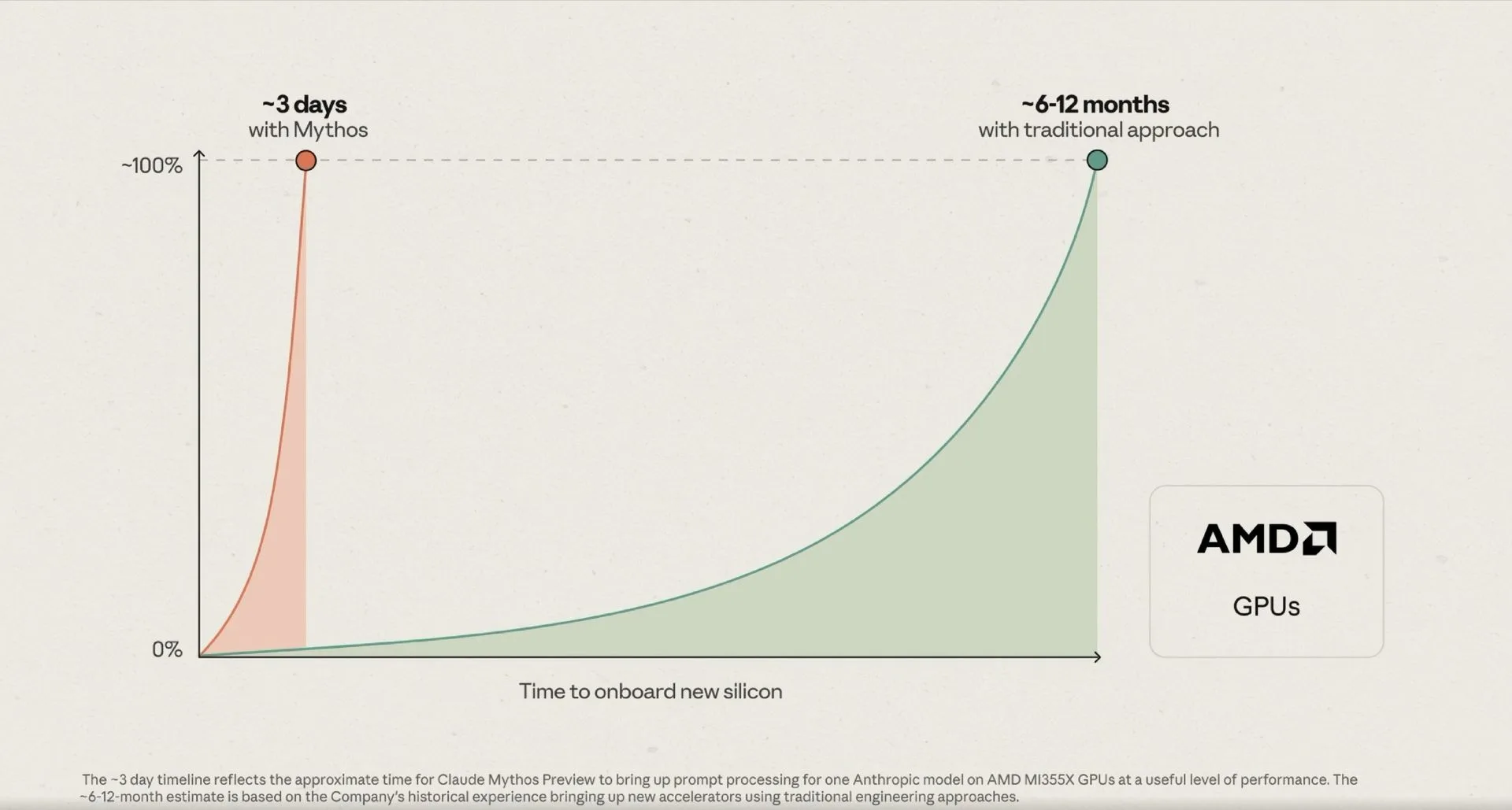
The chart above is the visual at the centre of the claim. It sets the three day line against the six to 12 month line and shows both reaching about 100 percent. Reporting on the roadshow noted that the chart does not say 100 percent of what, beyond the kernel line in the narration. That gap is worth keeping in mind while reading the rest of this review.
Time to bring up a new chip, days, as claimed by Anthropic
About three days for Mythos Preview on prompt processing for one model on MI355X, against a six to 12 month range Anthropic gives for its traditional approach. Both figures are Anthropic own. The chart uses 180 days for the low end of that range.
Real World Experience
This is a research review. Dirty Static did not run Mythos Preview, did not port a model to MI355X hardware, and did not measure any kernel. What follows draws on the roadshow itself as reported by several outlets, on AMD partnership release, and on earlier public statements from AMD and Anthropic about the same work.
The roadshow claim did not appear from nowhere. At AMD Advancing AI event on July 23, 2026, Brown described an earlier version of the same story. One engineer, he said, asked Claude to bring up an MI355X rack and left it running over the weekend. At the same event, AMD leaders said their engineers were using AI models to generate GPU kernels, and in some cases the results were better than the most carefully tuned versions written by hand. Those are statements from AMD stage, made by people selling AMD hardware, and they should be read that way.
The November version carries more weight for a simple reason. Anthropic is the buyer in this relationship, not the seller of the chips. It put the claim in front of investors who were deciding whether to buy its shares, with a prospectus filed the same day that says, in more cautious language, that the company can onboard new chip platforms in a fraction of the time it once took. The prospectus does not contain the three day figure. The roadshow slide does, with its footnote.
It got Claude running on AMD in just three days with basically no human intervention. Claude ported or wrote almost 100% of the kernels.
That is Brown wording in the roadshow, as quoted in reporting on the video. The sentence is clear about who did the work and how much of it the model did. It is less clear, on its own, about which part of running a model was finished in those three days. The footnote answers that question, and the answer is prompt processing.
Prompt processing, also called prefill, is the stage where a model reads its input before it starts writing an answer. It is real work and it matters for time to first token. It is not the whole of inference. The stage that follows, decode, is where the model generates its answer token by token, and it dominates cost in many production settings. Anthropic has not said whether decode was part of the three days. It has not said whether training was involved, and nothing in the footnote suggests it was.

There is a second limit that matters just as much. Anthropic published no speed result for the model running on AMD hardware. A port can be correct and still be slow. Useful level of performance, the phrase in the footnote, is not a number. Without throughput, latency, or cost per token on MI355X set against a comparable Nvidia part, a reader cannot tell whether the ported model was ready for production or ready for a demo. AMD has not commented on the three day figure in the reporting checked for this review.
What Works
The claim points at a real bottleneck. Kernel porting is exactly the kind of work that has protected Nvidia position. CUDA has close to two decades of tooling, libraries, and habits behind it. A lab that wants to use AMD, Google, or Amazon silicon has to pay the porting cost each time, in expert time. If AI coding tools cut that cost by a large factor, even a factor well below the headline, the economics of the whole market shift.
The claim also fits a deployment that is already signed. On July 22, 2026, AMD and Anthropic announced that Anthropic will deploy up to 2 gigawatts of AMD Instinct MI450 series GPUs in Helios rack scale systems, with the first gigawatt beginning in the first half of 2027. AMD committed to invest up to 5 billion dollars in Anthropic. The same release said the two companies will use Claude to optimize workloads for AMD Instinct GPUs and to speed up ROCm development, and that the MI450 deployment builds on existing use of MI355X GPUs. In other words, Anthropic is not describing a lab experiment with no customer. It is describing work on hardware it already runs and hardware it has agreed to buy at very large scale.
Brown broader point about the fleet also checks out against that release and against the roadshow reporting. Anthropic trains and serves Claude across four major chip families: Nvidia GPUs, AMD GPUs, Google TPUs, and Amazon Trainium. Brown calls that one fungible pool of compute, meaning the company tries to treat capacity across makers and sites as one pool it can assign to jobs. A faster porting path makes that pool easier to grow, because a new chip family stops being a months long software project before it can be used at all.
What Does Not
The headline and the footnote do not match in scale. Three days against six to 12 months sounds like a whole platform move. The footnote describes one model, one chip, and one stage of inference, at a level of performance Anthropic chose not to quantify. That does not make the claim false. It makes the claim narrow, and any reading that treats it as a full migration in three days goes beyond what Anthropic itself put in small print.
The baseline needs the same care. Six to 12 months is Anthropic own historical experience, by its own description. It is not a measurement taken by an outside group running the same port with human engineers. Baselines from a seller in a roadshow deserve skepticism as a matter of habit, even when the seller is also the buyer of the chips. The same habit applies to the autonomy line. Basically no human intervention is a strong phrase with no detail behind it in the public material. How many prompts, how many corrections, and how much test hardware time sat inside those three days is not on record.
There is also a practical catch that SemiAnalysis and other analysts have raised about this class of work in general. An agent that writes kernels still needs hardware to test those kernels on. Porting gets cheaper in engineer time, but it does not get free in compute. Access to enough AMD hardware for testing can become the new bottleneck, replacing the old one rather than removing it.
Competition
Mythos is not the only effort aimed at the CUDA advantage, and Anthropic is not the only lab that can use AI to write kernels.
| Approach | Who is behind it | What it does | What limits it |
|---|---|---|---|
| Mythos kernel porting, as claimed | Anthropic, on AMD MI355X | A frontier model ports or writes almost all kernels for one model in about three days, for prompt processing | Scope is narrow, speed is unpublished, timing is unverified outside Anthropic |
| HIPify conversion tooling | AMD | Converts CUDA code toward HIP and ROCm as a starting point for a port | Conversion is a start, not tuning. AMD own software leader said Claude was better than HIPify because it has web search built in, per EE Times reporting |
| GEAK kernel agent research | AMD researchers, published August 2025 | An AI agent that writes GPU kernels, tested against expert written kernels | Research results fell short of human experts on speed in that published work, at about 0.92 times expert speed on average in reporting on it |
| Nvidia own AI kernel work | Nvidia | Uses AI to create and tune kernels for its own hardware | Nvidia knows its own architecture best, as its chief executive said in April, which is exactly the advantage rivals are trying to narrow |
| TorchTPU and related portability work | Google and Meta, as reported | Lets PyTorch code written for Nvidia run on Google chips | A different path to the same goal, focused on framework portability rather than one model porting itself |
The table shows why the Mythos claim stands out and why it should not be read alone. Every major player is attacking the same software lock in, with tools, agents, or framework work. Anthropic version is striking because the model doing the porting is the product the company sells, and because the company put a number on it in front of investors. Striking is not the same as proven in production.
Final Verdict
Treat the three day figure as a real signal with a narrow meaning. On Anthropic own account, Mythos Preview did the kernel writing for prompt processing for one model on MI355X hardware in about three days, work the company says used to take six to 12 months. If that account is accurate, the cost of trying a new chip has fallen a lot, and that matters for every lab that rents or buys accelerators.
Do not treat it as proof that the CUDA advantage is gone. There is no published speed comparison, no decode result, no training result, and no outside check of the timing or the baseline. The honest test is already scheduled. The first MI450 Helios racks are due to begin deployment in the first half of 2027. If Anthropic brings those systems up in days and publishes how well Claude runs on them, the claim will have earned a much stronger verdict. Until then, the porting story is impressive, plausible given what Mythos has shown on code, and still mostly a claim made to investors by the company that benefits from believing it.
This is a research review. It draws on Anthropic IPO roadshow video as reported on November 10 to 11, 2026, AMD and Anthropic partnership release of July 22, 2026, AMD product material for MI355X, and reporting by Tom’s Hardware and other outlets checked on November 17, 2026. No hands on testing was performed, and Anthropic has not published the underlying porting data.
Sources
- Anthropic IPO roadshow video, Approach to compute chapter, November 10, 2026, via Anthropic IPO site at ipo.anthropic.com, as reported by Madrobot, Tom’s Hardware coverage syndicated at Truth Media, and other outlets
- AMD and Anthropic: Strategic partnership to deploy up to 2 gigawatts of AMD Instinct MI450 Series GPUs, July 22, 2026
- AMD: Instinct MI355X product material and ROCm documentation for MI350 series, including 288 GB HBM3E and 8 TB/s bandwidth
- Tom’s Hardware reporting via Truth Media: Anthropic says Claude Mythos Preview cut AMD MI355X onboarding from up to 12 months to around three days, November 16, 2026
- Madrobot: Anthropic Mythos got Claude running on AMD chips in three days, November 11, 2026: https://madrobot.blog/2026/11/11/anthropic-mythos-claude-amd-chips-three-days/
- Anthropic: Claude Mythos Preview announcement and Project Glasswing material, April 7, 2026, and its 244 page system card, as summarised in secondary reporting checked November 17, 2026
- Product and chart image: Anthropic roadshow chart via Tom’s Hardware / Future CDN; hero and kernel illustrations: Dirty Static, generated in house style
END OF TRANSMISSION
Stay curious. Question everything.