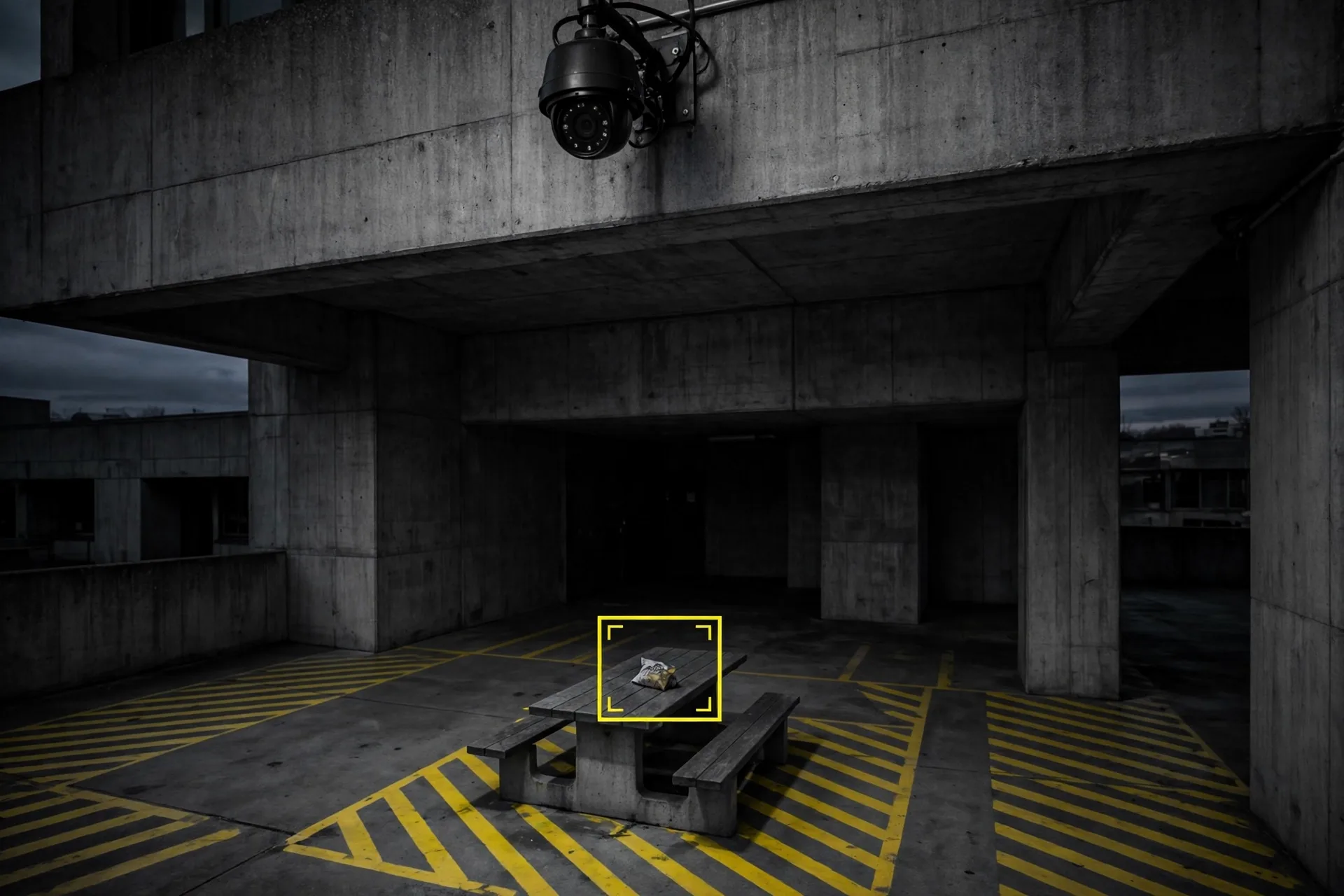
The snack was Cool Ranch Doritos, handed out by a coach after football practice. On the evening of October 20, 2025, Taki Allen was eating them outside Kenwood High School in Baltimore County, Maryland, with three teammates while they waited for a ride home. Minutes later, according to a lawsuit filed this week, police officers had the four students on their knees on the concrete, handcuffed and searched, with guns drawn.
No gun was found. What the school camera system had seen, the complaint says, was the bag in Allen hand, flagged by Omnilert Gun Detect as a firearm with 90 percent probability. And here is the detail that turns a bad false alarm into a court case. Staff reviewed the alert and cancelled it within about two minutes. The armed response happened anyway.
The Bigger Story
Start with the timeline the school district itself published on October 28, 2025, because the timeline is the story. At 7:04 p.m. the Omnilert alert was issued for review. Between 7:05 and 7:06 p.m., the district Executive Director of School Safety, its School Safety Manager and a Maryland Safe Schools Facilitator with county police reviewed it and cancelled it. In the district own words, no further action was taken in the Omnilert system.
At 7:17 p.m. the principal contacted the School Resource Officer and reported the alert. Because it was after school hours, that officer called the local precinct. At 7:23 p.m. the first officer arrived at Kenwood, responding to a report of a suspicious person with a weapon.
The state investigation fills in the missing link between the cancellation and the cars. The Maryland Office of the Inspector General for Education found that after the cancellation was sent by text message, a staff member did not notice that a cancellation had been issued and, out of concern, shared a screenshot of the alert with a law enforcement officer. That screenshot, not the live system, prompted the escalation.
Read that sequence slowly. The machine made a mistake. People caught the mistake quickly. Then the correction failed to travel as far as the alarm had, and a picture of the alarm did the rest. The lawsuit, Allen et al. v. Omnilert et al., argues that this was not one unlucky break. It says the students were failed by a system that school officials knew regularly produced false alerts, by a cancellation process with no reliable way to stop a response, and by adults who missed or ignored evidence that there was no gun.
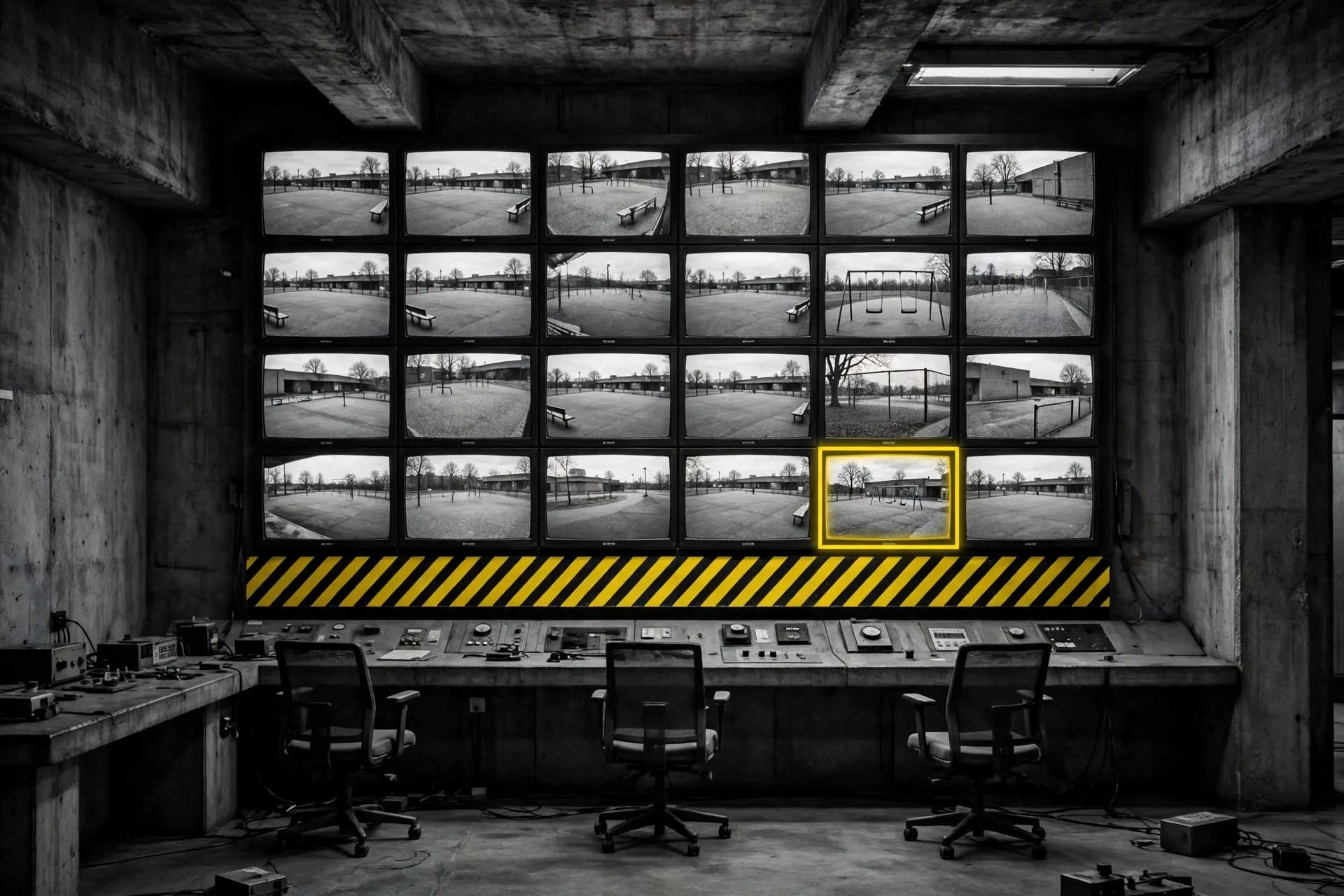
The complaint says the alert texted a photo to staff and kept moving even after reviewers had decided it was a mistake, a claim the district timeline partly supports and partly complicates. The district says its safety leaders cancelled the alert in the system. The complaint and the state report agree on the harder point. Nobody in the chain could be sure that cancelled meant stopped, everywhere, for everyone who had seen the first message.
Context
Omnilert Gun Detect watches existing school cameras and generates an alert when it sees an object it judges to meet the characteristics of a firearm. Baltimore County Public Schools introduced it in 2023, and by the spring of 2024 every school in the district was equipped, working across more than 7000 cameras. The district describes a layered approach to safety, with cameras as one layer among safety staff, resource officers, secure entrances and other detection systems.
That scale matters. A tool that watches thousands of feeds will be wrong in public, at volume, even if it is right most of the time. The complaint puts a number on that volume, saying a state finding showed that more than 99 percent of Omnilert alerts in the district were false positives that required no police response. That figure is an allegation in the complaint, drawn from the work of the inspector general, and readers should hold it as such until the court tests it. Even without the number, the basic maths of school surveillance is unforgiving. False alerts are not rare edge cases in a system this big. They are a routine output, and the procedure for handling them is the product as much as the model is.
The inspector general also corrected the popular version of what the machine saw. The office determined that the alert was detected as a potential threat due to the position of the individual, the reflective properties of the items, and relevant hand movements. In other words, the system did not simply look at a blue chip bag and label the bag a gun, however clean that version sounds as a headline. It read a posture, a glint and a grip, and it reached for the most dangerous interpretation available to it.
That distinction does not make the outcome smaller. If anything, it makes the design question sharper. A system trained to find guns in hands will sometimes find them in hands that are holding lunch, a phone or nothing at all. The question a school has to answer before it installs such a system is not whether the model will err. It is what an error is allowed to set in motion, and how fast a human correction can outrun it.
The same tension sat inside a very different test we covered this week, where models asked to mark targets in drone images often marked civilians and where calling the task a game often erased a refusal, in Models Pick Civilian Targets As Game. The setting was a lab and the stakes were simulated. At Kenwood the setting was a schoolyard and the response was real, which is why the Kenwood case may end up mattering more.
Different Perspectives
The students lawyers are blunt about where they place the blame, and it is not only on the software. Damon Hewitt, president and executive director of the Lawyers Committee for Civil Rights Under Law, said this in the announcement of the suit:
“Overreliance on artificial intelligence technology mixed with inept communication and coordination among key officials is a toxic mix.”
The Lawyers Committee represents the four students with Willkie Farr & Gallagher as pro bono counsel and Engel Law Group. The complaint alleges violations of federal and state constitutional rights, negligence and gross negligence and other violations, and reporting on the filing adds claims of unreasonable search and seizure, false arrest and false imprisonment. The students seek compensatory and punitive damages to be set by a jury. They also ask the court to bar the county and the district from using Omnilert Gun Detect or comparable systems until adequate procedures exist for verifying alerts, communicating cancellations and training staff.
Freida Winfield, who was on her way to collect her son Keith and the other students when they were detained, put the family view in one sentence in the same announcement. The police told her son, she said, that this could have been a real problem, and no child in Baltimore County should face that kind of danger while waiting outside his own school for a ride home from his mother.
The official record pushes back on parts of the wider indictment, and fairness means saying so plainly. The inspector general could not substantiate allegations that the district program was ineffective, inefficient or biased, and found no evidence in its summary that the alert itself was an act of racial bias. Its conclusion was narrower and, in a way, more damning of ordinary process. Human error and training gaps led the matter to escalate to a law enforcement response.
The district and police, for their part, said in their October 2025 statement that they had reviewed both responses, would add reminders about Omnilert signals to annual scenario based safety training, and would keep offering counselling and emotional support to students affected by the event. Councilman Julian Jones, quoted in that statement, said both agencies shared examples where the Omnilert system had captured valuable information that helped prevent bad outcomes, and agreed on annual retraining so staff follow existing protocols. Omnilert, asked about the new lawsuit by reporters, said through a spokesperson that it cannot comment on lawsuits. The defendants will answer the complaint in court, and none of the allegations in it have been proven.
So the perspectives do not line up as machine versus humans. The students say a known fallible tool was given too much power and too weak a brake. The state investigator says the brake existed but a person missed it and another person forwarded the alarm anyway. The district says the tool has also helped and that training is the fix. All three accounts can be partly true at once, and the court will have to decide which parts carry legal weight.
Why It Matters
Schools did not adopt gun detection AI because they love new software. They adopted it because the fear behind it is real, and because a camera that never blinks sounds like care at scale. That is exactly why this case deserves more than a laugh about a chip bag, and why the students lawyers are asking for rules rather than only money.
Every alert system makes a trade in silence long before anything goes wrong. It trades a small number of missed threats against a number of false ones, and it decides, in advance, how much force a probability is allowed to summon. A 90 percent figure on a screen feels like certainty to a busy adult at night. It is not certainty. It is a score from a model reading a posture and a reflection through a security camera, and at Kenwood even the people who ran the system overturned it in about two minutes.
The deeper problem is that a cancellation is a piece of information, and information needs a route as strong as the alarm route. At Kenwood the alarm travelled by system alert, by text and by screenshot. The cancellation travelled by text, and at least one person in the chain never saw it. A screenshot has no expiry date and no update. It looks exactly as urgent an hour later as it did in the first minute. Any school running a system like this, and many now do, should be asking a plain question this week. When we cancel an alert, how do we know that everyone who saw the alert has seen the cancellation, including the version saved on a phone?
There is also a question about who absorbs the cost of a false positive. For a vendor, a false alert is a statistic. For a district, it is an incident review. For four Black teenagers ordered to their knees outside their own school, the complaint says, it was an experience that changed how safe they feel waiting for a ride home. The inspector general found no substantiated bias in how the alert was generated. The lawsuit will test the response that followed, and the broader claim that harms from systems like this land unevenly even when a model treats every camera feed the same.
Closing Reflection
The most unsettling part of the Kenwood story is not that a machine was wrong. Machines that look for rare and terrible things will be wrong, often in strange ways, and everyone who bought this one had been told as much by its own alert history. The unsettling part is that the humans were right, quickly, and it did not matter, because being right in one room is not the same as being heard in every room the alarm reached.
That may be the real lesson schools take from this lawsuit, whatever a jury decides about damages. A detection system is only as safe as its slowest cancellation. Until a cancelled alert can chase down every screenshot, every text and every dispatched car with the same force as the original warning, the machine is not really the one in charge. The screenshot is.
Reporting draws on the complaint announcement and case summary from the Lawyers Committee for Civil Rights Under Law, the October 28, 2025 statement and timeline from Baltimore County Public Schools and county police, the Maryland Office of the Inspector General for Education investigative summary in Case 25-0014-I, and reporting by the Baltimore Banner, Route Fifty and The Guardian, checked November 2026. Claims drawn from the complaint are described as allegations.
Sources
- Lawyers Committee for Civil Rights Under Law, announcement of Allen et al. v. Omnilert et al., November 17, 2026
- Baltimore County Public Schools and Baltimore County Police Department, Staff and Community Update, October 28, 2025
- Maryland Office of the Inspector General for Education, Investigative Summary, Case 25-0014-I, November 2025
- The Baltimore Banner, Route Fifty and The Guardian, reporting on the lawsuit, November 18, 2026
- Hero and body illustrations: Dirty Static
END OF TRANSMISSION
Stay curious. Question everything.