
Dirty Static // The Verdict
The most complete agent stack for people who already pay for Claude, if you keep it on low risk work and watch the usage meter.
Best forPeople on a paid Claude plan who want one agent to work in Chrome tabs and across files and tools they choose, for routine research and document work
What works
- One paid plan covers both surfaces: the Chrome extension for signed in web work and Cowork for files, folders and connected tools
- Cowork now runs on web, desktop and mobile, keeps going with your laptop closed, and can split large work into parts that run at the same time
- The general availability release lets Claude act without approval for each step, with a safety classifier that checks each action against your request
- Anthropic publishes its prompt injection numbers, including the failures, and gives admins site lists and spend controls on team plans
What does not
- No free plan access for either surface, and browser and Cowork work draw on the same shared limit as chat and Claude Code and use it faster
- Chrome only for the extension: no support for other Chromium browsers and no mobile version of the extension yet
- Prompt injection is not solved: Anthropic reports strong recent results on its current test set, but older models still showed double digit success rates for attackers before safeguards
- Files on your own computer and apps outside the browser still need the desktop app, so the extension alone is not a full computer agent
Research review: based on published testing, specifications, and documentation, not hands on testing.
Anthropic spent more than a year keeping its browser agent on a short leash. Claude in Chrome began as a pilot for 1,000 Max users in August 2025. It reached every paid plan in December 2025. On August 26, 2026 Anthropic said it was generally available, and Claude could act in the browser without approval for every single step. Cowork travelled a parallel path next to it. Together they now form the agent offer you get when you pay for Claude.
What It Is
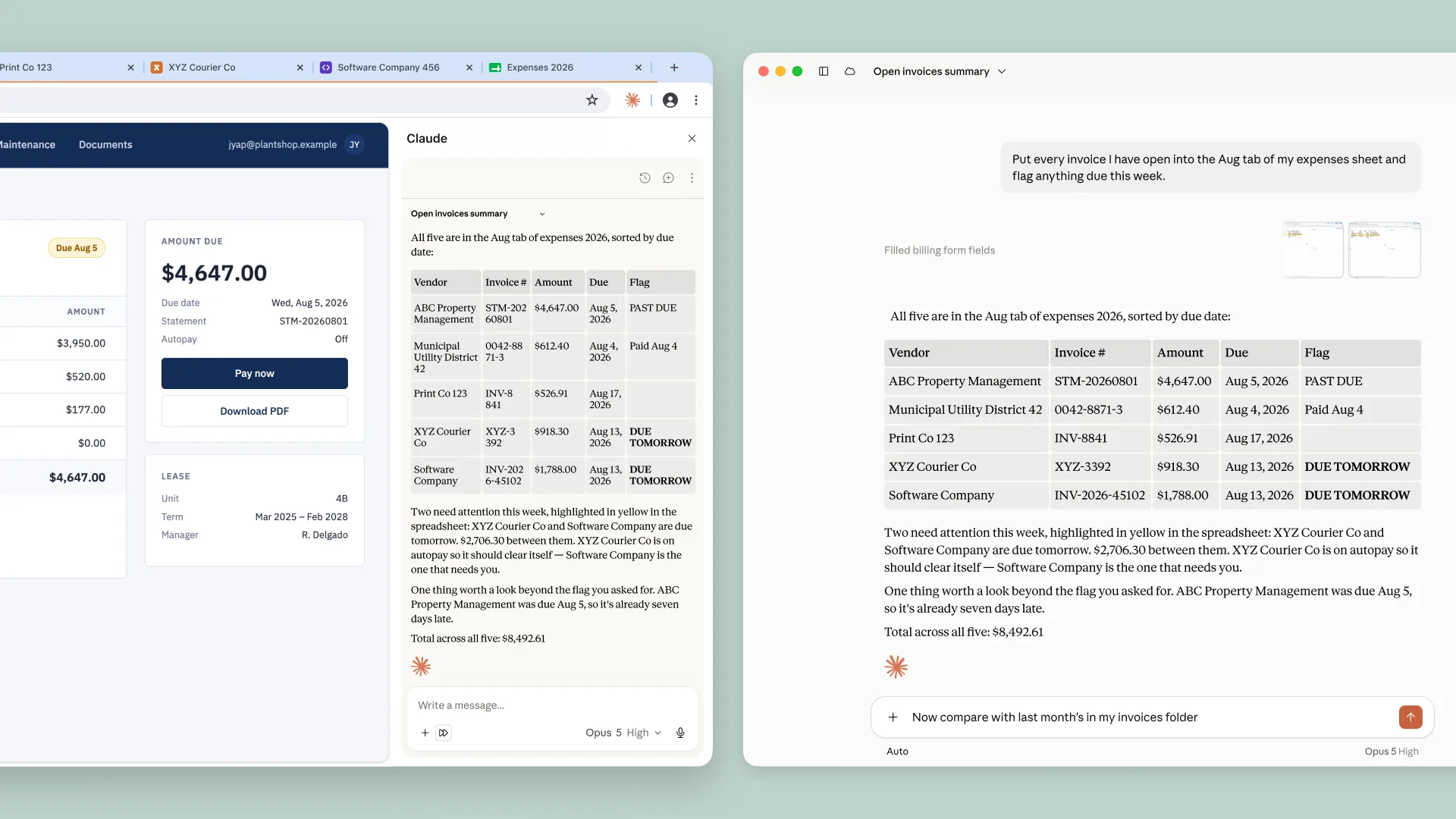
Claude in Chrome is a Chrome extension from Anthropic. You install it from the Chrome Web Store and sign in with a paid Claude account. It lives in a side panel and can view the page you are on. With your permission it can read and type text, click links, move between pages and fill in forms, using the logins you already have in that browser.
Cowork is the other half of the same idea, built for work beyond the browser. Anthropic describes it as the place where you hand Claude a goal and it works across folders and tools you choose until it returns work for you to check. It began as a research preview on January 12, 2026 for Max users on macOS. It reached general availability in April 2026. On September 16, 2026 Anthropic merged Cowork and chat into one Claude, so you no longer pick a mode first. You ask, and Claude decides if the job needs a quick answer or a longer run.
That merge matters for how you should judge this review. There is no separate Cowork subscription and no separate Chrome subscription. There is one Claude plan, and the two surfaces draw on it together. The Cowork product page says Cowork consumes limits faster than chat. Anthropic help material says browser work does the same.
Features and Specifications
The extension and Cowork share a plan and a usage pool, but they do different jobs. The extension reaches the tools that have no connector, such as internal dashboards, older systems and vendor portals, in Anthropic words from the general availability post. Cowork reaches your files and connected apps. Cowork tries a connector first, falls back to the browser when it needs to, and uses computer use on your screen only as a last resort, per the Cowork product page. Computer use itself is still in research preview.
Specifications
- Product
- Claude in Chrome extension plus Claude Cowork
- Maker
- Anthropic
- Extension platform
- Google Chrome on desktop only
- Cowork platforms
- Web, desktop and mobile, with local files reached through the desktop app
- Plans
- Pro, Max, Ultra, Team and Enterprise; no free plan access
- First pilot
- August 25, 2025, for 1,000 Max users
- All paid plans for Chrome
- December 18, 2025
- General availability for Chrome
- August 26, 2026
- Cowork launch
- Research preview January 12, 2026; general availability April 2026
- Current shape
- Cowork merged into Claude on September 16, 2026
| Area | What Anthropic documents |
|---|---|
| Browser actions | Read pages, type text, click links, move between pages, fill in forms |
| Work across tabs | Works across tabs you include, with site level permissions you grant or revoke in Settings |
| Scheduled work | Cowork can run a task on a daily, weekly or monthly cadence, and keeps going with your laptop closed |
| Files Cowork can read | Word, PDF, plain text, Markdown, HTML, JSON, CSV, Excel, PowerPoint, common image formats, YAML, XML and code files |
| Oversight | Cowork shows the files it opens, the tools it uses and the choices it makes, and you can redirect or stop it |
| Admin controls | Admins can turn Cowork off, set access by team, manage spend limits, control tool permissions by department, and stream activity to a SIEM system through OpenTelemetry |
| Claude Code link | Build in the terminal, then verify in the browser with Claude reading console errors and page structure, per Anthropic |
Pricing has no separate line for Chrome or Cowork. You pay for Claude. Prices below are from Anthropic pricing pages as reported on November 3, 2026 and the Cowork product page checked on November 5, 2026. Prices are in US dollars and do not include tax.
| Plan | Price | Notes for this review |
|---|---|---|
| Pro | $20 a month, or $17 a month billed yearly at $200 up front | Entry point for both Chrome and Cowork |
| Max | $100 a month | More usage than Pro for heavy daily work |
| Ultra | $200 a month | Top individual tier, renamed from the former Max 20x tier on October 30, 2026 |
| Team Standard seat | $25 a seat a month, or $20 billed yearly | For teams of 2 to 150 people |
| Team Premium seat | $125 a seat a month, or $100 billed yearly | More usage for staff who run long agent tasks |
| Enterprise | $20 a seat a month billed yearly, plus usage at API rates | Minimum seat count applies; admins can limit Chrome to approved domains |
Real World Experience
This is a research review. Dirty Static did not run hands on tests of the extension or Cowork for this article. What follows draws on Anthropic documentation, Anthropic safety posts, and published coverage that names its sources. Treat vendor claims as claims where the text says so.
The daily value is mundane, and that is the point. Anthropic internal use in the pilot post included managing calendars, scheduling meetings, drafting email replies, handling routine expense reports and testing new website features. Those are tasks that live in signed in pages with no clean API. An agent that can read the page and fill the form saves the copy and paste work that makes chat alone feel limited.
Cowork extends that logic to files. You point it at folders you choose. It can research, organise, draft a document or build a spreadsheet, and split a large project into parts that run at the same time. Because new Cowork sessions on Pro and Max run in the cloud by default since October 2026, per Anthropic help material reported in October coverage, a task can finish while you are away from your desk. You review the result from web or mobile.
The limit shows up fast if you use both surfaces a lot. Anthropic warns in plain language that Cowork uses your limits faster than chat because it coordinates several sub agents and many tool calls. Browser work draws on the same pool as chat and Claude Code. A long browser run and a long Cowork run on Pro can eat the allowance that a chat only user would spread across days. Max and Ultra exist for that reason, at five and ten times the sticker price of Pro.
Our earlier Tabbit browser review made the same trust point for a rival product, and it applies here with more force because Claude also touches your files. The agent is useful exactly where it is risky: inside accounts and folders that matter.
What Works
The strongest choice here is the extension form. You do not have to move to a new browser, rebuild your bookmarks or learn a new tab system. You add Claude to the Chrome you already use, grant sites one by one, and revoke a site in Settings when you are done. For teams, admins can enable or disable the extension for the whole organisation and set allow lists and block lists.
The second strength is continuity across surfaces. A task that starts in Chrome can draw on Cowork capabilities for files, and a Cowork task can open a browser when a connector cannot reach the data. The side panel in Chrome now runs as a Cowork session on most paid plans, per Anthropic support material reported in October 2026, so context is shared rather than trapped in one window.
The third strength is candour about safety, by the standards of this market. Anthropic published numbers at the pilot that made its own product look vulnerable, then kept publishing as the numbers improved. That record lets a buyer judge risk with data, even if the data comes from the maker.
What Does Not
Start with the prompt injection problem. A prompt injection is a hidden instruction in a page, email or document that tries to make the agent do something you did not ask for. Anthropic is clear that no browser agent is immune.
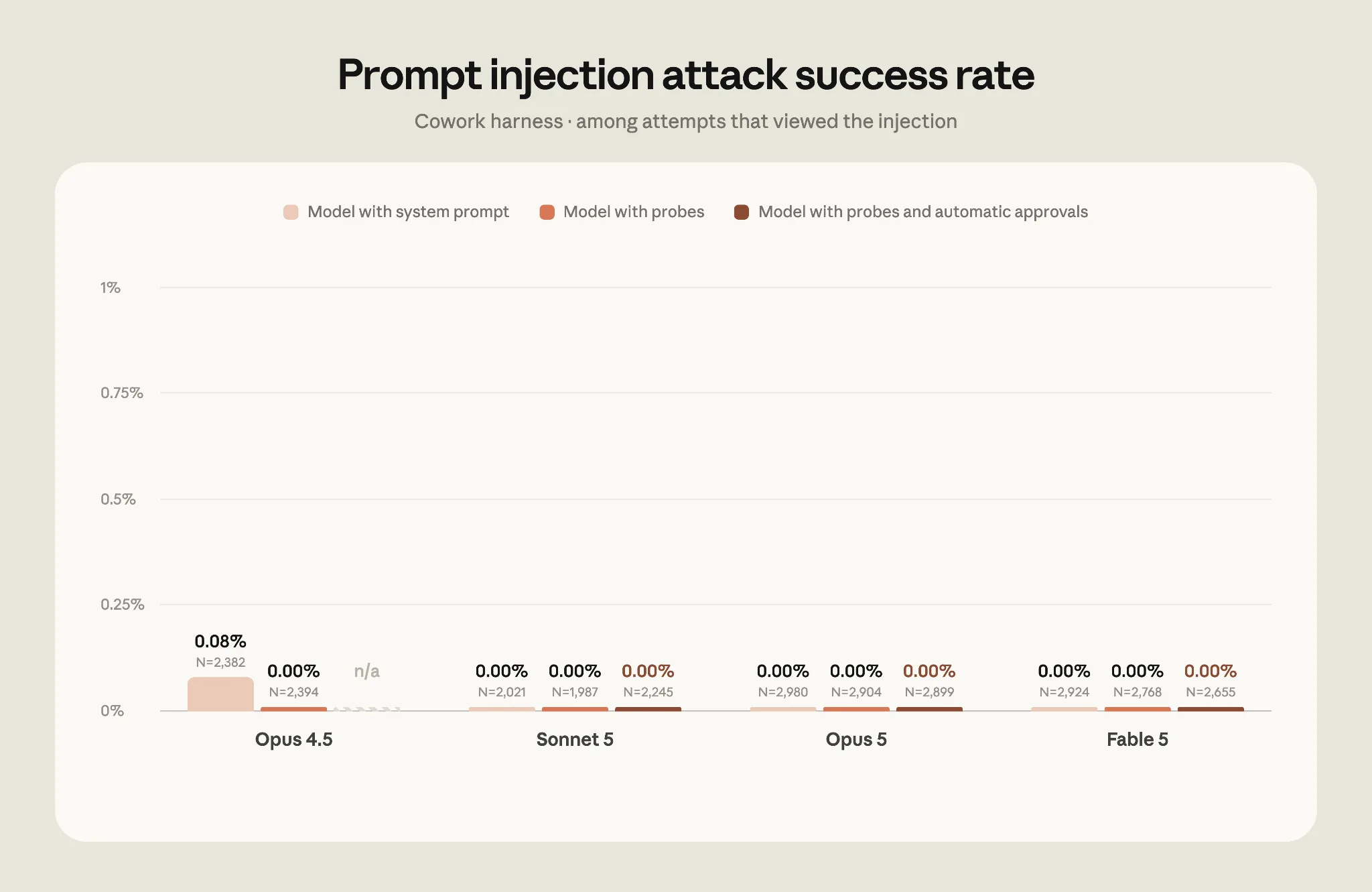
Prompt injection attack success rate, Anthropic testing, lower is better
Percent of attacks that succeeded. Pilot figures from Anthropic pilot post, August 2025, 123 test cases in 29 scenarios, autonomous mode. Current evaluation figures from Anthropic general availability post, August 26, 2026, stronger attacks from professional red team members. All figures are Anthropic internal results, not an independent audit. Checked November 5, 2026.
Read that chart with care. On the older pilot test, later models reached zero and Anthropic retired the test as saturated. On the harder current test, attacks still reached Opus 4.5 at a high rate before safeguards, and Fable 5 still showed 0.3 percent with the strongest safeguards, in what Anthropic says were low severity cases after manual review. Zero on one test set is not a promise for the open web. Anthropic own safety guide tells users to avoid the extension on financial, legal and medical sites and to start with trusted sites. Follow that advice even after general availability.
The platform limits are also real. The extension does not run on other Chromium browsers or on mobile yet, in Anthropic words. If your work lives in Edge or Brave, or on a phone, this is not your agent today. And if your work lives in local files or desktop apps, you still need the Claude desktop app. The extension alone cannot reach them.
Last, the merged product can confuse new users. Cowork is now just Claude, per Anthropic, but the help pages, product page and older coverage still use both names. Until the rollout reaches every account, some users will see Cowork next to Chat and others will not. That is a small friction, but it is friction at the exact moment a user decides how much access to grant.
Competition
Claude does not compete alone. The field now splits into extensions that stay in Chrome, full browsers that replace Chrome, and agents that live inside Chrome through Google own tools.
| Rival | Form | Cheapest way to get the agent | Platforms | Main contrast with Claude |
|---|---|---|---|---|
| Perplexity Comet | Full browser | Browser is free; paid Perplexity plans raise limits | Mac, Windows, iOS and Android | Free to start and strong on research with sources, but you must switch browsers |
| Gemini in Chrome with auto browse | Built into Chrome | Google AI Pro at $19.99 a month for auto browse, US only for acting | Chrome on desktop and Android | Stays in Chrome like Claude, but acting is paid and region limited, and it ties you to Google account tools |
| Opera Neon | Full browser | $19.90 a month for Neon own agents | Desktop | Built for delegating web tasks with several models, but its own agents have no free tier |
| Tabbit | Full browser | Standard edition free | Windows and macOS | Offers wide model choice in one browser, as covered in our Tabbit review, but it is a young browser with thin independent testing |
Comet is the pick if price and phone access matter most. Gemini in Chrome is the pick if your work already lives in Gmail, Calendar and Google other services and you are in the US. Neon is the pick if you want a browser built only for agents and you will pay for that focus. Claude is the pick if you already pay for Claude for chat or Claude Code and you want the browser and the file agent to share one plan, one context and one set of controls.
Final Verdict
Buy Claude for the work you already do in Claude, not for the browser alone. If you are on Pro for chat and you have routine web tasks in trusted tools, turn on the extension for those sites, keep automatic approval off until you trust a workflow, and watch how fast agent work drains your limit for a week. That week will tell you if Pro is enough or if the honest price for your use is Max.
If you lead a team, pilot it the way Anthropic piloted it: a small group, a short list of approved sites, no financial or health or legal work, and a review of what the agent touched. The published safety work is better than silence from rivals, but it does not remove the need for limits you set yourself.
The product earns its place because it meets work where work already happens, in Chrome tabs and in messy folders, without asking you to adopt a new browser to get an agent. It loses points for the same reason. An agent with your logins and your files is a new kind of access to grant. Grant it in slices, and this is the most coherent agent stack a Claude subscriber can buy today.
Sources
- Anthropic: Piloting Claude in Chrome
- Anthropic: Claude in Chrome is generally available
- Anthropic: Mitigating prompt injections in browser use
- Anthropic: Claude Cowork product page
- Anthropic pricing, as reported November 3, 2026, and the Cowork product page plan cards checked November 5, 2026
- Images: Hero image is a generated Dirty Static house style illustration. Body images are from Anthropic, credited at each image, from the general availability post.
END OF TRANSMISSION
Stay curious. Question everything.