
Dirty Static // The Verdict
Claim the profile now if you are eligible, and treat the agent as a careful trial. The Hub gives firms real control over facts and real data from ChatGPT itself, but agents start narrow, sell nothing on their own, and come with no promise of better placement.
Best forEligible firms that sell online and want their facts, prices and policies correct inside ChatGPT, plus a first view of how often ChatGPT sends people to them
What works
- A claimed profile lets a firm fix the facts ChatGPT repeats about it, with product feeds for prices and stock and a blue check after full verification
- The Hub reports mentions, website clicks and discovery topics from ChatGPT itself, ending the need to guess visibility from outside tools alone
- The agent chat is labelled, separate from the main chat, and built from the firm own product and policy facts, so customers know who is speaking
- No fee is listed for claiming or for an agent at launch, and Shopify stores get a short path in through a link that already feeds their catalogue to ChatGPT
What does not
- Business Agents are open only to eligible ecommerce and online service firms in the United States, and OpenAI reviews each category and use before an agent can publish
- An agent can explain and compare products but cannot complete a purchase, take a booking or check an order, so every sale still ends on the firm website
- Insights arrive only after activity passes thresholds OpenAI does not publish, a blank can mean too little data rather than zero, and firms never see the chats behind the numbers
- Each brand and each location is managed on its own for now, with no central control for groups, and claiming brings no promise of higher placement or more sales
Research review: based on published testing, specifications, and documentation, not hands on testing.
OpenAI has given every firm a front door inside ChatGPT, and then locked half of it. Businesses in ChatGPT launched in beta on November 10. Through a new Business Hub, a firm can claim its company profile, fix its details, add product feeds and read data on how people meet it in ChatGPT. A smaller group can go one step further and publish a Business Agent, a labelled chat that answers customers from the firm own facts. Facts checked November 11, 2026.
The scale explains the rush. OpenAI says ChatGPT reaches 1.2 billion people each week, and more of those people now start shopping and supplier research in a chat window rather than a search box. A wrong price or a stale policy inside that window is no longer a small error. It is the answer a customer acts on. This review judges whether claiming a profile, and maybe an agent, is worth a firm time this week.
What It Is
Businesses in ChatGPT is the umbrella name. Business Hub is the desk where a firm manages its presence. A Business Agent is the public face a customer can talk to. The three names sound alike and mean different things, and OpenAI own material keeps them apart for a reason. A firm can do the first two without ever publishing an agent.
A profile is what a customer sees when a firm appears in a ChatGPT answer. The customer can open the profile, see products and details, and choose to visit the website or, where one exists, start a chat with the agent. That chat is clearly labelled, sits apart from the customer main chat, and is distinct from ChatGPT own answers, per OpenAI. The firm supplies the facts. ChatGPT keeps its own voice in the main answer.
The timing pairs with the office push from its main rival. Anthropic launched sheets and boards inside Claude this week, tested in our Claude Sheets and Whiteboards review, which named ChatGPT workplace tools as the rival land grab from the other side. OpenAI move is less about files and more about the shop window. It wants firms to treat ChatGPT as a place where they are listed, measured and, in time, advertised.
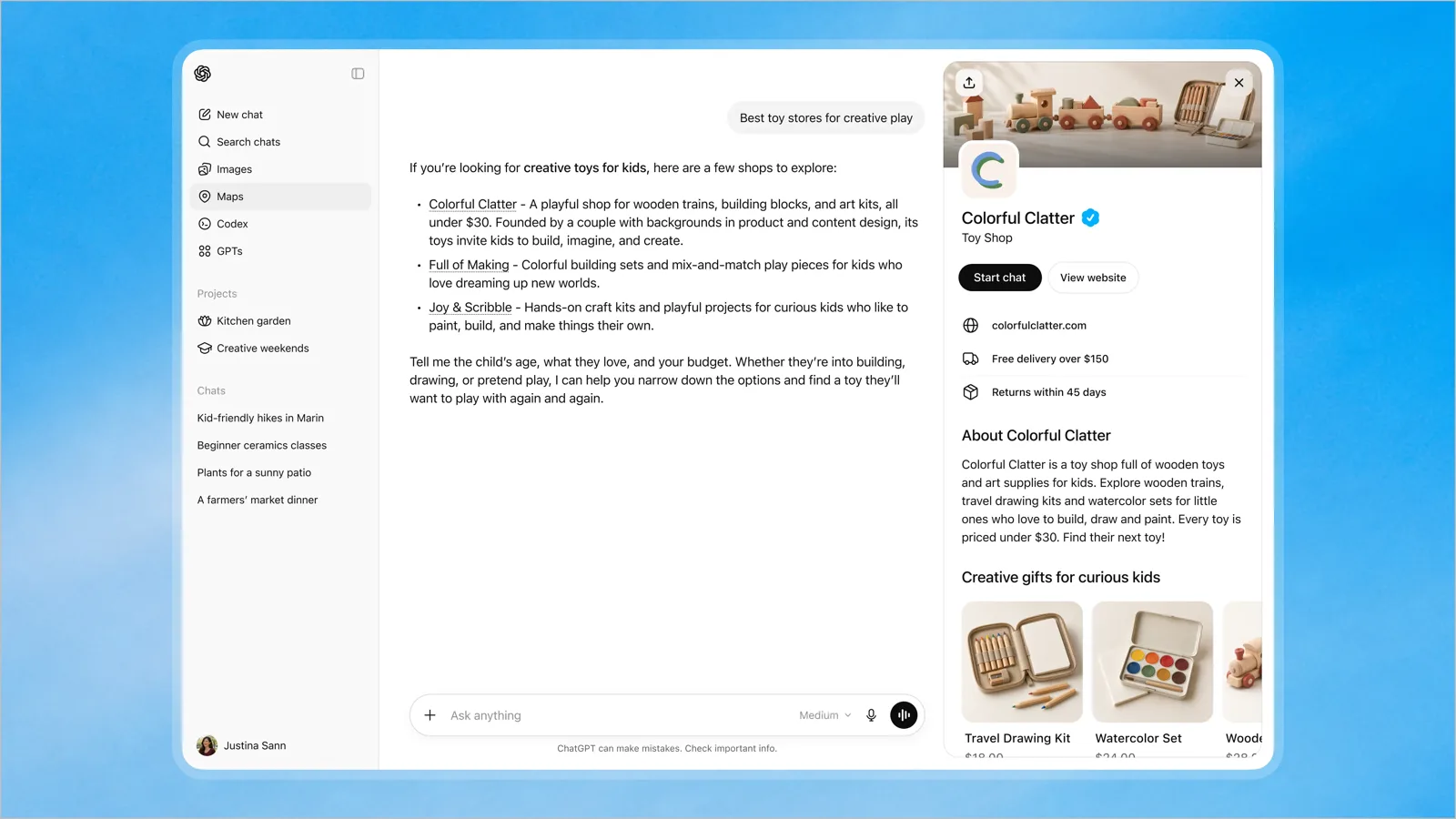
Features and Specifications
The Hub does three jobs: claim, correct and measure. After a claim is verified, a firm can update key details and add product feeds through its own entry, with pricing and availability. Shopify merchants can connect a store from Business Hub or from the Shopify admin side to ease verification, and OpenAI notes that eligible Shopify products already reach ChatGPT through Shopify Catalog. That last point matters. For Shopify firms, the shelf is stocked before the profile is claimed.
Specifications, from OpenAI launch post and setup material as reported
- Programme
- Businesses in ChatGPT
- Maker
- OpenAI
- Launch
- November 10, 2026, in beta
- Reach claim
- 1.2 billion people use ChatGPT each week, per OpenAI
- Profile claiming
- Eligible businesses located where ChatGPT is available; a website is needed at this stage, per setup material as reported
- Verification stage one
- Business phone, business email, a DNS text record on the firm domain, or a Shopify store, per the setup guide as reported
- Verification stage two
- An identity check through Persona before a firm can publish changes, view insights or build an agent; the blue check appears after that check is approved, per the setup guide as reported
- Insights window
- Past 28 days, per setup material as reported
- Insights shown
- Mentions, website clicks, profile views and discovery topics, all grouped and shown only after reporting thresholds are met
- Business Agents
- Eligible ecommerce and online service businesses in the United States, after a claim, with category and use review by OpenAI
- Agent limits
- Explains products and policies, compares options and links to the firm website; cannot complete purchases, take bookings or check orders, as reported from OpenAI material
- Ads route
- A firm can sponsor its agent and use it as the destination for ChatGPT Ads; sponsored spots are labelled and kept apart from ChatGPT answers
Insights need a careful read, because the definitions shape the numbers. For an online firm, a mention counts when ChatGPT references its website, so a brand name alone in an answer may not register, as reported from the setup material. For a local firm, a mention counts when ChatGPT shows a result for that location. Website clicks count recorded clicks on links, and a dashboard note reported on launch day warns that clicks do not confirm a visit or a sale. None of this makes the data weak. It makes it a signal with edges, and firms should read it as one.
Pricing is the simplest part today and the least settled part tomorrow. OpenAI setup material lists no fee for claiming or verification. Digiday reports that the Hub and agents cost nothing for now, and that OpenAI monetization lead Benji Shomair left a paid model open for later. The money that does move today is ads money: a firm can sponsor its agent, building on a sponsored agent test OpenAI began in September with selected advertisers in the United States, as reported at launch. Treat free as a launch term, not a contract.
| Part | Who can use it today | Cost today |
|---|---|---|
| Claim a profile in Business Hub | Eligible firms located where ChatGPT is available, subject to category and integrity checks | No fee listed |
| Publish profile changes and view insights | Claimed firms that also pass the Persona identity check | No fee listed |
| Build a Business Agent | Eligible ecommerce and online service firms in the United States, after claim and review | No fee reported at launch |
| Sponsor a Business Agent | Firms running ChatGPT Ads that point to their agent | Paid ads, rates not stated in launch material |
Real World Experience
This is a research review. Dirty Static did not claim a profile or publish an agent for this article. What follows draws on OpenAI launch post, OpenAI setup and policy material as reported on November 10 and 11, launch day accounts from people who started a claim, and trade reporting that names its sources. Treat company claims as claims where the text says so.
The claim flow has two gates, and the second gate is the one firms will feel. Gate one proves a link to the firm, by phone, email, domain record or Shopify store. Gate two is an identity check through Persona, and it has to pass before a firm can publish changes, view insights or create an agent. Launch day accounts fit that picture: one tester verified a claim by domain record and still saw a pending claim with no data, while other early users reported data already present. A claim filed is not a profile live, and a profile live is not an agent approved.

The agent design is careful about one thing above all: who is speaking. The chat is labelled, it opens only when a customer chooses it from a profile, and its answers come from the product and policy facts the firm supplied. OpenAI setup material, as reported, tells firms to test the agent with a plain customer question, such as whether a sale item can be returned, and to fix the facts if the answer is wrong. That is the right test, because a wrong return answer from your own agent is worse than a wrong answer from a general model. It carries your check mark.
The sponsored route is where trust will be tested. A firm can pay to make its agent the landing spot for a ChatGPT ad, with the spot labelled as sponsored and kept apart from ChatGPT answers. Shomair described the organic agent and the sponsored agent as the same agent behind two doors, in Digiday reporting. That is a clean design on paper. In practice, customers will judge the label, not the design note, and firms should want the label to stay loud.
What Works
The first strength is control over facts at the point where facts get repeated. Prices, stock, delivery terms and return rules are the details customers ask about and models get wrong. A feed the firm owns, tied to a verified profile, gives ChatGPT a better source than a scraped page from last season. For Shopify firms the path is shorter still, since their catalogue already flows in.
The second strength is data from the source. Until now, firms measured their standing in ChatGPT with outside tools that sample answers and estimate. The Hub reports mentions, clicks and discovery topics from inside the product. The topics may prove the most useful part. They show the themes in chats where a firm site was cited, which tells a firm what buyers think it sells, and where its own pages say too little.
The third strength is consent in the agent flow. The customer opens the profile. The customer starts the agent chat. The chat is labelled as the firm speaking, and it stays apart from the main chat and from ChatGPT own judgement. That order respects the reader, and it protects the firm too: an agent answer can be checked against the facts the firm supplied, rather than blamed on a model mood.
What Does Not
The map is small. Agents start with two kinds of firms in one country. Local shops and restaurants can claim only an existing listing in the United States for now, as reported from setup material, and every brand and location is managed on its own. A group with ten brands or forty sites faces forty small jobs, not one desk. OpenAI says tools for firms with more complex needs are planned. No date is given, and this review will not invent one.
The agent stops at the till. It can explain, compare and link. It cannot complete a purchase, take a booking or check an order. It also cannot be swapped for a firm own agent: Shomair said firms cannot bring their own agents, in Digiday reporting. So the agent is a well briefed greeter, not a sales desk and not a support desk. Firms with a strong help centre may find it answers the easy questions and hands off the rest to the same website customers could have visited first.
The insights have a fog built in. Data shows only after activity passes thresholds OpenAI does not publish. A blank field can mean too little activity, data still gathering, or nothing at all, and firms never see single chats, not even chats with their own agent. That privacy line is right for customers. It also means a firm cannot trace a bad agent answer back to the chat that produced it through the Hub, which makes careful testing before launch the only real safeguard.
Competition
Firms do not choose between this Hub and nothing. They choose where to spend the hours they give to being found and being answered well.
| Rival route | What you get | Main contrast with Business Hub |
|---|---|---|
| Google Business Profile | A mature, free listing system for search and maps, with reviews, photos and local details built over many years | Strong for local discovery today, while the Hub is about how a firm appears inside chat answers rather than on a map |
| Google Business Agent tests in ads | A retailer agent inside ad units, in a United States beta reported in September | A paid first design, while OpenAI offers an organic agent that a firm can also sponsor |
| Claude for work, including Sheets and Whiteboards | An assistant suite where teams build files and plans with Claude, covered in our Claude review today | A tool for a firm own staff, not a public profile or a customer facing agent for the firm |
| Outside AI visibility tools | Sampling based estimates of how brands appear across several AI assistants | Wider view across rivals, but estimated from outside; the Hub is narrow, covering ChatGPT only, and reports from the source |
| Your own website alone | Full control of facts, prices and policies, with no new desk to manage | Still the base every route draws on, but it gives no profile, no agent and no view of ChatGPT mentions or clicks |
Google is the pick for local search today. Outside tools are the pick when a firm needs one view across ChatGPT, Claude and other assistants. The Hub is the pick when ChatGPT itself is where customers meet the firm, because no outside tool can hand back the source data or the verified feed slot.
Final Verdict
Claim it. That part is not close. If your firm is eligible, the cost is time, the gain is correct facts and a first honest look at mentions and clicks, and the risk sits in sloppy data rather than in the claim itself. Do the website audit first, pass both verification stages, and read the first 28 days of insights as a baseline rather than a score.
The agent needs a narrower yes. Eligible online sellers and service firms in the United States should build one, test it hard on returns, prices and edge cases, and publish only when its answers match the website word for word on the facts that cost money. Everyone else should wait without guilt. Your category or country is not open yet, and OpenAI has given no date to plan around.
What OpenAI has built is a listing desk with a measured view and a careful first agent, not a new sales channel. The firms that gain most will be the ones whose facts were already clean and whose expectations stay plain: be correct where customers ask, learn what the topics reveal, and let the website still close the sale.
Sources
- OpenAI: Introducing Businesses in ChatGPT
- The Keyword: ChatGPT Opens Business Profiles and Agents to Brands
- GrowthX: Businesses in ChatGPT: What is it and how it works
- TechBooky: Businesses in ChatGPT Adds Profiles and Agents
- FoneArena: OpenAI rolls out Businesses in ChatGPT with Business Hub and Business Agents
- Images: Hero and counter illustrations are generated Dirty Static house style illustrations. The profile figure is official OpenAI launch art, credited at the image.
END OF TRANSMISSION
Stay curious. Question everything.