Dirty Static // The Verdict
A well built idea with one strong trial behind its method and no trial yet behind this exact product. Worth the money only if you treat it as a sleep routine tool, use the trial window hard, and skip it entirely if any safety exclusion applies to you.
Best forAdults with restless sleep who already track heart rate and HRV, want a drug free evening routine, and will judge the device on their own data inside the 30 day trial
What works
- Three parts that actually connect: ear stimulation, overnight tracking from Zenoband Mobi or a watch or ring you may already own, and an app coach that reads both
- Sleep Mode uses the same stimulation pattern as a published randomized trial in chronic insomnia, 4 Hz and 20 Hz with a 200 microsecond pulse width
- No subscription is required to use the app and your recorded data, per published retailer guidance, and the current offer bundles Zenoband Mobi free
- Clear safety list, a 30 day trial, and a device warranty that extends by one year when you register the warranty card
What does not
- The strong trial tested the method in a clinic protocol, twice a day for 30 minutes over eight weeks, not this product in a 20 minute bedtime routine at home
- The company own pages do not agree on price or mode names, with $439 on the main product page, $499 on its sleep page, and Recovery and Relief both used for what looks like the same slot
- Six broad benefit areas rest on one main evidence area, sleep, and the wider claims for focus, digestion and pain remain company claims
- The free Zenoband Mobi is a gift with no warranty, no return rights and no after sales service, and the earpiece itself carries only one month of warranty
Research review: based on published testing, specifications, and documentation, not hands on testing.
Most sleep gadgets stop at a score. They watch you sleep badly, grade the damage in the morning, and sell you a chart. Luna Plus tries to act before the night starts. You put an earpiece in your left ear for 20 minutes before bed, it sends mild electrical pulses to a branch of the vagus nerve, and the system then tracks what your heart and sleep do next.
That is a bolder pitch than a tracker, and a harder one to judge. Electrical stimulation of the vagus nerve has real research behind it. It also attracts broad wellness claims that run well ahead of that research. This review separates the two, using ZenoWell own product pages, its Sleep Europe 2026 release, and the trial the company cites by name.
What It Is
Luna Plus is made by ZenoWell, a neurotechnology company based in Berlin and incubated at Heidelberg University Medical School, in company wording. The technique is called transcutaneous auricular vagus nerve stimulation, shortened to taVNS. Transcutaneous means through the skin. Auricular means the ear. The vagus nerve is a major nerve in the parasympathetic system, the system linked to rest and digestion. One branch of it reaches the outer ear, and taVNS sends mild pulses to that branch.
ZenoWell frames the system as Track, Understand, and Improve. Track is the data layer. Understand is the AI Coach reading that data each morning. Improve is the stimulation session, adjusted over time from what the data shows. That loop is the product. The earpiece alone is the older and simpler Luna, which still exists in the range.
The company showed Luna Plus at IFA Berlin and presented it at Sleep Europe 2026 in Maastricht from October 20 to 23, at Booth A75, per its release. Global pre orders first opened in July 2026, and the offer was still live on the product page on November 6, 2026, with a fresh round of coverage this week.
Features and Specifications
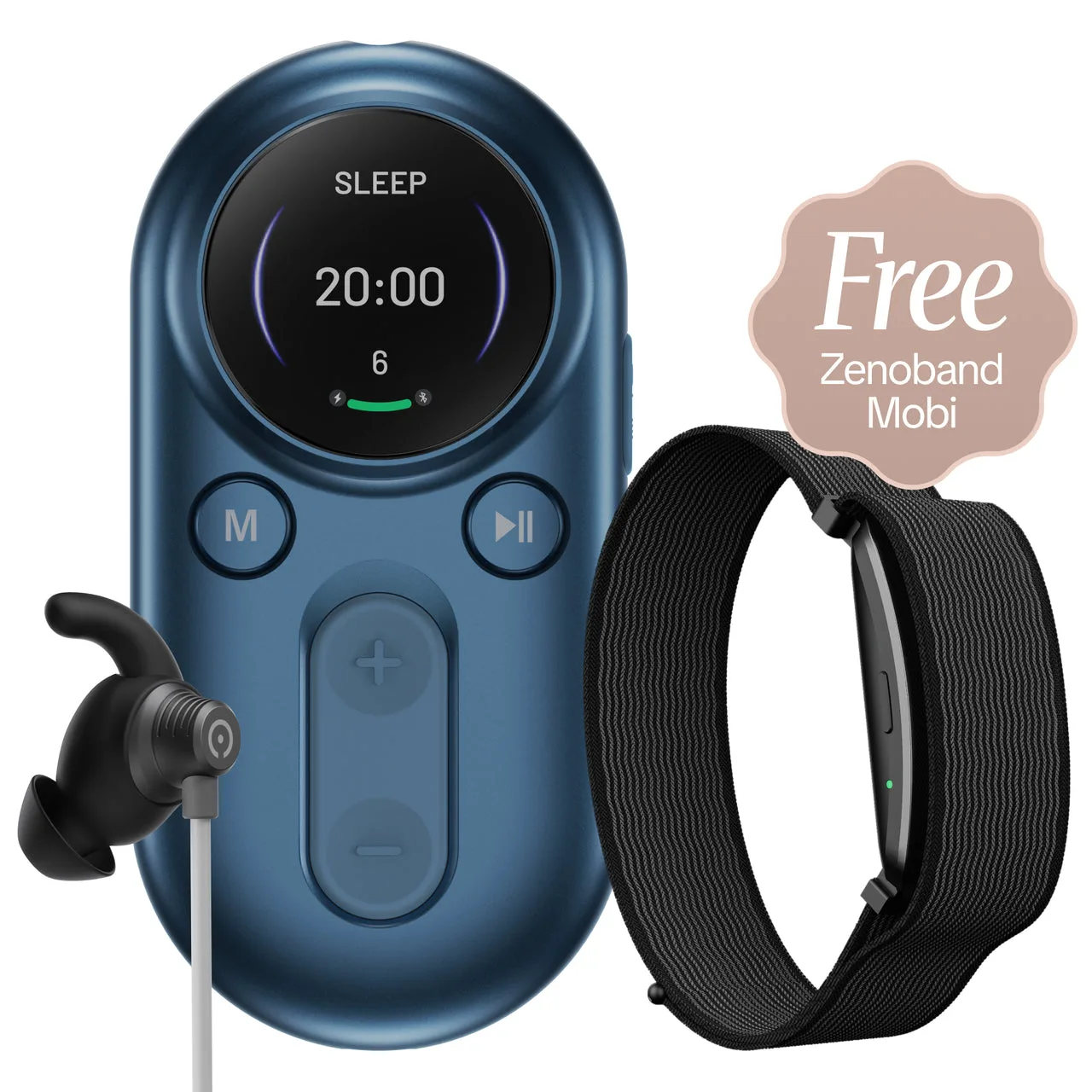
Four modes run on the device itself: Sleep, Relax, Relief and Medit, in the company FAQ wording. The app unlocks Focus and Digest, plus guided audio and session history. One wrinkle: other ZenoWell pages list Recovery where the FAQ lists Relief, and the main product page names six modes as Sleep, Relaxation, Recovery, Focus, Meditation and Digestion. Treat the count as settled at six and the exact names as unsettled until the company cleans up its own pages.
Sleep Mode is the flagship. ZenoWell says it alternates between 4 Hz and 20 Hz with a nominal pulse width of 200 microseconds, and cites Zhang et al., 2024 for those parameters. You moisten the earpiece with gel or water, place it in the left ear, and raise the intensity until you feel a comfortable tingling. A gel tube and a spray water bottle ship in the box.
Specifications
- Product
- ZenoWell Luna Plus, models A102 and B102 series
- Maker
- ZenoWell, Berlin, incubated at Heidelberg University Medical School
- Method
- taVNS, stimulation of the auricular branch of the vagus nerve, left ear
- Modes
- Six in total; four on the device and Focus and Digest in the app
- Sleep Mode pattern
- Alternating 4 Hz and 20 Hz, nominal pulse width 200 microseconds, per ZenoWell
- Session length
- About 20 minutes, Sleep Mode used before bed
- Tracking inputs
- Zenoband Mobi, or Apple Watch, Oura Ring, WHOOP and other compatible wearables, plus phone face scan
- AI Coach
- Multimodal assistant built on retrieval augmented generation and a curated vagus nerve research database, per ZenoWell
- Certifications listed
- CE, FCC, RoHS and UKCA
- Software updates
- 2 years, per the product page
- Warranty
- 1 year on the device, plus 1 extra year when you register the warranty card; 1 month on the earpiece
- Trial
- 30 days, for the device and earpiece only
Pricing needs care because ZenoWell own pages disagree. The main product page showed $439 on November 6, 2026, struck through from $758, with free delivery and Zenoband Mobi listed as a free limited offer. The company sleep page listed Luna Plus at $499 on the same check. The main product page is where checkout happens, so $439 is the figure to budget on, and the gap is worth a screenshot before you pay.
| Item | Price checked November 6, 2026 | Notes |
|---|---|---|
| Luna Plus | $439 on the main product page | Zenoband Mobi listed as a free gift; the sleep page showed $499 |
| ZenoWell Luna | $409 on the company US store | Four modes, no app and no AI Coach |
| ZenoWell Vita | $239 on the company store | Three modes, the simple entry device |
| App and AI Coach | No subscription required | Retailer guidance says recorded data stays accessible without added charges; the US comparison page lists 2,000 AI Coach points included, and ZenoWell does not explain clearly what happens when points run out |
Shipping on the product page: orders processed within 7 business days, standard delivery of 7 to 14 business days, shipping to EU countries, the UK and selected countries worldwide, with free shipping on orders over $100 and possible import fees outside the EU.
Real World Experience
This is a research review. Dirty Static did not test Luna Plus at home. What follows draws on ZenoWell documentation, its conference release, the trial it cites, and the limited independent hands on coverage published so far. Treat company benefit claims as claims where the text says so.
The routine is simple on paper. One 20 minute session before bed, left ear, gel or water on the contact points, intensity set by feel. The Review Smiths, in a short hands on piece, described the setup in similar terms: a small earpiece, a tingling sensation compared to a TENS machine, and core modes that work without the phone. That last point matters. A sleep tool that demands screen time at bedtime would fight its own purpose, and Luna Plus can run its core modes with the phone in another room.
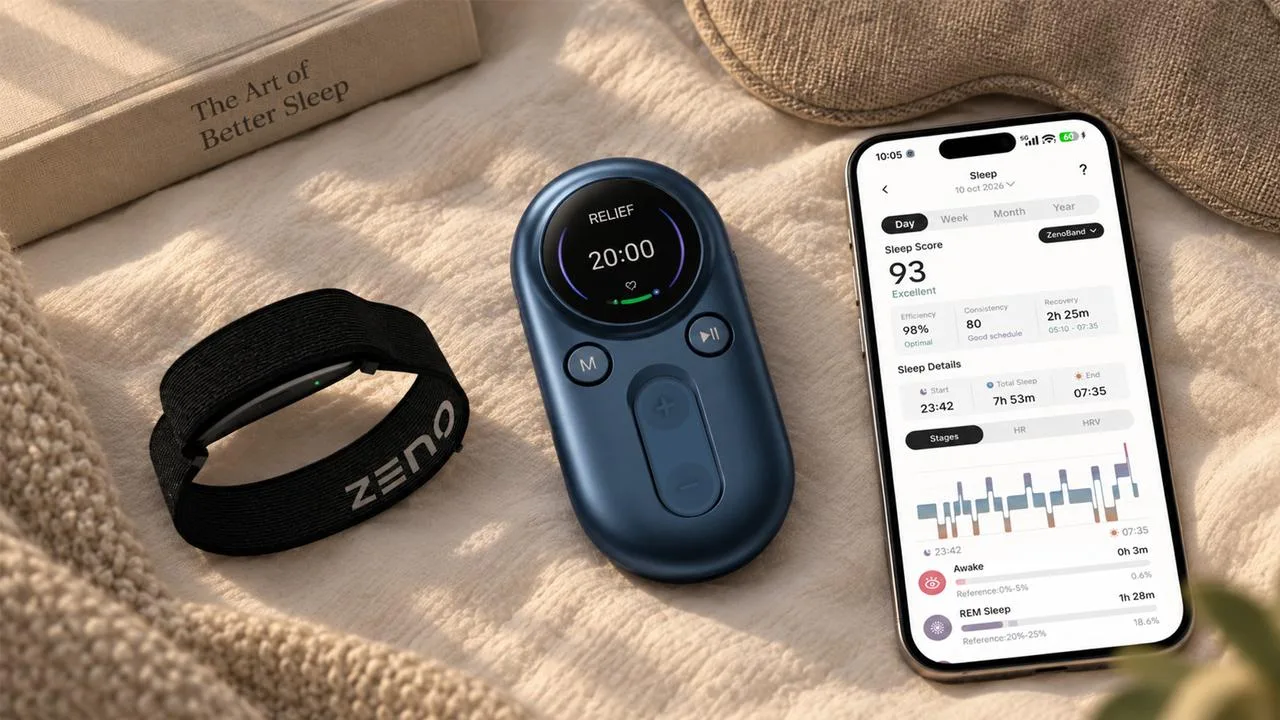
The tracking half will feel familiar if you own a modern watch or ring. Zenoband Mobi records heart rate, HRV, sleep score and sleep time. Apple Watch, Oura Ring and WHOOP can feed the same app, per the Sleep Europe release, and the US store also lists Garmin, COROS, Fitbit and Health Connect. The app shows changes in heart rate and HRV before, during and after a session, plus sleep stages and trends over days, weeks and months.
The AI Coach is where the pitch gets ambitious. ZenoWell says the coach is a multimodal assistant built on retrieval augmented generation over a curated database of vagus nerve research. In plain terms, it answers and advises from a set library of sources rather than from the open web. Each morning it breaks down the prior night, combining wearable data and session logs with context you give it, such as late meals, travel, or a check in that says you feel drained. You can speak to it to log your state and get a session suggestion.
Read that as guidance, not diagnosis. ZenoWell itself says the AI Coach is not a medical diagnosis tool. Its value, if it works well, is pattern spotting across data you would never join up by hand. Its risk is the usual one for this category: fluent advice that sounds personal because it read your charts.
What Works
The strongest part of this product is that its Sleep Mode parameters are not invented marketing numbers. They match a real trial. In Zhang et al., published in JAMA Network Open in 2024, 72 adults with chronic insomnia were randomized to active taVNS or sham stimulation. The active group improved far more on the Pittsburgh Sleep Quality Index, the standard sleep quality scale used in the trial.
Change in PSQI score at week 8, Zhang et al. 2024, lower is better
Mean reduction in Pittsburgh Sleep Quality Index score from baseline. Active taVNS fell by 8.2 points and sham by 3.9 points, a difference of 4.2 points, with an effect size of Cohen d 1.2. The trial ran in Beijing with 72 participants. Checked November 6, 2026.
The second strength is the closed loop design. A stimulator with no tracking asks you to trust a feeling. Luna Plus at least tries to show you session by session changes in heart rate and HRV, and night by night changes in sleep. If nothing moves after weeks of use, your own data makes the return decision easier, and the 30 day trial gives you a window to use it.
The third strength is restraint on money after purchase. There is no required subscription for the app in the material checked, and the current bundle adds the tracking band at no added price. In a market where Pulsetto pairs a cheaper device with an optional premium tier and branded gel costs, a single payment has real appeal.
What Does Not
Now the catch, and it is a large one. The trial protocol was not the Luna Plus routine. Trial participants received taVNS twice a day, in 30 minute sessions, five days a week, for eight weeks, in a clinical study. Luna Plus asks for one 20 minute session before bed. Same nerve, same frequency pattern, very different dose. ZenoWell product page goes further and prints study referenced figures of 59 percent improvement on PSQI, 66 percent on the Insomnia Severity Index and 73 percent on deep sleep. Those are company presented figures tied to research on the method. They are not results from a trial of this product in your home, and no published trial of Luna Plus itself was found in this research.
The breadth of the pitch also outruns the evidence. Six modes reach across sleep, stress, head tension, focus, meditation and digestion. The solid published support found here is for sleep, with smaller and mixed work elsewhere. Dealroom coverage of the pre order launch made the same point in blunter form: recent trials point to possible sleep benefits, studies are small and varied, and the wider health claims remain unproven with no independent validation offered at launch.
Then there are the small print traps. The free Zenoband Mobi, the part that makes tracking work if you own no other wearable, is a gift. ZenoWell states plainly that gifts are not covered by warranty, returns, exchange or after sales service. If the band dies, the loop breaks and the company owes you nothing for it. The earpiece, the part in contact with your skin every night, carries one month of warranty. For a $439 system, both terms are thin.
Last, the company presentation is messy in ways a careful buyer will notice. Prices differ across its own pages. Mode names differ across its own pages. Session and shipping details have shifted between older coverage and the current product page. None of that proves the device is weak. All of it says to buy on the current product page terms, in writing, and to test hard inside the trial window.
Competition
Auricular stimulation is a small field with clear price poles. Nurosym sits at the premium end with an app free design. Pulsetto attacks from the neck at a lower entry price. The base Luna shows what ZenoWell charges when the app and coach are stripped out.
| Rival | Form | Price as listed in November 2026 coverage | Session | Main contrast with Luna Plus |
|---|---|---|---|---|
| Nurosym | Single ear clip on the tragus, app free | About €699, about $700 in US comparisons | About 30 minutes | Strong published evidence base for its own device and no app at all, at a far higher price |
| Pulsetto FIT | Neck worn cervical stimulator | About $296 | About 4 minutes, sleep program about 10 | Shorter sessions and a lower entry price, with an optional premium subscription and gel costs to add |
| ZenoWell Luna | Ear stimulator, no app | $409 on the company US store | About 20 minutes | Four modes and no tracking or coach, so the Plus premium buys the data loop |
| Neuvana Xen | Earbud stimulator synced to music | About $449 | Varies | Pairs stimulation with listening, with no sleep tracking loop of its own |
Nurosym is the pick if device specific evidence matters most and money matters least. Pulsetto is the pick if four minute sessions are the only kind you will actually do. Luna Plus is the pick only in one case: you want stimulation and tracking joined in one app, and you will use the trial month to demand proof from your own numbers. Readers weighing other wearables may also want our Legend Pendant review and our Brilliant Labs Halo smart glasses coverage for how this site judges small devices with large claims.
Final Verdict
Luna Plus is not nonsense, and it is not proven. The nerve pathway is real, the sleep trial behind the method is genuinely strong for a study of its size, and the system design is smarter than a stimulator sold on vibes alone. ZenoWell then weakens its own case with six modes of broad claims, inconsistent prices and names, and gift terms that leave the tracking band unprotected.
Buy it only as an experiment with an exit. Order from the main product page at $439, confirm the trial terms at checkout, wear it every night, and watch two things: your sleep trend and your HRV trend. If both sit flat at day 25, send it back inside the window and keep the lesson for free. If they move, you have paid for a routine you can see working, which is more than most sleep gadgets ever show you.
Skip it without a second thought if any safety exclusion fits you, if you want a treatment for insomnia rather than a wellness routine, or if you already own a good tracker and expect the coach alone to justify $439. It will not. The earpiece is the product. Judge it like one.
Sources
- ZenoWell: Luna Plus product page
- ZenoWell via Fitt Insider: ZenoWell Joins Sleep Europe 2026 to Present Its taVNS Sleep Technology
- ZenoWell via Fitt Insider: ZenoWell Launches Luna Plus to Build Connected VNS Ecosystem
- Zhang et al.: Transcutaneous Auricular Vagus Nerve Stimulation for Chronic Insomnia Disorder, JAMA Network Open, 2024
- Dealroom: ZenoWell opens pre orders for Luna Plus
- Wareable: ZenoWell Black Friday deals and Luna Plus guidance
- The Review Smiths: ZenoWell Luna Plus hands on notes
- Images: Hero image is a generated Dirty Static house style illustration. Body images are from ZenoWell, credited at each image.
END OF TRANSMISSION
Stay curious. Question everything.