Apple ended the Intel Mac, and with it the old Hackintosh scene. That scene worked by patching the Intel build of macOS onto hardware Apple never sold. Current versions of macOS have no Intel build at all, so there is nothing left to patch. Stela, an open source project by GitHub user tylertms, takes the harder road instead. It boots the unmodified Apple silicon build of macOS on an ordinary PC and translates the code as it runs.
Version 0.1.0 landed on November 11, 2026, and it matters because the approach should not work as well as it apparently does. A launch post on X by @qwerty__cs announcing the release shows the ARM build of macOS 27.2 booting, on a machine built around a Ryzen 7 9800X3D and an RTX 5080. That is Apple software written for Apple chips, running on an AMD processor and an NVIDIA card, with no Apple hardware anywhere in the chain.
Stela
Official siteA general purpose Apple silicon layer for x86-64 PCs, written in Rust. Primary use case: booting the unmodified Apple silicon build of macOS on Intel and AMD hardware, for people who want to experiment with the platform Apple left behind.
Key features: a translator that compiles arm64e code to x86-64 both ahead of time and just in time, covering more than 3,000 AArch64 instruction encodings; a Metal driver that compiles AIR shader code directly to NIR for NVIDIA cards; and a hardware model that presents the PC to macOS as a Mac mini with an M2 chip. The installer contains no Apple software. It downloads macOS from Apple during setup.
 The Stela project icon. Image: Stela project
Not a Hackintosh
The distinction matters. A classic Hackintosh took the Intel build of macOS and patched it until it tolerated foreign hardware. The operating system still ran natively, because it had been compiled for the same kind of processor. Apple closed that door when it stopped shipping Intel builds.
Stela never touches the operating system. The Apple silicon build arrives unmodified, and everything foreign about your PC gets handled underneath it. A translator rewrites its arm64 instructions into x86-64 instructions your processor understands. A driver layer gives it graphics through an NVIDIA card, hardware Apple has not shipped in a Mac for years. macOS believes it is running on a Mac mini with an M2, because Stela models that machine for it.
That makes Stela closer to an emulator with ambitions than to a patch kit. It also explains both the achievement and the warning label. Translation costs speed on every instruction, and a hardware model this young will meet hardware it cannot handle.
The translator does the heavy lifting
The core of the project is a compiler that works in two modes. It translates arm64e code to x86-64 ahead of time where it can, and just in time where it must, then caches the translated code so the work is not repeated. Guest registers map onto host registers, which is where much of the speed in any translator is won or lost.
Coverage is broad on paper. The README counts more than 3,000 AArch64 instruction encodings, and the translator runs on any processor that meets the x86-64-v2 baseline, which covers Intel and AMD chips from about 2011 onward. Breadth is not the same as polish, and the README makes no speed claims worth repeating. It says the result is slow, and that is the number to plan around until independent testing says otherwise.
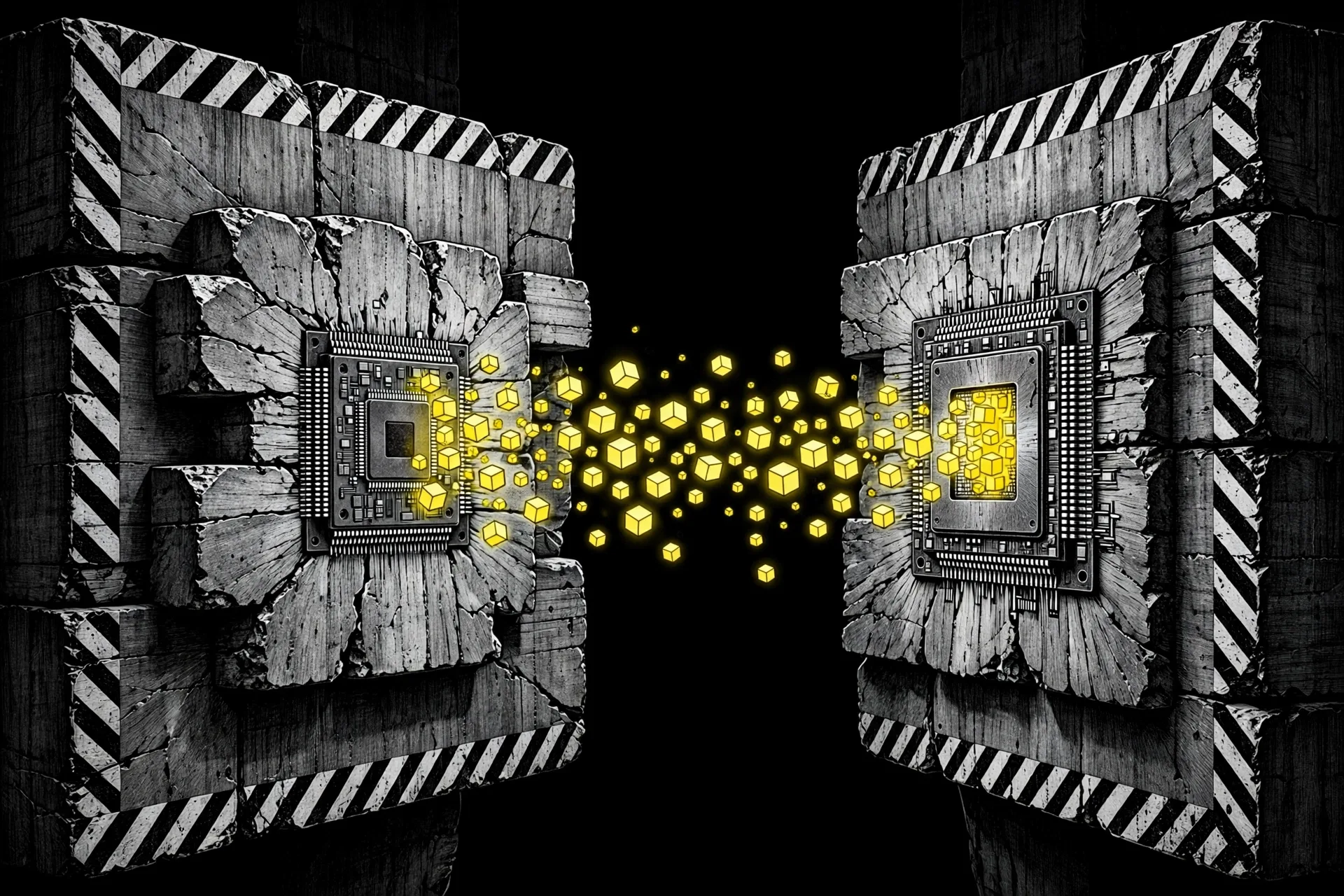 Translation is the whole trick: arm64 code goes in one side, x86-64 code comes out the other. Illustration: Dirty Static
A Metal driver for NVIDIA cards
Graphics is where projects like this usually die. macOS draws its interface with Metal, Apple graphics API, and it expects Apple GPU families. Stela answers with a Metal driver written for NVIDIA hardware. It compiles AIR, the intermediate form Metal shaders travel in, directly into NIR, the intermediate form used by Mesa, the open source graphics stack.
The driver supports the Metal3 and Apple7 GPU families, and the hardware list is short and specific. You need an NVIDIA GTX 16 series card or an RTX 20 series card or newer. Older NVIDIA cards, AMD graphics, and Intel graphics are not on the list, and no amount of wishing changes that for this release.
What you need
The requirements read like a filter, and most PCs will fail at least one line of it.
| Requirement | Detail, per the README |
|---|---|
| Processor | x86-64-v2 baseline, Intel or AMD, about 2011 or newer |
| Firmware | UEFI, with Secure Boot turned off |
| Memory | 8 GB of RAM |
| Graphics | NVIDIA GTX 16 series or RTX 20 series or newer |
| USB stick | 8 GB or more |
| Disk space | An empty GPT partition of at least 60 GB |
| Network | Access during install, because setup downloads macOS |
If your machine passes, the model it will pretend to be is fixed for now. Stela currently models the Mac mini (M2) only, and the README says it runs macOS 27.
Install, carefully
Download stela from the releases page on GitHub. On Linux or macOS, run the setup command in a terminal. On Windows, double click stela.exe. You then choose the USB stick, the macOS version, and the Mac model, and confirm.
Boot the PC from the stick and the install proceeds, downloading macOS as it goes. To update a stick made with an older version, download the new stela, plug the stick in, and run the setup update command the README lists for your platform.
Building from source is a heavier lift. You need Rust and LLVM with Clang 21 or newer, and the first build fetches and compiles the Linux, Mesa, and LLVM sources before it produces anything. The README warns that this takes a long time, which in build terms usually means set it going and find something else to do.
Price and platforms
Stela costs nothing. The code is open source under GPL-2.0-or-later, written in Rust, and the repository went public on October 12, 2026. At the time of writing it held about 624 stars and 25 forks, with two releases published, and the README links a Discord server where the community gathers.
The legal shape is worth understanding before you start. Stela contains no Apple software at all. The installer downloads macOS from Apple, and the README Legal section states plainly that you are responsible for following Apple software licence agreement and terms of use. Whether running macOS on a PC fits inside that licence is a question the project leaves with you, and this profile is not going to answer it either.
What Works
- Runs the real, unmodified Apple silicon build of macOS rather than a patched Intel build Apple no longer ships
- Translator covers more than 3,000 AArch64 instruction encodings and runs on Intel or AMD chips from about 2011 onward
- A working Metal driver for NVIDIA cards, the component projects like this usually lack
- Free, open source, written in Rust, with an unusually honest README
What Does Not
- The README itself warns that your current chances of it booting are low
- Slow, by the project own description, and short on testing
- NVIDIA GTX 16 or RTX 20 series or newer only, with no AMD or Intel graphics support
- One machine model for now, the M2 Mac mini, and one macOS generation, macOS 27
Who should try it
Best for: the curious with a spare PC that happens to carry a recent NVIDIA card, and the patience to treat a failed boot as data. Developers watching the translation approach will also find the source worth reading, because the two compiler modes and the register mapping are the interesting engineering here.
Everyone else should wait. If you need macOS to work on this week, buy the Mac mini Stela is pretending to be. The project itself points the same way when it tells you the odds of booting are low.
Final Thoughts
Stela is the most interesting kind of version 0.1.0: a wild idea, demonstrated working, with its limits printed on the box by its own author. Apple closed the Intel road, and someone has started building a translation road underneath the Apple silicon build instead. Whether that road ever gets fast enough or broad enough for daily use is an open question. That it exists at all, in Rust, in public, a month after the repository opened, is the story.
Sources
- The project repository and README: tylertms/Stela on GitHub, read November 11, 2026
- The releases page: Stela releases
- Launch coverage: post by @qwerty__cs on X, November 11, 2026 (macOS 27.2 detail and the Ryzen 7 9800X3D and RTX 5080 screenshot machine)
- Project icon: Stela project
END OF TRANSMISSION
Stay curious. Question everything.