NV UEFI Unlocker, an open source tool by GitHub user physicsdolphin, claims to remove the Tensor Core rate cap on GeForce RTX 20, 30 and 40 series cards from a bootable USB stick, with no VBIOS flash and no patched driver. Its reported results include an RTX 2070 gaining 67 to 75 percent in a matrix multiplication test and an RTX 4060 Laptop GPU gaining 65 percent in FP16 throughput.
Your GeForce card is slower at AI math than the silicon inside it needs to be. NVIDIA caps Tensor Core work in FP16, BF16 and TF32 with FP32 accumulation at half rate on consumer cards, while professional cards built on the same chips run at full rate. A new open source tool claims it can lift that cap before your operating system starts, then hand you a faster card for as long as the machine stays powered.
The Announcement
NV UEFI Unlocker landed on GitHub on October 26, written in Rust by a developer working as physicsdolphin. It is a UEFI application that runs from a FAT32 USB stick in the short window after the machine firmware starts and before the NVIDIA driver loads. In that window it performs a complete firmware routine on the card, applies a small set of register writes, reads them back to confirm they landed, resets the GPU, and chains onward into Windows, Linux, or any other EFI bootable system.
Nothing about the card changes for good. There is no VBIOS flash to undo and no driver file is patched, so a driver update cannot break the trick. Cut the power completely and the unlock is gone; run the stick again at the next cold boot and it comes back.
The Work It Builds On
The idea comes from gpu-unlock, a Linux kernel module by Zagitta that picked up more than 13,000 GitHub stars in under two weeks. Its README lays out the mechanism plainly: the tensor rate cap is a market segmentation choice, the silicon can run faster, and a set of speed selector writes applied before the stock driver binds the card removes it. The module writes those selectors, resets the card, and lets the unmodified driver take over.
Zagitta’s project reports an RTX 3090 Ti rising from 88 to 157 TFLOPS in BF16 matrix math, drawn from compatibility reports its users filed. Community testers running image generation in ComfyUI reported gains of about 56 to 59 percent, while token generation in language models did not move at all, because decoding is limited by memory bandwidth rather than tensor rate. What the UEFI tool adds is reach: the same style of unlock, moved in front of the operating system, where Windows users can get at it.
Important Details
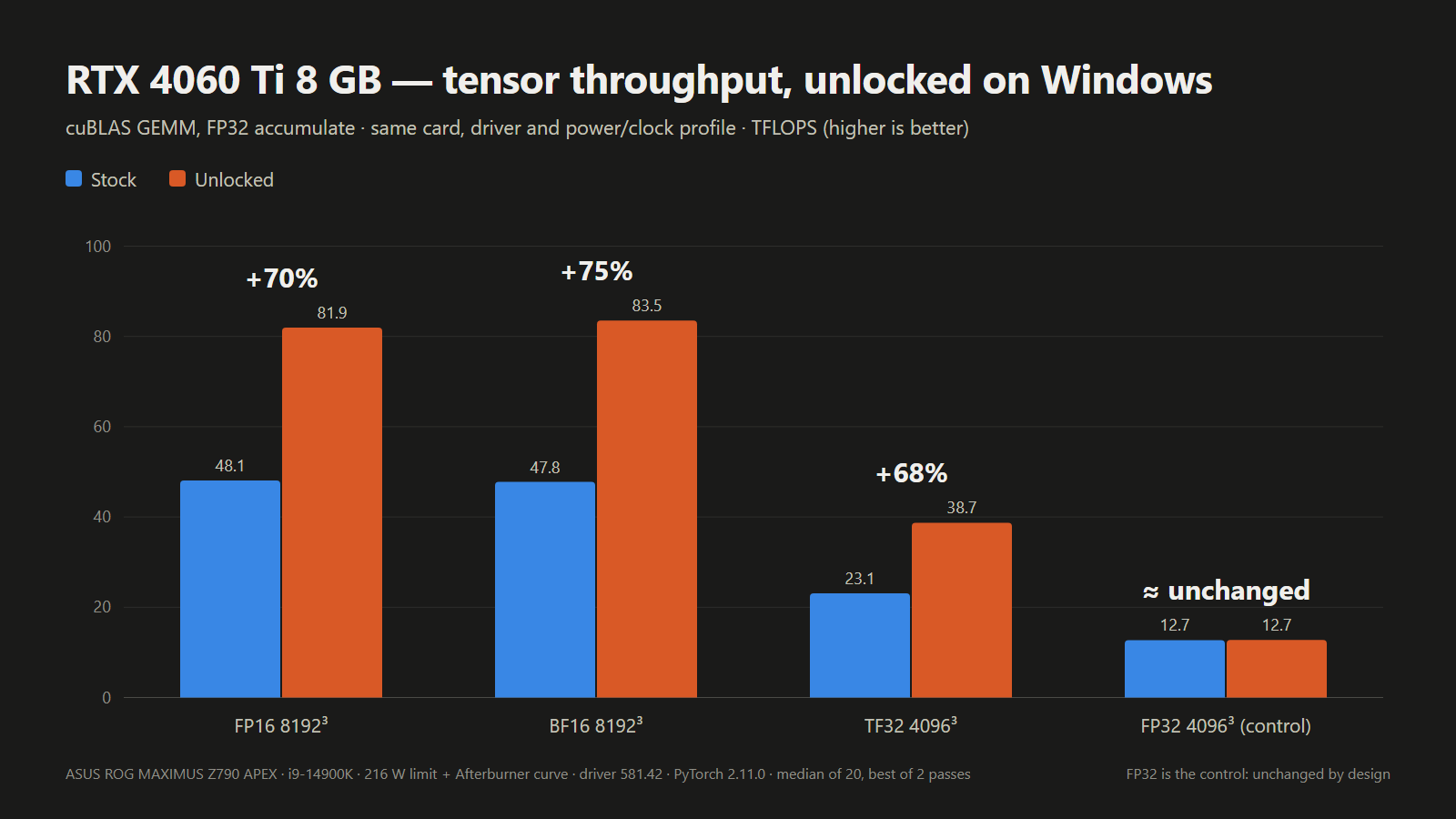
Every figure below comes from the project itself or from coverage relaying its results. None of it comes from an independent lab, and the project warns that success is not guaranteed on any given card or board.
| Card | Test, as reported | Stock | Unlocked | Gain |
|---|---|---|---|---|
| RTX 2070 | Matrix multiplication, FP32 accumulation | 36 TFLOPS | 60 to 63 TFLOPS | 67 to 75 percent |
| RTX 4060 Laptop GPU | FP16 throughput | 29.89 TFLOPS | 49.33 TFLOPS | 65 percent |
| Series | Status in the project matrix |
|---|---|
| RTX 20, Turing | Supported; some models have known issues |
| RTX 30, Ampere | Supported; the deepest testing so far |
| RTX 40, Ada | Supported, desktop and laptop |
| GTX 16, Turing | Theoretical; waiting on real machine reports |
| RTX 50, Pascal and older | Not supported |
Getting there takes some nerve. You download the release and run its script on the target machine to build the stick; the script fetches the pinned NVIDIA firmware itself, because the release ships without it. Secure Boot has to be disabled, or set to trust the tool once you enroll its certificate. Owners of RTX 20 series cards run one extra step first, a script that switches the card into the GSP firmware mode the unlock needs, followed by a restart.
What’s Next
The compatibility table is the thing to watch. Notebookcheck reports that the RTX 30 series is fully tested as of version 2.1.6, while the RTX 20 and 40 series entries still rest on a thinner pile of user reports, and GTX 16 support is still being built. Every new report on the project tracker either firms up a card family or finds a board that breaks the routine.
The other open question is NVIDIA. Nothing in the coverage suggests the company has responded, and whether it moves to close the window these tools walk through, or leaves them alone, is speculation. Until a reviewer with a test bench runs both unlocks end to end, every figure in this story stays where it belongs: in the reported column.
Sources
- NV UEFI Unlocker: physicsdolphin/nv-uefi-unlocker on GitHub
- GPU Unlock: Zagitta/gpu-unlock on GitHub
- Wccftech: New NVIDIA UEFI GPU Unlocker Brings Up To 75% Higher AI Compute Performance To RTX 20, 30 & 40 Series GPUs On Windows
- VideoCardz: Modders create automated tool to unlock AI performance on NVIDIA GeForce RTX 20, 30 and 40 series GPUs
- Notebookcheck: UEFI-level pre-driver Nvidia GPU unlocker now available for RTX 2xxx, 3xxx and 4xxx GPUs on Windows and Linux
- Benchmark chart: NV UEFI Unlocker project (physicsdolphin) on GitHub
END OF TRANSMISSION
Stay curious. Question everything.