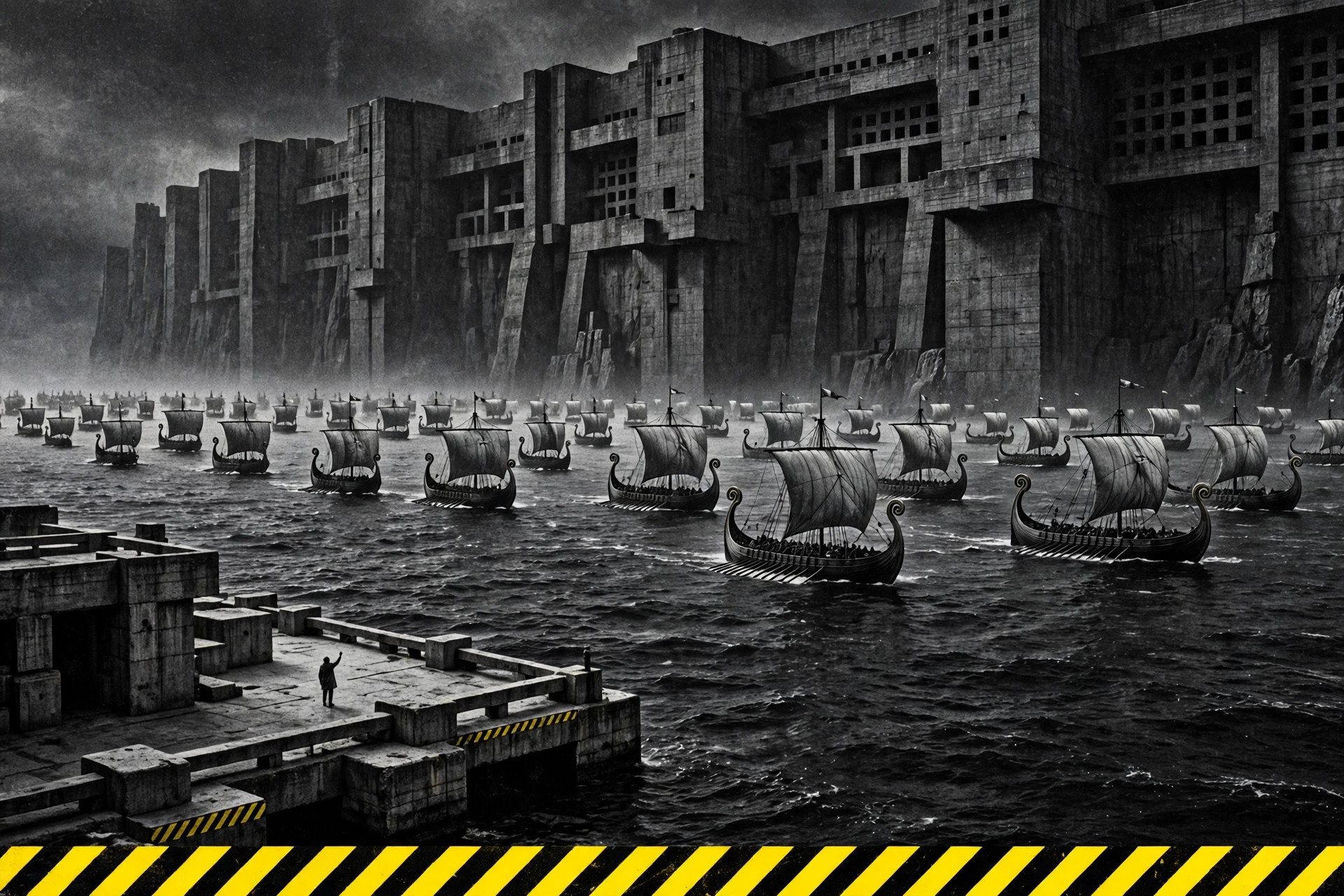
Elon Musk promised a full length Odyssey made by Grok Imagine and true to Homer. What arrived was seven minutes on X that critics called motiveless and meaningless, in the same week China put a fully AI made feature in cinemas and sold almost no tickets. Two auditions for machine cinema, and audiences felt nothing at both.
Odysseus does not want to go to war. In the opening of Episode 1 of the Odyssey series made with Grok Imagine, posted on X on October 23, he agonises over the call to join the Greek forces sailing for Troy, takes leave of Penelope and his son Telemachus, and accepts a small wooden horse figurine that Penelope asks him to bring home to the boy. Then the fleet sails, ten years of war compress into minutes, and the episode ends with Odysseus holding that figurine like a threat or a promise. The whole thing runs a little over seven minutes in 4K. It has been watched millions of times. Almost nobody who reviewed it felt a thing.
Peter Bradshaw of the Guardian gave it one star. His verdict on every dramatic beat in the episode, the feigned madness, the farewell, the sea journey, was blunt.
Motiveless and meaningless as the movement of shapes on a laptop screensaver.
The Telegraph wrote of sloppy gruesomeness. Rolling Stone reported viewers calling the acting soulless and wooden. MovieWeb collected the public reaction in similar terms, with one widely shared comment calling the episode soulless slop. This was not a quiet demo that slipped out to a few specialists. By the Monday after release, the post on the Grok Imagine account had passed six million views, and reporting since then has put the count above seven million. Millions watched. The feeling did not arrive.
The Bigger Story
Start with the promise, because the promise set the test. In July, after months of posts attacking the version of The Odyssey directed by Christopher Nolan, above all its casting, Elon Musk wrote on X that before the year ends Grok Imagine would make a full length movie of The Odyssey that is historically accurate and true to the art of Homer. Note the shape of that vow. It did not promise a moving film. It promised an accurate one, as if Homer had left behind a record to check rather than a poem to interpret.
What arrived three months later was not a full length movie. It was Episode 1 of a series, made with Grok Imagine in creative collaboration with Wonder Studios and director Dev Walker, as the release post itself credits. Wonder cofounder Xavier Collins told the Guardian the episode was made in less than two weeks with a creative team of three, and that the team had been given no political direction, only the chance to work with a frontier lab on one of the best stories ever told. A breakdown published on October 27 described a crew of three to five people working with scripts, shot lists and character references, and about 18 hours spent on editing, sound and colour for the episode. This was not a film conjured from one prompt. It was a small human crew steering a video model, and the result still landed as a screensaver.
The contrast act was playing in cinemas the whole time. Nolan and his cast and crew shot The Odyssey on IMAX film cameras across multiple countries, at a reported cost of 250 million dollars. It opened on July 17 and has since taken about 1.8 billion dollars worldwide, becoming the highest grossing film in IMAX history at more than 500 million dollars from IMAX screens alone, according to reporting by TheWrap and Collider. One Odyssey asked audiences to pay and sit still for nearly three hours, and they did, in record numbers. The other asked for seven free minutes on a phone, and the verdict was that even seven minutes felt long.
Context
The Grok episode was only one of two auditions machine cinema gave that week, and the other one had real tickets at stake. On the same day, October 23, Bona Film Group released Sanxingdui: Future Past in China, billed as the first fully AI generated feature to receive a wide theatrical release there. More than 10,000 screenings were scheduled on its first day. By the Monday it had taken about 180,000 dollars against a reported budget of 1.5 million dollars, and Cartoon Brew reported the total had reached only about 253,000 dollars by November 2, its eleventh day in cinemas. The makers had spent more than two years on it and generated more than 1.2 million source images. Bona executive Jiang Defu framed the gamble in advance: the company was the first to try it, the first to get a theatrical release permit, and the first to be tested by the audience. The audience gave its mark.
Two failures in one weekend, on two continents, in two formats, point at the same gap, and critics and researchers have named it with unusual consistency. Writing in The Conversation, in an analysis republished by TechXplore, the case is put plainly. Video models generate a sequence by calculating what image is likely to follow the last one. That method can produce a startling still and a passable few seconds. Sunlight moves across polished bronze. Dirt clods fly behind a straining ox. The folds of a tunic stir in the wind. But a story is not a chain of plausible images. A scene has to connect to what came before it, and a character has to want something for reasons the audience can feel, with a cost attached if they fail.
Performance is where the chain breaks first. TechCrunch, one of the milder voices, allowed that a few individual shots might provide a reasonable simulacrum of reality. Paulo Vargas of Digital Trends found the best shots were the ones without actors in them, ancient landscapes and close views of grimy hands, where the illusion holds for a few seconds. Then, in his phrase, the people begin to move, and worse, they start speaking. Faces slide. Voices flatten. Emotion in human performance often lives in contradiction, a smile held over nerves, silence where grief should be loud, and a model asked to render sadness produces the average shape of sadness, which reads on screen as no feeling at all.
| Date | What happened |
|---|---|
| July 17, 2026 | The Odyssey directed by Christopher Nolan opens in cinemas |
| July 22, 2026 | Musk promises a full length Grok Imagine Odyssey, historically accurate and true to Homer, before the year ends |
| October 23, 2026 | Grok Imagine posts Episode 1, about seven minutes, on X; Sanxingdui: Future Past opens across China the same day |
| October 27, 2026 | The Guardian gives Episode 1 one star; WIRED reports Grok itself saying the episode does not meet a strict historical standard |
| November 2, 2026 | Cartoon Brew reports Sanxingdui: Future Past at about 253,000 dollars after 11 days, against a reported 1.5 million dollar budget |
There is one more layer, and honest critics admit it. The Conversation analysis notes that audiences judge work more harshly when they know a machine made it, and sometimes prefer machine made images when the origin is hidden. Grok carried its origin in its name. Every viewer pressed play already knowing, and some share of the contempt was loaded before the first frame. That bias is real, and it still does not explain the Chinese box office, where audiences simply stayed away, or the specific and repeated complaints about movement, speech and motive from reviewers who praised individual shots in the same breath.
Different Perspectives
The defence deserves a fair hearing, because there is one. Collins told the Guardian that Wonder would address the criticism aimed at the boats and the pacing in the next episode, which is the correct response from a small team learning a new instrument in public. Supporters of the project add a point about scale that should not be waved away. Three people in under two weeks produced seven minutes that earlier generations of this technology could not have produced at all, at a cost that is a rounding error beside 250 million dollars. As a demonstration of where video models stand, Episode 1 is evidence of speed. Judged as a tool test rather than a film, it shows shot making getting cheaper and faster at a pace no honest observer can dismiss.
A second view comes from the makers of the Chinese feature, and it is more modest than the marketing around it. Reporting cited by Cartoon Brew says the team behind Sanxingdui: Future Past set out to establish a workable pipeline for bringing generative tools into feature production, and believe they did that, whatever the ticket sales say. On this reading, both October releases were prototypes wearing the clothes of finished films, and the flop is the price of running the experiment in public instead of in a lab. Studios watching from the sidelines got their data either way.
The third view is the one the directors quoted by UKScreen keep returning to, and it is not about tools at all. A film carries the life of the person who made it, in hundreds of choices about lens, light, rhythm and colour that add up to a vision. Alfonso Cuarón built Roma out of his own childhood in Mexico City. Guillermo del Toro returns to water again and again, a thread he traces to childhood and faith. The argument is that specificity is the mechanism of feeling: the more particular a film is, the more universal it becomes, because viewers translate its details into memories of their own. A model trained on everything is specific about nothing in particular. It has no childhood to draw on, no loss to work through, no obsession to feed. It can imitate the surface of a choice without ever having a reason for one.
Hold those views together and they agree on more than the shouting suggests. Nobody serious claims the tools will stop improving, and nobody serious claims Episode 1 moved its audience. The argument is about what the improvement curve is climbing toward. If the missing ingredient is resolution, continuity and lip sync, time fixes it. If the missing ingredient is a life behind the camera, time fixes nothing, and each new episode will be a better screensaver.
Why It Matters
The stakes are not really about one rich man losing a bet against a famous director, entertaining as that is. Studios under cost pressure are watching these experiments for permission. If a seven minute episode made by three people can be marketed as a film, the temptation to treat film as content that merely needs to exist will grow, in trailers, in filler programming, in the long tail of streaming catalogues where nobody checks whether anyone felt anything. The Chinese result matters precisely because it was a market test with prices attached. Viewers will accept generative tools in short clips on a feed, as USC professor Stanley Rosen observed about the Sanxingdui flop, and remain deeply sceptical when asked to pay for a feature. Scepticism at the box office is the one review a studio cannot argue with.
There is also a question hiding inside the word accurate, the word Musk chose. Homer is not a dataset. The Odyssey has survived nearly three thousand years not because its boats are correct but because its core is a man trying to get home to his wife and son, told with longing that every displaced person in every century has recognised as their own. A production that treats the poem as a fact problem to solve has misunderstood the assignment before the first prompt is written. Grok, asked by WIRED whether its own episode met a strict historical standard, answered no and called the work an adaptation rather than a reconstruction. The chatbot gave the most honest review the project received, and it was a review of the brief, not just the footage.
Closing Reflection
AI can generate a shot of a thousand ships. That line from The Conversation analysis is the whole story in one sentence, because the harder task it names is making an audience feel the cost of one goodbye. Episode 1 contains a goodbye. A wife hands a husband a carved horse for their son, and the moment should carry ten years of war inside it. Instead it slides past like one more plausible image in a chain, watched by millions, remembered by almost no one, because nothing in the frame knows what parting costs.
That is the verdict audiences delivered twice in one October week, once with ridicule and once with empty seats. Feeling is not a rendering setting. It is the residue of choices made by people who have something at stake in the story, and until a machine has something at stake, its Odysseus will keep sailing home to a family he cannot miss, in a film nobody can feel.
Reporting draws on the Grok Imagine release post on X on October 23, 2026 and its production breakdown on October 27, the Guardian review by Peter Bradshaw and its interview with Xavier Collins of Wonder Studios, WIRED reporting on Grok and historical accuracy, TechCrunch and Digital Trends reviews, the analysis by The Conversation republished by TechXplore on October 29, UKScreen reporting on Sanxingdui: Future Past and director vision, Cartoon Brew box office reporting through November 2, and TheWrap and Collider reporting on the IMAX record of the Nolan film, checked November 2026.
Sources
- Grok Imagine, Episode 1 release post on X, October 23, 2026, and production breakdown, October 27, 2026
- The Conversation analysis, republished by TechXplore, October 29, 2026: https://techxplore.com/news/2026-10-grok-thousand-ships-ai-remake.html
- UKScreen, Musk and China Handed Cinema to AI. Audiences Felt Nothing: https://ukscreen.com/news/musk-grok-odyssey-sanxingdui-ai-film-flop-directors-vision/
- Cartoon Brew, box office report on Sanxingdui: Future Past: https://www.cartoonbrew.com/box-office-report/sanxingdui-future-past-week-2-box-office-268831.html
- The Guardian review and Wonder Studios interview, as reported October 27, 2026: https://thebullpost.press/meaningless-as-a-laptop-screensaver-reviewers-slate-musks-ai-made-odyssey-film/
- Cryptopolitan, Musk’s promised Odyssey movie arrives as a 7-minute Grok episode: https://www.cryptopolitan.com/musk-odyssey-movie-7-minute-grok-episode/
- The A.V. Club, on Episode 1: https://www.avclub.com/elon-musk-grok-ai-the-odyssey-first-episode
- TheWrap, on the IMAX record of The Odyssey: https://www.thewrap.com/creative-content/movies/christopher-nolan-the-prestige-70-mm-imax-screenings-theaters-when/
- Illustrations: Dirty Static
END OF TRANSMISSION
Stay curious. Question everything.