
EveryApp is a platform from the team behind OpenSEO that installs open source apps into your own Cloudflare account behind a single Gateway. One sign in, one Workers Paid bill, and access for agents through an MCP Gateway, with four flagship apps at launch: OpenSEO, OpenCRM, OpenAnalytics and OpenMail.
Your agent can write an internal tool before lunch. Then the real work starts: hosting, a database, sign in, permissions, API keys and backups. Most small tools die in that second list, stuck on a laptop where only the person who prompted them can use them.
EveryApp is an attempt to delete the second list. It is an open source platform that sets up a Gateway inside your own Cloudflare account, and every app you install lives behind that Gateway. Your team signs in once, the apps hold no keys of their own, and the whole stack runs on Cloudflare building blocks instead of a server you have to feed.
The Gateway is the whole trick
Every request to every app passes through the Gateway, and the apps themselves have no public address. You connect an API once, an app asks for access, and the Gateway makes the call, so no single app ever holds your keys. If you want another lock on the door, the project points you to Cloudflare Access in front of the whole install.
The economics rest on the same design. Everything runs serverless on Workers, with D1 for data, R2 for files and KV for state, all inside your account. An app nobody uses costs nothing, and the project says the $5 a month Workers Paid plan hosts hundreds of apps. That figure is the project claim, not a test result, but the shape of it is sound: one plan, many small apps, no container bill per tool.
Agents are first class citizens here, not an afterthought. When you add an app, the project says it becomes accessible at once through the Every App MCP Gateway, so Claude Code, Codex, Cursor and other MCP clients can reach the same tools your team uses in a browser. The docs even ship as an llms.txt file, written for models to read.
EveryApp
Official siteThe platform itself. Primary use case: giving a small team, or a team of agents, a set of working web apps without running servers.
Key features: one command Gateway setup in about 15 minutes, or a single prompt pasted into Claude Code, Codex or Cursor; one sign in for every app; an MCP Gateway for agent access; a standard stack and component library so agents build new apps in known patterns.
Advantages: your data and your keys stay in your own Cloudflare account, idle apps cost nothing, and new tools follow the same rules as the installed ones. Limitations: the README calls the project early development with rough edges, and the whole model ties you to Cloudflare.
The flagship four
GitHub stars, checked October 29, 2026
Bars are scaled to OpenSEO. The three newest apps sit near zero on that scale, which is exactly the point of the chart.
OpenSEO
Official siteAn open source alternative to Semrush and Ahrefs, and the reason this team gets a hearing. Primary use case: SEO research you pay for by use instead of by the month.
Key features: keyword research, rank tracking, competitor insights, backlinks, site audits and AI visibility, plus an MCP server and agent skills so Claude Code, OpenClaw and Hermes can work with your SEO data directly. Advantages: MIT licensed, mature by the standards of this list, and the data bill goes to DataForSEO only for requests you actually make. Limitations: the data is not free, and the hosted version charges 28 percent on top of DataForSEO costs, a markup the project states openly.
OpenCRM
Official siteA CRM that files your conversations for you, in the project words. Primary use case: keeping companies, contacts and deals current without manual data entry.
Key features: companies, contacts, deals, tasks and notes with custom fields and saved views; capture from Gmail, Google Calendar and Outlook that is read only and never sends or drafts mail; website tracking that turns visitors and form submissions into contacts; CSV import and export; MCP tools for AI clients. Advantages: the capture pitch answers the oldest CRM complaint, which is that nobody updates it. Limitations: the repo was created on October 26, 2026, days before this post, and it needs R2 enabled on your Cloudflare account. Treat it as a promising start, not a settled system of record.
OpenAnalytics
Official siteWeb analytics on your own Cloudflare account, with no cookies. Primary use case: site stats you own outright, without a consent banner driven by your analytics tool.
Key features: a 3 KB tracker with custom events and Web Vitals; dashboards for pages, referrers, campaigns, sessions, funnels, goals, retention and devices, with a live view; public share links that are read only; scheduled email reports; bot filtering; MCP tools so agents can query reports. It stores no IP addresses, and Cloudflare resolves location at the edge. Advantages: the privacy posture is structural, not a settings page. Limitations: also created on October 26, 2026, so the feature list is days old in public. It needs one secret of its own and, the docs note, no API keys and no R2.
OpenMail
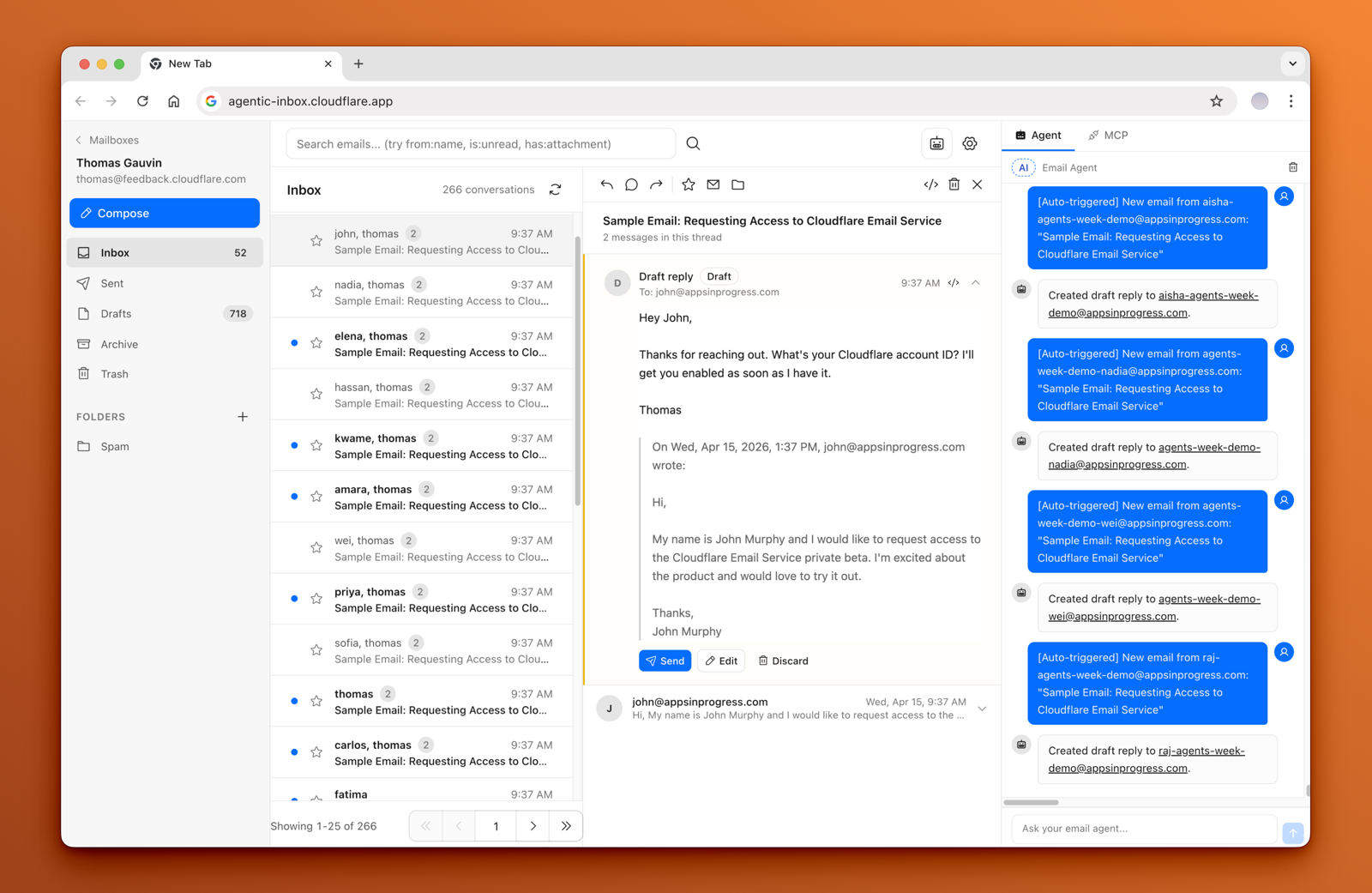
Official siteA team inbox on your own domain, where mail arrives through Cloudflare Email Routing. Primary use case: shared mail with an agent doing the drafting and a human keeping the send button.
Key features: sending and receiving on your own domain with threads, folders, search and attachments; an agent in the side panel that reads, searches, drafts and sends; a draft written for each new message, with sending always held for your confirmation; a custom system prompt per mailbox; each mailbox in its own Durable Object with SQLite, and attachments in R2; MCP tools for AI clients. Advantages: the confirmation rule is the right default for agent mail. Limitations: you bring a model key, a mail domain on Cloudflare with Email Sending, and R2, and the repo is as new as the rest of this wave. OpenMail is a fork of a Cloudflare demo project, credited in its README.
| App | What it covers | Standout feature | Watch out for |
|---|---|---|---|
| OpenSEO | SEO research | MCP server and agent skills, pay by use data | DataForSEO costs apply to every request |
| OpenCRM | Companies, contacts and deals | Conversations filed to records on their own | Public repo is days old |
| OpenAnalytics | Web analytics | 3 KB tracker, no cookies, no stored IP addresses | Public repo is days old |
| OpenMail | Team inbox on your domain | Agent drafts, human confirms the send | Needs a model key, R2 and a Cloudflare mail domain |
Getting started
The documented path is short. You need a Cloudflare account on Workers Paid and a domain on Cloudflare, and the project puts setup at about 15 minutes.
npm install -g everyapp
everyapp setup --domain apps.yourcompany.com
From there, everyapp install https://github.com/every-app/open-seo adds the flagship, and everyapp create my-app starts your own. Individual apps also carry their own configure step once installed. The alternate path says plenty about who this is for: paste one prompt into Claude Code, Codex or Cursor and let the agent run the setup itself.
Which should you choose?
If the SEO bill is the one that hurts, start with OpenSEO alone. It stands on its own with Docker and Cloudflare self hosting paths, a hosted option at $10 a month, and no need to adopt the wider platform on day one.
If you run a small stack of internal tools and every one has its own login, its own server and its own bill, EveryApp is aimed at you. One Gateway, one sign in and one Workers Paid plan is a clean answer, provided your team already lives on Cloudflare or is willing to move the tooling layer there.
If you build tools with agents, the platform itself is the product. A standard stack, a component library and an MCP Gateway mean the agent stops inventing infrastructure on each build, and the app it ships lands somewhere your team can actually open it.
If the data is client data, or the tool carries revenue, wait and watch. Star the repos, run OpenSEO, try OpenAnalytics on a side project, and let the young apps earn trust in public before anything load bearing moves in.
Final thoughts
Most self hosting pitches fail on arithmetic: one container, one database and one bill per app, until the stack costs more than the subscriptions it replaced. EveryApp attacks that arithmetic at the root, with serverless parts that cost nothing at rest and a Gateway that keeps keys and access in one place.
The tradeoff is concentration. Your apps, your keys and your agent access all pass through one Gateway in one Cloudflare account, by design. That is easier to secure than a dozen scattered installs, and it also means that one account deserves your best password habits and your full attention. Early, concentrated and genuinely well aimed: that is a fair summary, and in this corner of software, well aimed counts for a lot.
Sources
- The platform, its Gateway model, setup and app list: github.com/every-app/every-app and everyapp.com
- OpenSEO workflows, costs and self hosting: github.com/every-app/open-seo
- OpenCRM features and install: github.com/every-app/open-crm
- OpenAnalytics features and install: github.com/every-app/open-analytics
- OpenMail features and install: github.com/every-app/open-mail
- Screenshot: OpenMail demo, from the EveryApp project’s open-mail repository on GitHub
END OF TRANSMISSION
Stay curious. Question everything.