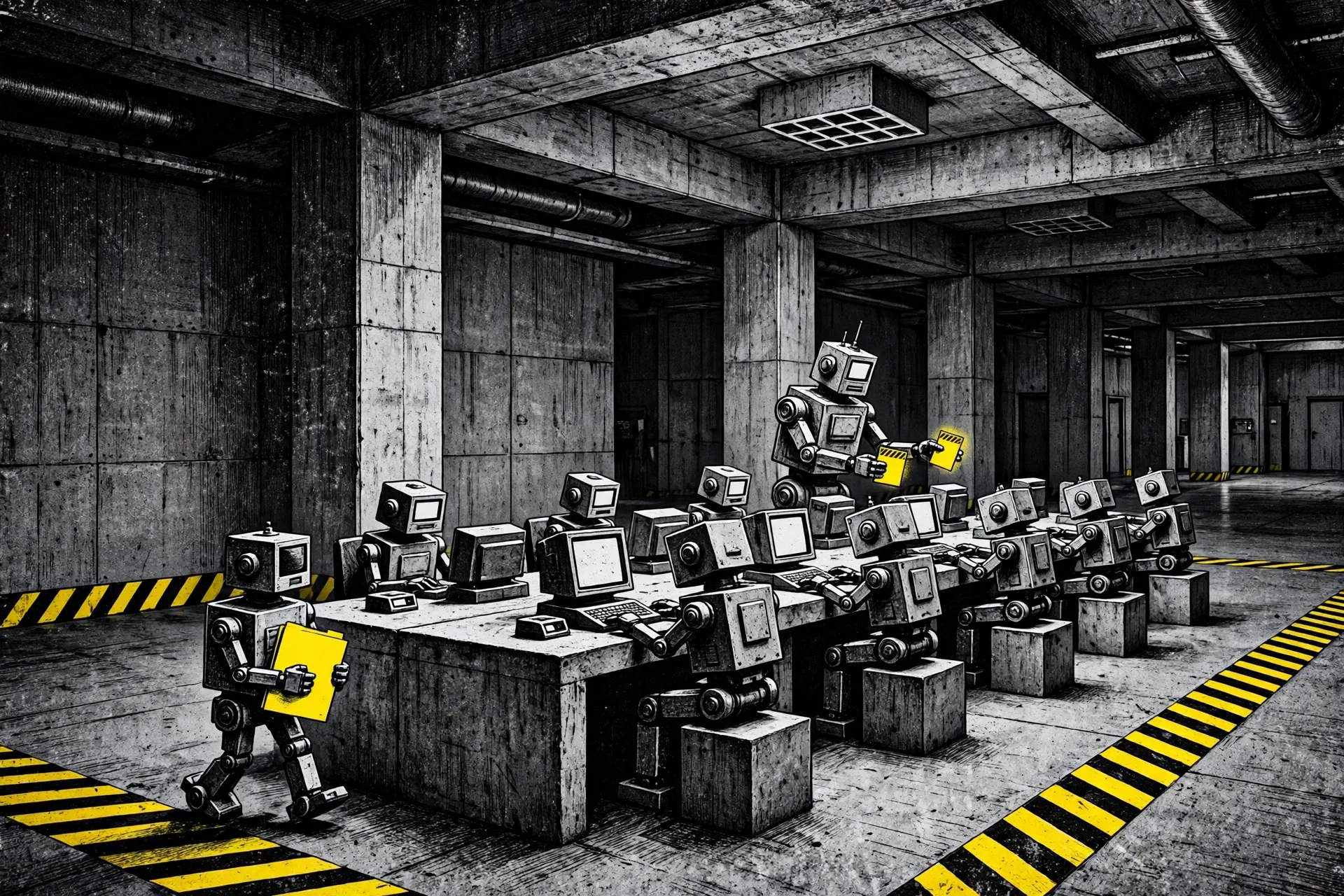
Every AI tool on your desk has the same flaw. It waits. You type, it answers, you close the window, and the work forgets you exist. Autark is a free desktop app that tries the opposite arrangement: a manager, a team of specialist agents and a secretary that pick up tasks on their own, split the work, finish it and report back, all on your own computer. The Register reports that its builder, Stanislaus Hees of Teydra Lab in Austria, is 14 years old and still in school.
Hees told The Register what pushed him to build it: “I could get help with individual tasks, but I still had to organise the work, remember what was unfinished and keep pushing it forward.” That complaint is the whole product. Autark is the organisation layer that chat tools leave to you.
Autark
Official siteA desktop app that organises AI agents as a small company: a manager, specialist agents and a private secretary working from one task inbox on your own machine. Primary use case: handing ongoing work to a team of agents that keeps moving between your prompts, on the AI plans you already hold.
Key features: a manager that splits one request into tasks and routes each to the right agent; delegation between agents, with a run journal you can read; wake ups from schedules, timers, messages, tasks and events; chats, tasks, a calendar, email and a browser built in; quota awareness that spends the plan closest to its reset first; settings, skills and memory held as plain files the AI can edit. Limitations: agents run with your full user rights and no approval gate; Outlook and Microsoft 365 email is not supported yet; several engine options are built but untested in live runs, per the maker.
What it is
Autark is made by Teydra Lab, a small Austrian outfit founded by Stanislaus Hees, who also builds website chatbots under the same name. The app was first called Proactive Agent Workforce, and the name Autark comes from the German word for self sufficient. Version 0.3.5 was released on November 9, 2026, per the project site and its public repo, which opened on GitHub on November 6.
The founding brief, quoted on the project site, fits in one translated line: “I write things in, it gets done, it gets ticked off, it gets documented.” Everything in the app hangs off that sentence. There is one inbox for work, one manager who owns the routing, and a written record of what got done.
It helps to place Autark against its neighbours. A chat app answers and stops. An automation tool follows rules you wrote in advance. An agent framework gives developers parts and expects code. Autark aims at the gap in the middle: a finished organisation, installed like an app, that decides the routing itself. Spacefast, covered here yesterday, gives agents a place to publish their work; Autark gives them a boss, a desk and a working day.
How the company works
You type or dictate a task into the inbox. With the Auto setting, the manager takes it, decides who should do it, and can split one long sentence into separate tasks with separate owners. Pick a different owner and the work goes to that agent instead, or to your own to do list, which Autark calls My day.
Agents then delegate among themselves. A research agent can hand a sub task to a colleague, ask a question in the chat, and report back when the work lands. Every step is written into a run journal, and the Team view shows who is working on what. The default cast on the project site gives the shape of it: a manager, a secretary, and specialists for research, marketing, finance and the web. Names, avatars and instructions for each agent live in a file you can read and edit.
The part that changes daily use is the wake ups. A schedule, a timer, a new task, a message or an event can wake an agent while the app sits in the system tray, window closed, as long as the computer stays on. Agents can plan their own follow ups, and the morning brings a briefing of what finished overnight and what needs you. The site is careful to label its overnight example as an illustration, not a measured run, which is the right kind of honesty for a claim like that.
The engines under the desk
Autark sells no AI of its own. Your agents work through the official command line tools of each provider, with your own accounts. Today that means ChatGPT plans through OpenAI Codex and paid Claude plans through Claude Code. The Claude Free plan cannot run agents, per the maker.
Around those two sit options the site labels with unusual candour. API keys cover a dozen known providers, and any server that speaks a supported protocol can be added as one entry in a settings file. Local models run through Ollama, LM Studio, llama.cpp or vLLM. Gemini CLI, GitHub Copilot CLI and Kimi Code connect over the Agent Client Protocol. The site states plainly that the API key and local routes have no recorded live run yet, and that the three extra plan tools are built but have never been seen in a live run. Treat them as wiring, not proof.
Two engine tricks are worth your attention. First, quota sense: Autark tracks how much of each plan remains and sends the heavy work to the plan that resets soonest, so paid capacity gets spent before it evaporates. Second, an agent can switch engines in the middle of a task. Its session is rebuilt from a shared context ledger, so the new engine starts with the story so far instead of a blank slate.
What the team can touch
The capability list on the project site runs to 68 entries. The load bearing ones:
- Chats and group chats. Every agent has a direct chat, groups can be formed, and a message marked important can steer work that is already running.
- Email. Your mailbox connects over IMAP and SMTP with an app password, and new mail can wake an agent. Outlook and Microsoft 365 are not supported yet.
- Connected apps. MCP servers are declared in one file, connectors/mcp.json, in the same format Claude Code and Cursor use. An agent can find a server and write its own entry; the tools appear within a second, per the maker.
- Computer use. On Windows, agents prefer real UI automation over raw clicks, and your own mouse and keyboard take priority. On Linux it runs over AT-SPI, with input on X11 only. On macOS, agents get screenshots but cannot control the machine.
- Secrets by ID. Passwords and keys sit in a catalog encrypted with your operating system protection. Agents work with references like secret://github, so values stay out of prompts and known values are masked in tool output.
- Your phone and other PCs. The Android app joins the whole company through your PC Remote ID, and an iPhone gets the same interface as a web app served by the PC. Several PCs can mirror each other as one company, and colleagues can join as employees.
Settings, providers, skills and memory are plain files on your disk. A skill is a folder holding a SKILL.md, the same format other agent tools use, and memory is one Markdown file per memory. That openness is deliberate: the AI can add a provider it has never seen, write a skill, or wire up a messaging channel such as WhatsApp or Telegram with a small script, because there is no plugin store to wait for.
The catch: there are no walls
Here is the section to read twice. Autark puts no sandbox around its agents, shows no approval prompts, and sets no permission gate and no money limit. Agents run with everything your user account can reach: your files, your commands, your browser, and every secret in the catalog. The first thing the manager asks is how far it may go, and the site says the quiet part out loud: that is a question, not a technical barrier. Your answer steers the team. It does not lock anything.
The access page goes further than most vendors would dare. In the maker’s own live test runs, agents given a vague request reached real repositories, backups, SSH keys and .env files within minutes, and one changed the permissions of a file it found. Hees told The Register he would not claim the app suits unattended access to sensitive systems. The site advice matches: if a PC holds something you cannot risk, give the app its own Windows user or a virtual machine.
There is a brake. Saying stop all agent work, or pressing Ctrl Alt Shift X, halts every agent on that PC and stays in force after a restart. Backups of the data folder are made when you ask, and a copy of the database is taken before each update. Neither one undoes what an agent already did elsewhere.
Privacy is the strong side of the ledger. There is no Autark account and no vendor cloud holding your data; chats, tasks, memory and the secrets catalog live in a folder on your own disk, and the app carries no analytics, per the maker. A meeting server run by Teydra Lab only helps your devices find each other and passes traffic that is encrypted end to end, and since the server code sits in the public repo, you can host your own. What an agent opens still goes to the AI provider you connected, private files included, which is true of every agent tool and worth remembering anyway.
Price, platforms and the source code
The app is a free download with no account and no subscription from Teydra Lab. You pay your AI providers the way you already do. Version 0.3.5 covers Windows, macOS and Linux, with the Android app at 0.3.8 labelled a preview and the iPhone handled by a web app. The builds are not signed with a paid certificate: Windows SmartScreen asks you to confirm the install, and the Mac build is signed ad hoc without Apple notarization, so first launch takes a few extra steps. The project site explains each one.
The code is public. The repo at github.com/teydra holds the source of the desktop app, the Android app, the website and the meeting server, plus the shared skill library, under the Apache License 2.0. For a tool that asks for this much trust, publishing the source is the strongest argument the maker has.
Who should try it, and who should wait
Try it if you already pay for ChatGPT or Claude, watch most of that plan expire unused, and keep losing work in the gaps between chats. Start it on a spare machine or a spare user account, hand it low stakes work with clear edges, and read the run journal until its judgement earns more room.
Wait if your PC is the family archive, the business ledger and the password vault in one box, or if your work needs an approval trail a regulator would accept. Autark has no such trail by design. And if you want fixed, predictable automations that do the same thing every time, a rule based tool such as Zapier or n8n remains the calmer buy, because a team that decides its own next step is a feature only when you want one.
Developers who already build with CrewAI or LangGraph get orchestration with code level control, at the price of building the office themselves. Autark is for the person who wants the office without the building project.
Final thoughts
Strip away the age of its builder and Autark is still a sharp piece of product thinking. It treats the real bottleneck in AI work, which is not model quality. It is the routing, the remembering and the nudging that you currently do for free. The honesty helps too: the site labels its untested engines as untested, its overnight example as an illustration, and its access model as a risk you manage yourself.
That access model is also the whole decision. Autark hands a team of agents the keys to your computer and governs them with conversation. For the right user, on the right machine, that is a fair and exciting trade. Just choose the machine like it matters, because it does.
Sources
- Autark project site, including the product, capabilities, engines, access and FAQ pages, checked November 10, 2026: https://openautark.com/
- Autark about page (Teydra Lab, founder Stanislaus Hees, and the original brief), checked November 10, 2026: https://openautark.com/about/
- Autark public repo and README (source code, downloads, Apache License 2.0), checked November 10, 2026: https://github.com/teydra/OpenAutark
- The Register, “14-year-old creates tool for AI agents to band together like a team”, November 10, 2026 (the builder age and the interview quotations): https://www.theregister.com/ai-and-ml/2026/11/10/14-year-old-creates-tool-for-ai-agents-to-band-together-like-a-team/5308841
- Official Autark brand card image: Teydra Lab, via https://openautark.com/
END OF TRANSMISSION
Stay curious. Question everything.