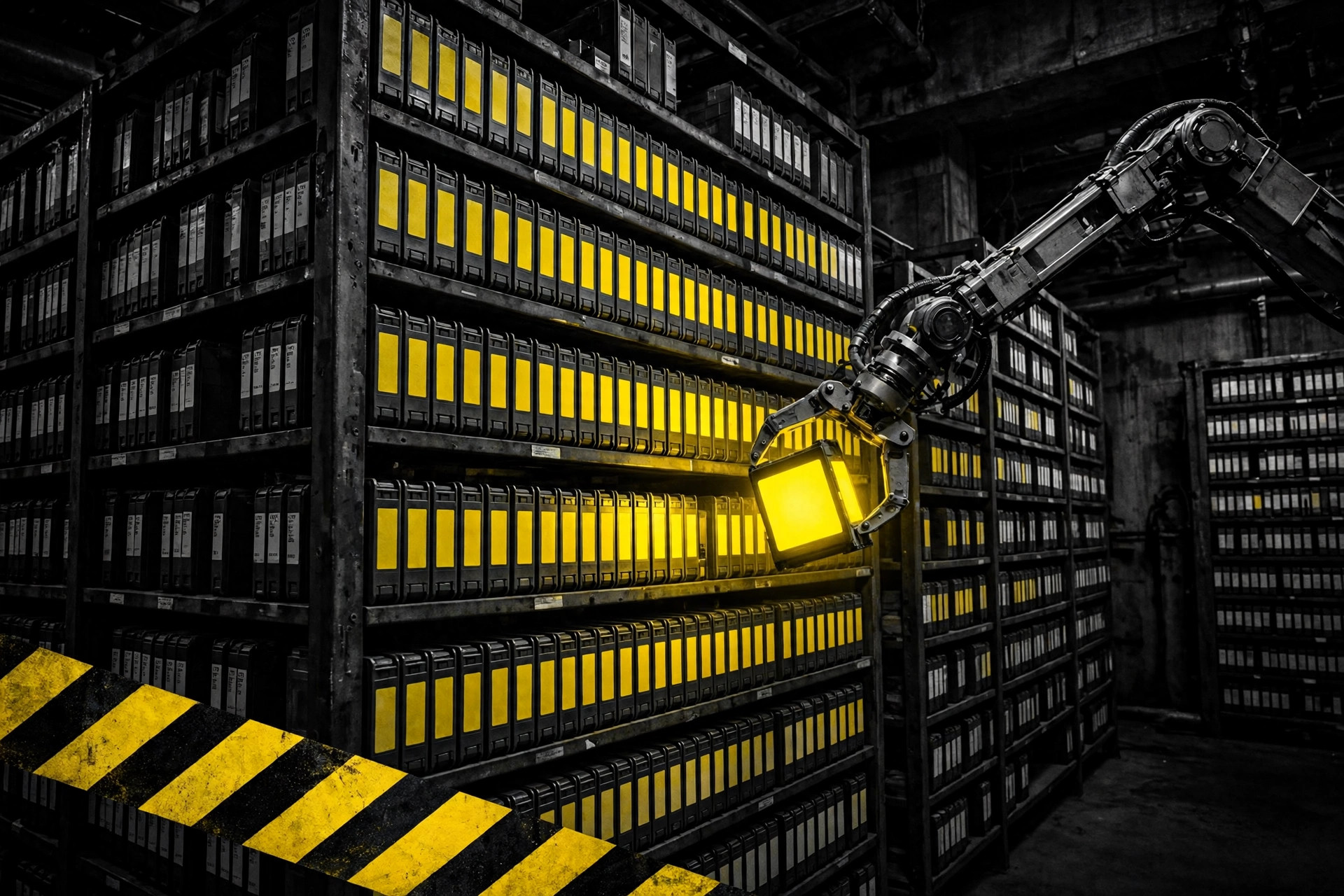
Fujifilm plans to quintuple tape production, its biggest buildup in two decades, because the AI boom needs somewhere cheap, cold, and offline to store everything.
The most futuristic industry on Earth is placing its biggest storage bet in twenty years on a technology from the 1950s. According to Nikkei reporting from Tokyo, Fujifilm plans to increase its magnetic tape production capacity fivefold, the company’s largest buildup for the medium in roughly two decades, driven directly by demand from artificial intelligence.
Tape was supposed to be dead. Instead it became the warehouse of the AI era, the offline medium where data centers, financial institutions, and research organizations keep the data that matters most and moves least.
AI makes mountains of cold data
Every model run produces far more data than anyone will ever look at again: training sets, checkpoints, logs, sensor feeds, generated media. Most of it is cold, written once and read rarely, but far too valuable to delete. Regulations demand some of it be kept. Retraining demands the rest.
Storing cold data on hard drives means paying for spinning disks and electricity around the clock. Tape asks for neither. A cartridge on a shelf draws no power, costs a fraction as much per terabyte as disk, and is rated to sit there for decades. Industry price tracking this year put tape near $4 to $6 per terabyte while drive prices climbed on AI demand, stretching the cost gap to roughly three and a half to one.
The numbers were already turning
Fujifilm is not betting on a hunch. The LTO Program, the consortium behind the dominant tape format, reported that shipped tape capacity jumped 57 percent year over year in the first quarter of 2026. That followed an all time record of 176.5 exabytes shipped in 2024 and 160.3 exabytes in 2025, a dip the industry now reads as a pause rather than a decline.
The format keeps getting denser, too. LTO-10 cartridges reaching buyers this year hold 40 terabytes native and up to 100 terabytes compressed, and Fujifilm has already demonstrated 50 terabyte enterprise tape with IBM. Only two companies on Earth make LTO cartridges, Fujifilm and Sony, which makes Fujifilm’s fivefold expansion a genuine supply event, not a marketing line.
The feature no hacker can patch around
Tape carries one advantage no software update can give a disk array: it can leave. A cartridge pulled from a library and shelved is physically disconnected from every network, an air gap that ransomware cannot cross and a corrupted system cannot reach. For banks, hospitals, and labs guarding the one copy of data they cannot afford to lose, that gap is the entire point.
What to watch
The open question is pace. AI data growth is not slowing, hard drives are in short supply because the same boom is buying them, and tape capacity takes factories, not downloads. If Fujifilm’s buildup lands on schedule, tape stays the quiet default for the cold layer of the AI stack. If it slips, the duopoly becomes the bottleneck for the most data hungry industry in history.
Either way, the obituary was premature. The future of AI will be stored, in part, on spools.
Original reporting: Nikkei Asia, by Taiyo Suzuki and Rion Katsumi. Shipment data: LTO Program technology providers.
END OF TRANSMISSION
Stay curious. Question everything.